The New Biotech Hubs Are Built Around Bottlenecks
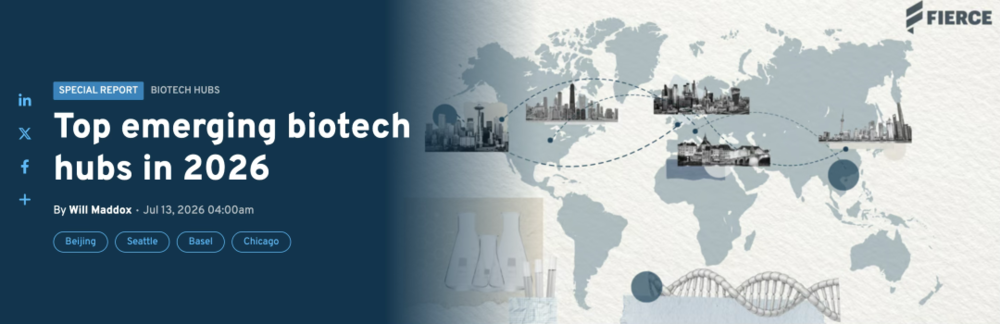
💡See why AI-biotech winners may be ecosystems that fix one bottleneck, not cities that copy Boston.
⚡ 30-Second TL;DR
What Changed
Basel benefits from talent circulation around Roche and Novartis, but remains more effective at drug development than at producing new biotech giants.
Why It Matters
The article suggests that AI-biotech leadership will depend less on city size and more on the quality of connections between models, proprietary data, wet labs, capital, and talent. For founders, the strongest location may be the ecosystem that removes one decisive commercialization bottleneck.
What To Do Next
Map your AI-biotech startup's drug lifecycle and compare Seattle-style data and model access with Chicago-style lab and seed-capital infrastructure before choosing a base.
Key Points
- •Basel benefits from talent circulation around Roche and Novartis, but remains more effective at drug development than at producing new biotech giants.
- •Seattle combines David Baker's protein-design research with cloud infrastructure, software talent, and AI-first biotech startups such as Xaira Therapeutics.
- •Chicago addressed its main bottleneck through Portal Innovations, combining seed capital, fully equipped labs, and fundraising support.
- •London has world-class scientific and funding inputs, while its key challenge is converting research strength into scalable commercial exits.
🧠 Deep Insight
AI-generated analysis for this event.
🔑 Enhanced Key Takeaways
- •The rise of these hubs is increasingly driven by 'compute-bio' convergence, where proximity to high-performance computing (HPC) clusters and specialized GPU infrastructure is becoming as critical as proximity to wet-lab facilities.
- •Chicago's biotech ecosystem has specifically leveraged the 'ARPA-H' (Advanced Research Projects Agency for Health) funding model to bridge the 'valley of death' between academic research and commercial viability.
- •London's strategy is currently pivoting toward the 'Golden Triangle' (London-Oxford-Cambridge) integration, utilizing the Francis Crick Institute as a central node to facilitate cross-institutional data sharing and talent mobility.
- •Seattle's biotech growth is uniquely tied to the 'Amazon-Microsoft' talent pipeline, which provides a steady influx of software engineers transitioning into bioinformatics and computational biology roles.
- •Basel is undergoing a structural shift by implementing 'open innovation' campuses that allow external startups to utilize the proprietary R&D infrastructure of legacy giants like Novartis and Roche.
🛠️ Technical Deep Dive
- Integration of AlphaFold 3 and similar protein-structure prediction models into local cloud-native R&D workflows.
- Utilization of 'Digital Twin' technology for clinical trial simulation to reduce patient recruitment bottlenecks.
- Deployment of federated learning architectures to allow multi-institutional data training without compromising patient privacy or data sovereignty.
- Implementation of automated, robotic-cloud laboratory interfaces that allow remote control of wet-lab experiments via API.
🔮 Future ImplicationsAI analysis grounded in cited sources
⏳ Timeline
Weekly AI Recap
Read this week's curated digest of top AI events →
👉Related Updates
AI-curated news aggregator. All content rights belong to original publishers.
Original source: 虎嗅 ↗