The LLM Kill Line Keeps Rising
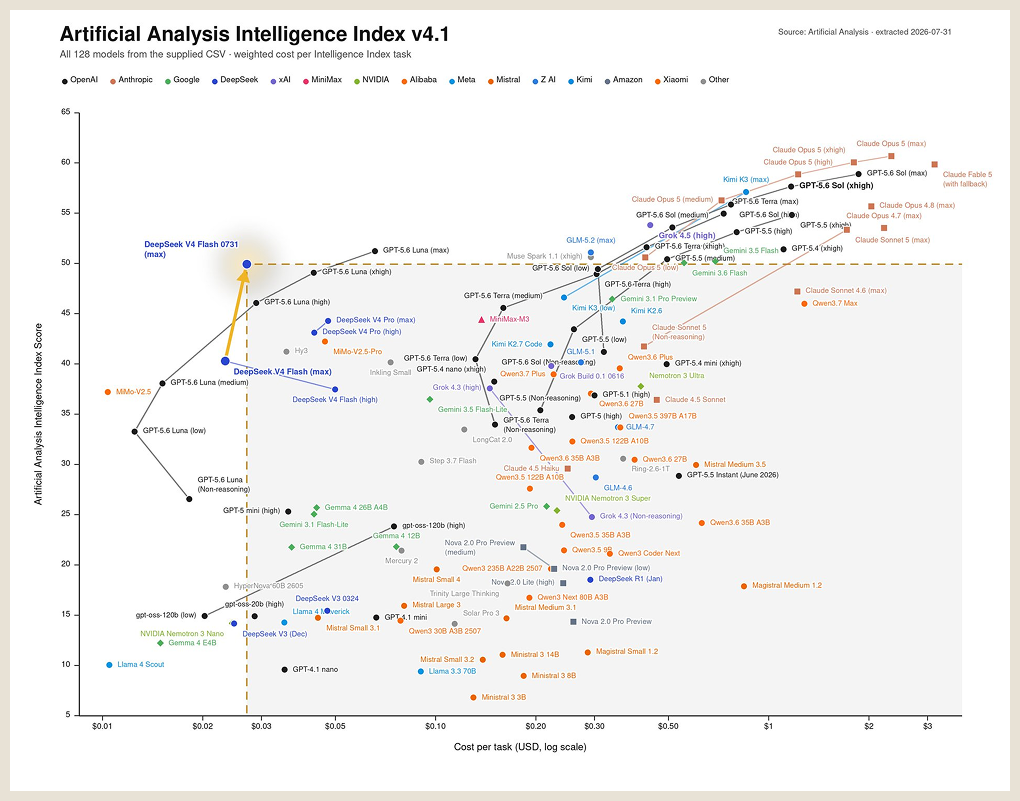
Agent adoption is redefining model competition from chat benchmarks to cost per completed task.
30-Second TL;DR
What Changed
The competitive threshold for AI large models continues to rise.
Why It Matters
AI builders can no longer select models based only on chat quality or public benchmark scores. The winning stack will likely be the one that delivers reliable agent task completion at the lowest total inference and orchestration cost.
What To Do Next
Benchmark your current model stack on representative multi-step Agent tasks, measuring completion rate, latency, tool-call failures, and total cost per successful task.
Key Points
- •The competitive threshold for AI large models continues to rise.
- •The industry is shifting from benchmark rankings toward survival-driven cost competition.
- •Agents are becoming the main application interface for large models.
- •Model vendors must optimize end-to-end task performance and total cost.
- •Continuous cost reduction and iteration leave little room for complacency.
Deep Insight
AI-generated analysis for this event — not the original article.
Enhanced Key Takeaways
- •The industry is witnessing a shift toward 'Inference-Time Compute' scaling, where models are rewarded for spending more compute during the reasoning phase rather than just relying on pre-training scale.
- •Hardware utilization efficiency has become a primary differentiator, with companies moving away from general-purpose GPU clusters toward specialized AI-ASIC architectures to lower the 'cost-per-token' floor.
- •Data scarcity for high-quality, human-verified reasoning chains is driving a surge in synthetic data generation pipelines as a critical competitive moat.
- •The 'Agentic Workflow' paradigm is forcing a transition from monolithic model architectures to Mixture-of-Experts (MoE) designs that allow for dynamic activation of parameters based on task complexity.
- •Regulatory compliance and data sovereignty requirements are increasingly dictating the deployment architecture, forcing vendors to offer hybrid cloud-edge solutions to maintain market share in enterprise sectors.
Competitor Analysis
- OpenAI (o-series/GPT)
- Reasoning/Agentic
- Anthropic (Claude)
- Safety/Long Context
- Google (Gemini)
- Multimodal/Ecosystem
- DeepSeek (Open Weights)
- Cost-Efficiency/MoE
- OpenAI (o-series/GPT)
- Premium/High-Compute
- Anthropic (Claude)
- Competitive/Tiered
- Google (Gemini)
- Integrated/Cloud-Scale
- DeepSeek (Open Weights)
- Disruptive/Low-Cost
- OpenAI (o-series/GPT)
- Reasoning/Math
- Anthropic (Claude)
- Coding/Nuance
- Google (Gemini)
- Multimodal/Integration
- DeepSeek (Open Weights)
- Price-to-Performance
| Feature | OpenAI (o-series/GPT) | Anthropic (Claude) | Google (Gemini) | DeepSeek (Open Weights) |
|---|---|---|---|---|
| Primary Focus | Reasoning/Agentic | Safety/Long Context | Multimodal/Ecosystem | Cost-Efficiency/MoE |
| Pricing Strategy | Premium/High-Compute | Competitive/Tiered | Integrated/Cloud-Scale | Disruptive/Low-Cost |
| Benchmark Lead | Reasoning/Math | Coding/Nuance | Multimodal/Integration | Price-to-Performance |
Technical Deep Dive
- Shift toward Test-Time Compute: Models now utilize iterative search algorithms (like Monte Carlo Tree Search) during inference to improve accuracy on complex tasks.
- Mixture-of-Experts (MoE) Optimization: Increased use of sparse activation to reduce FLOPs per token, allowing larger parameter counts with lower latency.
- Quantization Advancements: W4A8 and lower-bit precision techniques are becoming standard for production deployment to maximize throughput on existing hardware.
- Agentic Frameworks: Integration of ReAct (Reasoning + Acting) patterns and tool-use capabilities directly into the model's fine-tuning objective to reduce hallucination in multi-step workflows.
Future ImplicationsAI analysis grounded in cited sources
Timeline
- 2023-11Initial industry pivot toward 'Agentic' capabilities following the release of advanced tool-use APIs.
- 2024-05Widespread adoption of Mixture-of-Experts (MoE) architectures to combat rising inference costs.
- 2025-02Market shift toward 'Inference-Time Compute' as the primary metric for model intelligence over static benchmarks.
- 2026-01Industry-wide focus on 'Task Economics' where vendors are evaluated on end-to-end cost per successful agentic outcome.
Weekly AI Recap
Read this week's curated digest of top AI events →
AI-curated news aggregator. All content rights belong to original publishers.
Original source: 钛媒体 ↗
This is a summary, not the original. Read the source, or get the weekly briefing.
The weekly digest
One email a week. Unsubscribe anytime.