The Data Bottleneck in Embodied AI and Robotics
💡Understand why robotics lags behind LLMs and the massive effort required to build high-quality embodied datasets.
⚡ 30-Second TL;DR
What Changed
Robotic data requires synchronized multi-modal inputs like vision, force feedback, and joint control, which are not natively available on the internet.
Why It Matters
The scarcity of high-quality embodied data is the primary constraint on robot generalization. Solving this will likely require breakthroughs in simulation-to-real transfer and automated data generation.
What To Do Next
Investigate synthetic data generation pipelines or Sim-to-Real frameworks to reduce reliance on expensive manual teleoperation.
Key Points
- •Robotic data requires synchronized multi-modal inputs like vision, force feedback, and joint control, which are not natively available on the internet.
- •High-quality 'teleoperation' data is the gold standard but remains expensive and difficult to scale due to human labor requirements.
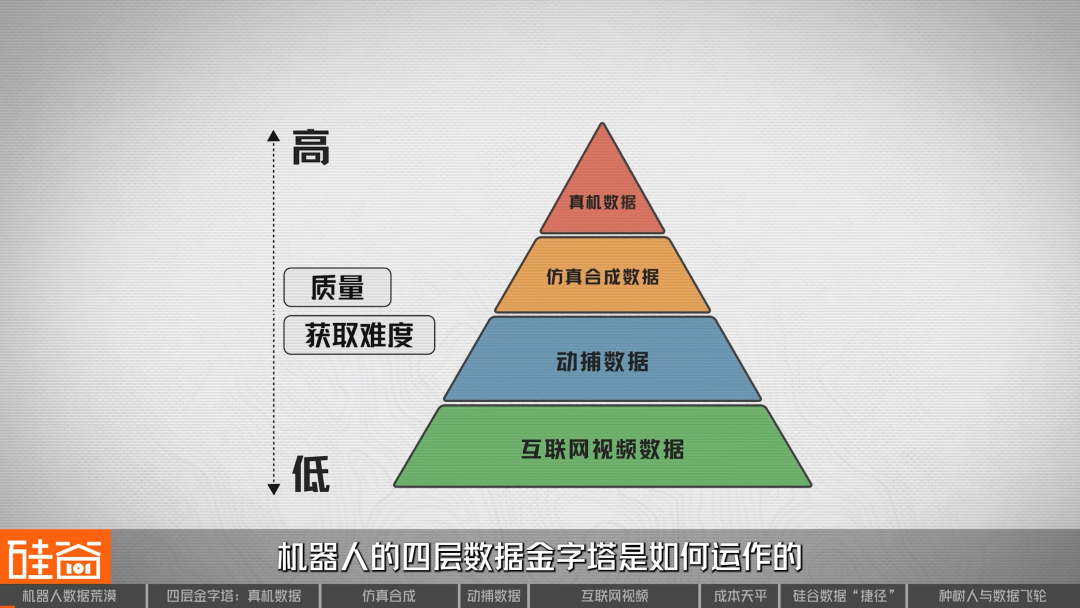
- •Industry is exploring a four-layer data hierarchy, ranging from low-quality synthetic data to high-precision expert teleoperation data.
- •A skilled teleoperation operator requires significant training and talent, with efficiency often limited to 25% of total working time.
🧠 Deep Insight
Web-grounded analysis with 29 cited sources.
🔑 Enhanced Key Takeaways
- •Assisted teleoperation systems, such as Policy Assisted TeleOperation (PATO), are emerging to enhance data collection efficiency by automating repetitive tasks and enabling a single human operator to manage multiple robots simultaneously, thereby reducing mental load and speeding up the process.
- •The integration of synthetic data generation (SDG) with world models is becoming a critical strategy for training embodied AI, as it allows for the creation of perfectly labeled 3D data, the simulation of rare edge cases, and a significant reduction in the cost and time associated with real-world data acquisition.
- •Large-scale, open-source datasets like Google DeepMind's Open X-Embodiment, which aggregates over 1 million real robot trajectories from 22 different robot types and 500+ skills, are crucial for developing generalist robot policies and facilitating transfer learning across various robotic platforms.
- •The collection of high-fidelity real-world robotics data remains prohibitively expensive, with a single hour of expert manipulation data potentially costing between $1,000 and $10,000, and existing datasets are often fragmented across incompatible formats and proprietary silos, complicating integration and scalability.
- •Specialized AI-powered data annotation and curation platforms are being developed to address the complexity and scale of robotics data, offering features like automated labeling, quality assurance, and structured management for multimodal inputs including LiDAR, point clouds, video, and force feedback.
📊 Competitor Analysis▸ Show
| Platform/Company | Primary Focus | Key Features | Pricing Model | Notes |
|---|---|---|---|---|
| Scale AI | Enterprise data annotation | High-volume 2D/3D annotation, sensor fusion, quality assurance | Enterprise (custom) | Industry standard for AV/defense, but lacks robotics-specific collection/training. |
| Encord | AI-native data infrastructure for Physical AI/Robotics | Full data lifecycle (curation, annotation, evaluation), supports LiDAR, point clouds, sensor fusion, active learning, automated QA. | Not specified (likely enterprise) | Positions itself as top data labeling platform for Physical AI. |
| NVIDIA Isaac Sim | Robot simulation and testing | Open-source framework on Omniverse, physically accurate virtual environments, digital twin reconstruction, data generation (MobilityGen). | Open-source framework | More than a data tool; an infrastructure layer for robotics. |
| Labellerr | Robotics data platform | Synthetic data generation, real-world data annotation, quality control, AI-powered auto-labeling, multi-sensor support. | Not specified | Built specifically for robotics teams. |
| SVRC (Silicon Valley Robotics Center) | Full-loop robot data pipeline | Hardware procurement/leasing, teleoperation recording (multi-modal), cloud training, simulation integration, data marketplace. | HW margin + subscription | Younger platform, covers hardware to deployment. |
| Config | Curated motion datasets for robot foundation models | Proprietary data conversion for human-recorded motion, 100,000+ hours of human motion data. | Not specified | Focuses on transforming datasets to align with robotic movement. |
| Rhoda AI | Foundation models for Physical AI | Direct Video Action (DVA) model, trains robots from internet video data. | Not specified | Aims for efficient data use and complex tasks with minimal training. |
🛠️ Technical Deep Dive
- Policy Assisted TeleOperation (PATO): This system employs a learned assistive policy to automate repetitive subtasks during data collection. It intervenes only when uncertain, reducing human operator mental load and allowing a single operator to manage multiple robots in parallel, thereby improving data collection efficiency.
- Synthetic Data Generation (SDG) Environments: SDG leverages interactive 3D environments, often powered by engines like Unity, Unreal, or NVIDIA Omniverse. These environments provide perfect "ground truth" data (e.g., precise depth, segmentation, velocity) without manual annotation. Techniques like procedural generation and domain randomization are used to create vast, varied scenarios, including rare edge cases, to prevent overfitting and enhance model robustness.
- Multimodal Data Alignment Challenges: Embodied AI requires synchronized inputs from various sensors, including vision, force feedback, joint control, and sometimes tactile sensing and linguistic instructions. A significant technical challenge is ensuring temporal coherence and proper alignment across these diverse modalities, as many existing datasets only capture subsets, leading to difficulties in building coherent representations for robot learning.
- 3D-GRAND Dataset Architecture: This synthetic dataset utilizes generative AI to construct virtual rooms that are automatically annotated with 3D structural information and densely grounded textual descriptions. An AI pipeline uses vision models to describe object attributes and a text-only model with scene graphs to generate scene descriptions, followed by a hallucination filter for quality control. This approach drastically reduces the cost and time of creating 3D-text datasets for language grounding in embodied AI.
- Open X-Embodiment Dataset Standardization: This large-scale dataset standardizes data formats by pooling 60 existing robot datasets from 34 research labs. It contains over 1 million real robot trajectories across 22 robot embodiments and 500+ skills. Robot actions are uniformly represented as a 7-dimensional vector, typically including x, y, z coordinates, roll, pitch, yaw, and gripper opening or their rates, facilitating the training of generalist, cross-robot policies.
🔮 Future ImplicationsAI analysis grounded in cited sources
⏳ Timeline
📎 Sources (29)
Factual claims are grounded in the sources below. Forward-looking analysis is AI-generated interpretation.
- Google Search Source
- Google Search Source
- Google Search Source
- Google Search Source
- Google Search Source
- Google Search Source
- Google Search Source
- Google Search Source
- Google Search Source
- Google Search Source
- Google Search Source
- Google Search Source
- Google Search Source
- Google Search Source
- Google Search Source
- Google Search Source
- Google Search Source
- Google Search Source
- Google Search Source
- Google Search Source
- Google Search Source
- Google Search Source
- Google Search Source
- Google Search Source
- Google Search Source
- Google Search Source
- Google Search Source
- Google Search Source
- Google Search Source
Weekly AI Recap
Read this week's curated digest of top AI events →
👉Related Updates


AI-curated news aggregator. All content rights belong to original publishers.
Original source: 虎嗅 ↗