The $3 Trillion AI Infrastructure Debt Risk
💡AI risk is moving beyond stock valuations into $3 trillion of leases, contracts and data-center credit exposure.
⚡ 30-Second TL;DR
What Changed
The commitments include about $1.2 trillion in unstarted leases and $1.9 trillion in procurement and other contractual obligations.
Why It Matters
If AI demand or pricing falls short, fixed lease payments and project debt could pressure data-center valuations, refinancing and private-credit portfolios. AI founders and enterprise buyers should therefore evaluate infrastructure counterparties' financing resilience, not just GPU availability or headline capacity.
What To Do Next
Before committing to an AI cloud provider, stress-test its GPU capacity contract under 30% lower utilization and verify termination, take-or-pay and service-continuity clauses.
Key Points
- •The commitments include about $1.2 trillion in unstarted leases and $1.9 trillion in procurement and other contractual obligations.
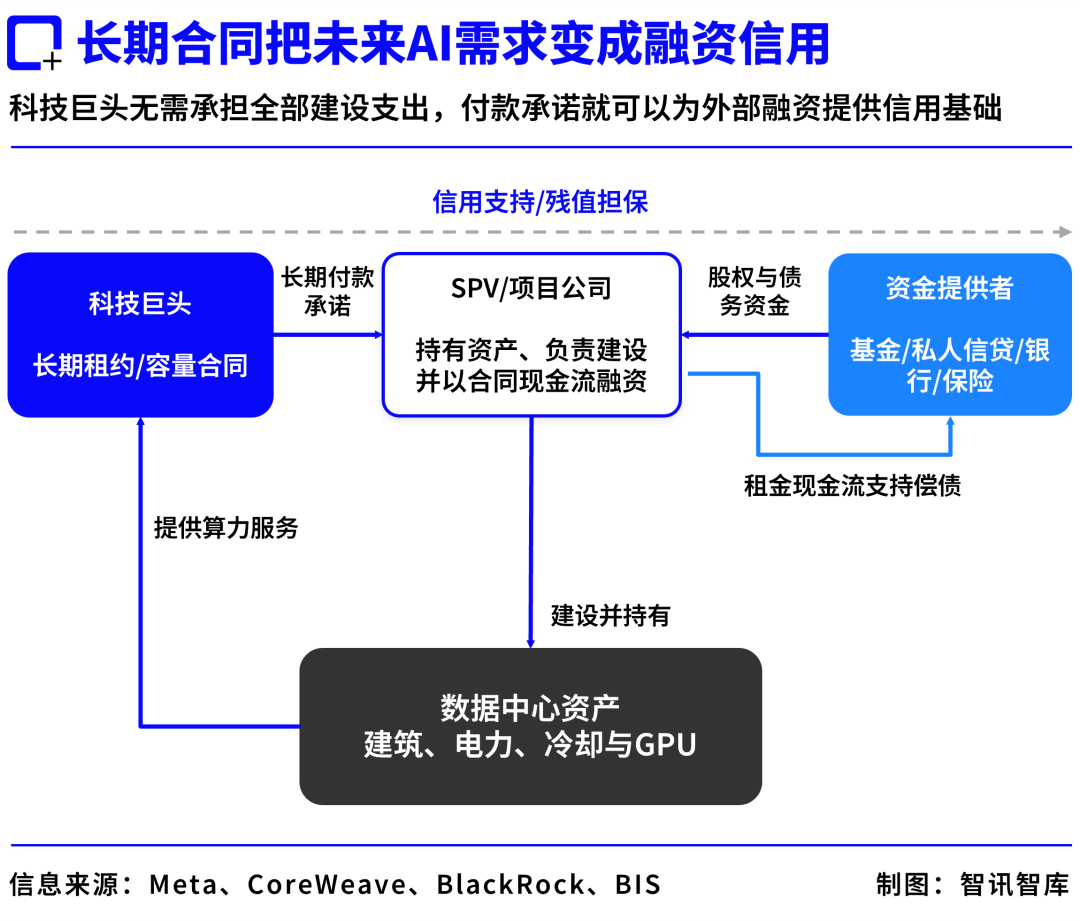
- •SPVs and joint ventures can borrow against future technology-company rent payments, creating shadow-lending exposure outside the tenants' balance sheets.
- •AI infrastructure has mismatched clocks: data centers last decades, GPUs may be replaced within years, and customer demand can shift rapidly.
- •CoreWeave illustrates the model with $60.7 billion in remaining performance obligations and asset-level debt backed by take-or-pay contracts.
- •The first failures may occur at highly leveraged data-center developers and AI cloud providers rather than at the largest technology tenants.
🧠 Deep Insight
Background and context from public sources — not the original article. 7 sources cited.
🔑 Enhanced Key Takeaways
- •Goldman Sachs estimates that AI-related debt issuance reached approximately $500 billion in 2026 alone, signaling a rapid acceleration in market reliance on debt financing.
- •Apollo Global Management identifies a potential $1 trillion financing gap, as the $2 trillion AI ecosystem demand exceeds the $1 trillion capacity of traditional investment-grade credit markets.
- •AI-related borrowing now constitutes over 40% of all new long-term, investment-grade corporate debt, creating significant concentration risk for institutional investors.
- •In Q2 2026, CoreWeave successfully utilized GPUs as formal collateral for an $8.5 billion financing facility, establishing a precedent for using rapidly depreciating hardware to secure debt.
- •Hyperscaler capital expenditure is projected to hit $697 billion in 2026, with power availability and permitting delays acting as primary 'delivery risks' that threaten the viability of debt repayment schedules.
🛠️ Technical Deep Dive
- AI infrastructure financing now utilizes GPU-backed collateral models, where hardware is treated as a formal asset class for debt security.
- Financing structures increasingly rely on private credit and infrastructure funds to bypass traditional corporate balance sheet constraints.
- Debt instruments are being engineered to bridge the maturity mismatch between long-term physical data center assets and the shorter lifecycle of high-performance compute hardware.
🔮 Future ImplicationsAI analysis grounded in cited sources
⏳ Timeline
📎 Sources (7)
Factual claims are grounded in the sources below. Forward-looking analysis is AI-generated interpretation.
Weekly AI Recap
Read this week's curated digest of top AI events →
👉Related Updates


AI-curated news aggregator. All content rights belong to original publishers.
Original source: 虎嗅 ↗
This is a summary, not the original. Read the source, or get the weekly briefing.
Weekly AI briefing
One email a week. Unsubscribe anytime.