Texas confirms second screwworm case, threatening livestock
💡Biological threats in agriculture are increasingly being mitigated by AI-powered surveillance and detection tools.
⚡ 30-Second TL;DR
What Changed
Second confirmed screwworm case in Zavala County, Texas
Why It Matters
This biological outbreak could lead to increased demand for AI-driven animal health monitoring and automated pest detection systems in agriculture.
What To Do Next
Explore computer vision datasets for livestock health monitoring to identify early signs of parasitic infection in agricultural settings.
Key Points
- •Second confirmed screwworm case in Zavala County, Texas
- •Cases detected within 9km of each other in a short timeframe
- •USDA monitoring potential impact on regional livestock health
🧠 Deep Insight
Background and context from public sources — not the original article. 15 sources cited.
🔑 Enhanced Key Takeaways
- •Texas Governor Greg Abbott has issued a statewide disaster declaration in response to the confirmed screwworm cases, highlighting the severity of the threat.
- •The USDA and Texas Animal Health Commission have established a unified Incident Command Team, created a 20 km (12-mile) infested zone around the detection sites, and implemented strict quarantines and movement controls on live animals to contain the spread.
- •Intensified sterile fly operations are underway, with 2 million sterile screwworms being dispersed aerially twice a week and an additional 4 million sterile flies per week deployed via 24 ground release chambers in the affected area.
- •The re-emergence of New World screwworm was anticipated, with models projecting its entry into the U.S. in 2025, but previous efforts had successfully delayed its return.
- •A potential outbreak of New World screwworm in the U.S. could lead to an estimated $4.3 billion in annual losses for producers and over $10.6 billion in total economic losses across the southern United States.
🛠️ Technical Deep Dive
- Sterile Insect Technique (SIT): The primary eradication method involves mass-rearing New World screwworms (Cochliomyia hominivorax) and exposing 5- to 6-day-old pupae to gamma radiation (from caesium-137 or cobalt-60) to induce sexual sterility. This sterilization does not impair the male flies' longevity, searching behavior, or mating ability.
- Mechanism of SIT: When sterile male flies mate with wild female flies, which typically mate only once, the females lay unfertilized eggs that do not hatch, thereby reducing the wild population over generations. For effective eradication, a ratio of at least 10 sterile flies to every indigenous screwworm is maintained.
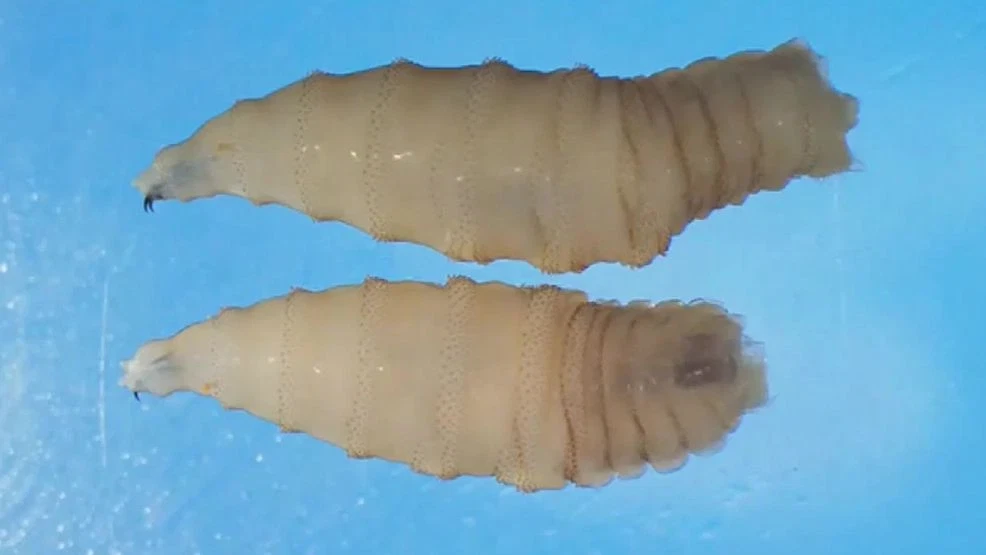
- Screwworm Biology: The New World screwworm is a parasitic blowfly whose larvae infest open wounds or mucous membranes of warm-blooded animals, including livestock, pets, wildlife, and occasionally humans and birds. Unlike other maggots, screwworm larvae feed exclusively on living tissue, causing severe pain, tissue destruction, secondary infections, and often death if untreated.
- Life Cycle: Female flies lay hundreds of eggs at wound edges; these hatch rapidly into larvae that burrow into the flesh. After 5-7 days of feeding, mature larvae drop to the ground, pupate in the soil, and emerge as adult flies in 3-5 days.
- Monitoring and Identification: Sterile flies are dyed with a fluorescent dye, visible under UV light, to distinguish them from wild flies during surveillance efforts.
- Deployment: Sterile flies are released through both aerial dispersal via aircraft and ground release chambers strategically placed in and around infested zones.
- Additional Control Measures: SIT is complemented by intensive surveillance, strict animal movement controls, quarantines of infested animals, and public education campaigns.
🔮 Future ImplicationsAI analysis grounded in cited sources
⏳ Timeline
📎 Sources (15)
Factual claims are grounded in the sources below. Forward-looking analysis is AI-generated interpretation.
Weekly AI Recap
Read this week's curated digest of top AI events →
👉Related Updates
AI-curated news aggregator. All content rights belong to original publishers.
Original source: cnBeta (Full RSS) ↗
This is a summary, not the original. Read the source, or get the weekly briefing.
The weekly digest
One email a week. Unsubscribe anytime.