Tesla data labelers express distrust in FSD technology
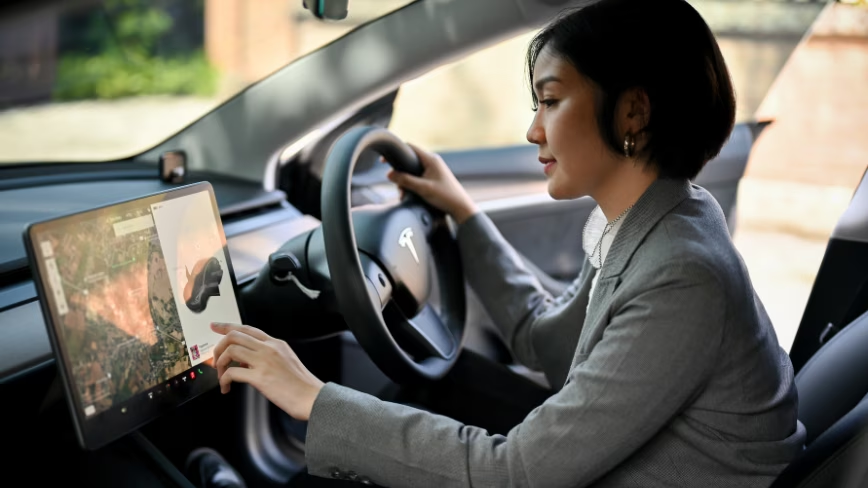
💡Internal skepticism from those who train Tesla's AI highlights critical safety gaps in real-world autonomous deployment.
⚡ 30-Second TL;DR
What Changed
Seven out of nine former data labelers would not ride in an FSD-enabled Tesla.
Why It Matters
This report highlights a critical disconnect between internal technical confidence and public product deployment, potentially impacting consumer trust and regulatory scrutiny.
What To Do Next
Review your own model's 'edge case' failure rates and ensure internal QA teams have clear channels to report safety concerns before deployment.
Key Points
- •Seven out of nine former data labelers would not ride in an FSD-enabled Tesla.
- •Internal staff skepticism contrasts with Tesla's public marketing of autonomous capabilities.
- •Concerns raised by those closest to the training data suggest potential gaps in model reliability.
🧠 Deep Insight
Background and context from public sources — not the original article. 29 sources cited.
🔑 Enhanced Key Takeaways
- •Tesla's public safety claims for FSD, asserting it is up to 10 times safer than human drivers, are based on a flawed methodology that inflated results by approximately three times, according to a Reuters investigation and traffic-safety researchers.
- •Former data labelers reported routinely observing FSD failing at critical basic tasks, including yielding to emergency vehicles, stopping for school buses, navigating construction zones, and accurately recognizing pedestrians, with some clips showing near-misses with children.
- •The U.S. National Highway Traffic Safety Administration (NHTSA) has escalated its investigation into Tesla's FSD system to an engineering analysis, probing dozens of incidents involving FSD running red lights, turning into oncoming traffic, and failing to detect reduced visibility conditions.
- •Internal staff revealed that Tesla's robotaxi pilot in Austin involved extensive pre-launch mapping and specific hazard training, which contradicts CEO Elon Musk's public assertions that Tesla's system does not require laborious local mapping like its competitors.
📊 Competitor Analysis▸ Show
| Feature/Category | Tesla FSD (Supervised) | Waymo (Robotaxi) | Mercedes-Benz Drive Pilot |
|---|---|---|---|
| Autonomy Level (SAE) | Level 2+ (Supervised) | Level 4 (Fully Driverless) | Level 3 (Conditional Automation) |
| Operational Domain | Nearly all roads, requires continuous driver supervision | Geo-fenced areas in specific cities (e.g., Phoenix, San Francisco, Los Angeles) | Specific roadways in California and Nevada, requires driver readiness to take over |
| Sensor Suite | Vision-only (8 cameras) | Lidar, radar, cameras | Lidar, radar, cameras, ultrasonic sensors |
| Safety Data/Benchmarks | 6.9 billion supervised FSD miles; safety claims under scrutiny for flawed methodology | 20+ million real-world autonomous miles, 1+ billion simulation miles; 91% serious crash reduction vs. human drivers in same areas | Certified for Level 3 operation under specific conditions |
| Commercial Model | Optional software purchase ($12,000) or subscription ($200/month) for consumer vehicles | Robotaxi service (ridesharing) | Integrated into premium vehicles, likely a premium option/package |
🛠️ Technical Deep Dive
- Architecture Shift: FSD v12 (released as "Supervised" in April 2024) transitioned from a traditional rule-based C++ codebase to a purely neural network (NN) driven, end-to-end (E2E) AI system, replacing over 300,000 lines of explicit C++ code with a system that learns directly from driving data.
- Neural Network Design: The system comprises 48 distinct neural networks working in concert, processing raw inputs from eight exterior cameras to provide 360-degree environmental coverage.
- Perception and Planning: These networks transform 2D camera images into a 3D spatial understanding using Bird's Eye View (BEV) transformations and occupancy networks, directly outputting steering, acceleration, and braking commands from raw camera inputs.
- Feature Extraction: RegNets, a variant of Residual Neural Networks, act as efficient convolutional neural network architectures for extracting spatial features from video streams, complemented by BiFPNs (Bidirectional Feature Pyramid Networks) for multi-scale feature fusion.
- Temporal Processing: Transformers are employed to process time series data from continuous video frames, enabling end-to-end training from images to control commands.
- Training and Data: The neural network is trained on millions of hours of real human driving video data. Tesla utilizes its Dojo supercomputer to accelerate data annotation and network training, including AI-powered auto-labeling for vast datasets. The "shadow mode" feature allows Autopilot to process driving decisions in parallel with human drivers, flagging discrepancies for continuous learning.
- Vision-Only Approach: FSD V12.4 is specifically designed for a vision-only approach, relying exclusively on cameras and the E2E neural network for all perception and depth estimation, moving away from radar reliance.
🔮 Future ImplicationsAI analysis grounded in cited sources
⏳ Timeline
📎 Sources (29)
Factual claims are grounded in the sources below. Forward-looking analysis is AI-generated interpretation.
- electrek.co
- mexicobusiness.news
- aiweekly.co
- tipranks.com
- carriermanagement.com
- futurism.com
- digitaltoday.co.kr
- deccanchronicle.com
- landline.media
- cbtnews.com
- inspirepreneurmagazine.com
- panterlaw.com
- autonocion.com
- wikipedia.org
- omahausedcar.com
- techdogs.com
- patentpc.com
- yeslak.com
- fredpope.com
- teslaacessories.com
- matrixbcg.com
- youtube.com
- dawnproject.com
- veltyx.de
- eeworld.com.cn
- thinkautonomous.ai
- teslaacessories.com
- basenor.com
- wikipedia.org
Weekly AI Recap
Read this week's curated digest of top AI events →
👉Related Updates

AI-curated news aggregator. All content rights belong to original publishers.
Original source: The Next Web (TNW) ↗
This is a summary, not the original. Read the source, or get the weekly briefing.
The weekly digest
One email a week. Unsubscribe anytime.