Tesla Cybercab autonomous employee rides starting soon in Texas
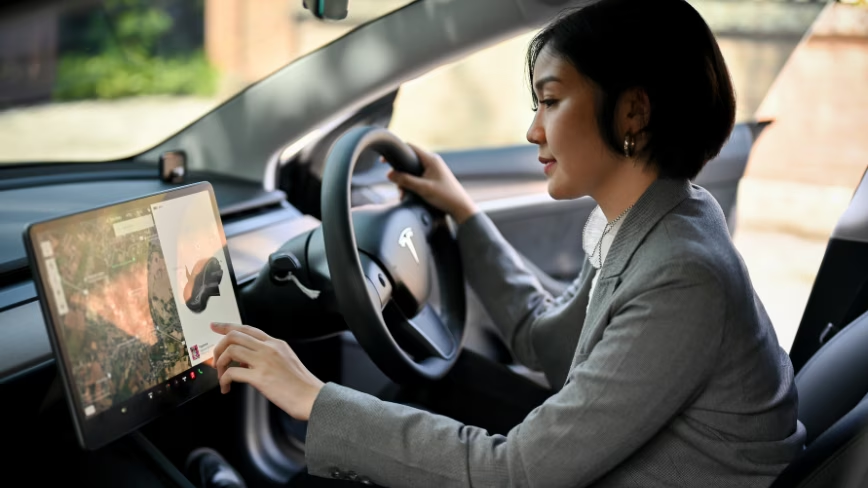
💡See how Tesla is moving from prototype to operational robotaxi deployment in real-world factory environments.
⚡ 30-Second TL;DR
What Changed
Cybercab features no steering wheel or pedals
Why It Matters
This marks a transition from prototype demonstration to real-world operational testing for Tesla's robotaxi platform.
What To Do Next
Monitor Tesla's FSD progress and safety reports to evaluate the feasibility of deploying vision-only autonomous fleets.
Key Points
- •Cybercab features no steering wheel or pedals
- •Employee-only rides to launch soon at Texas factory
- •Demonstrated autonomous driving in outbound lot
🧠 Deep Insight
AI-generated analysis for this event — not the original article.
🔑 Enhanced Key Takeaways
- •The Cybercab utilizes Tesla's 'Unsupervised FSD' (Full Self-Driving) software stack, which relies exclusively on vision-based neural networks without LiDAR or radar sensors.
- •Regulatory approval for the Texas factory pilot was granted under specific private-property exemptions, allowing the vehicle to operate without traditional manual controls like steering wheels or pedals.
- •Tesla has integrated inductive charging technology into the Cybercab, eliminating the need for physical plug-in charging stations at the Texas facility.
- •The vehicle's architecture is built on Tesla's next-generation 'dedicated robotaxi' platform, which is distinct from the Model 3/Y chassis used in earlier FSD testing.
- •Production of the Cybercab is slated to leverage Tesla's 'unboxed' manufacturing process, designed to significantly reduce assembly time and factory footprint compared to traditional automotive lines.
📊 Competitor Analysis▸ Show
| Feature | Tesla Cybercab | Waymo (Jaguar I-PACE) | Zoox (Robotaxi) |
|---|---|---|---|
| Steering Wheel | None | Present | None |
| Sensor Suite | Vision Only | LiDAR/Radar/Camera | LiDAR/Radar/Camera |
| Charging | Inductive | Plug-in/Manual | Plug-in/Manual |
| Deployment | Private/Factory Pilot | Public Robotaxi Service | Public Robotaxi Service |
🛠️ Technical Deep Dive
- Architecture: Built on a dedicated robotaxi platform utilizing the unboxed manufacturing process.
- Sensor Suite: Pure vision-based system using high-resolution cameras and Tesla's proprietary FSD inference computer.
- Charging: Integrated inductive wireless charging pads located at designated depot points.
- Control System: Fully drive-by-wire system with redundant actuators for steering and braking, removing all mechanical linkages.
🔮 Future ImplicationsAI analysis grounded in cited sources
⏳ Timeline
Weekly AI Recap
Read this week's curated digest of top AI events →
👉Related Updates
AI-curated news aggregator. All content rights belong to original publishers.
Original source: The Next Web (TNW) ↗
This is a summary, not the original. Read the source, or get the weekly briefing.
The weekly digest
One email a week. Unsubscribe anytime.