Tesla Autopilot under investigation after crashing into residential garage
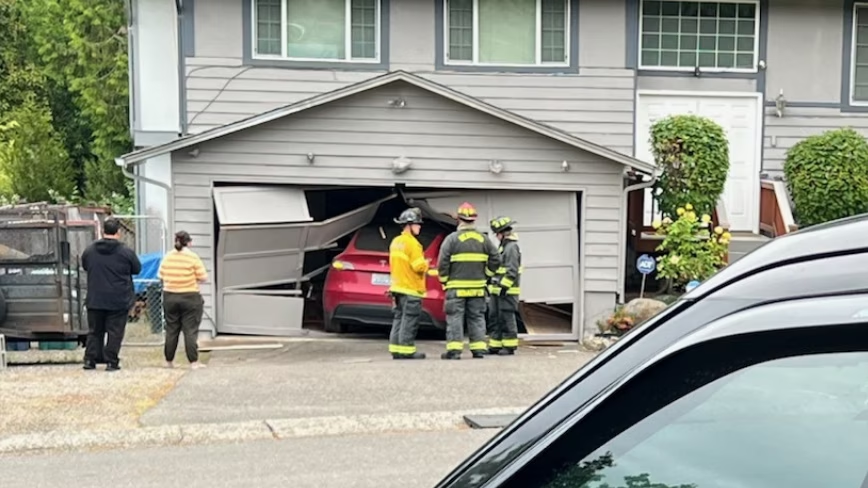
💡Critical safety incident involving Tesla's Autopilot highlights ongoing challenges in autonomous navigation reliability.
⚡ 30-Second TL;DR
What Changed
Tesla vehicle on Autopilot swerved into a private garage in Redmond, WA.
Why It Matters
This incident adds to the growing scrutiny of Tesla's driver-assistance systems and may influence future regulatory safety requirements for autonomous driving features.
What To Do Next
Review your safety-critical system logs and edge-case testing protocols to ensure robust failure handling in autonomous navigation modules.
Key Points
- •Tesla vehicle on Autopilot swerved into a private garage in Redmond, WA.
- •Police are actively investigating the cause of the malfunction.
- •No injuries were reported, and the driver showed no signs of impairment.
🧠 Deep Insight
Background and context from public sources — not the original article. 19 sources cited.
🔑 Enhanced Key Takeaways
- •The incident in Redmond, Washington, occurred on June 8, 2026, around 11 a.m. in the 6300 block of 151st Avenue NE, with the driver explicitly stating that the Tesla's Autopilot system malfunctioned.
- •This crash adds to a history of scrutiny for Tesla's Autopilot and Full Self-Driving (FSD) systems, which have been linked to hundreds of nonfatal incidents and dozens of fatalities, prompting multiple investigations by the National Highway Traffic Safety Administration (NHTSA).
- •The NHTSA escalated an investigation into Tesla's FSD system to an Engineering Analysis on March 18, 2026, covering over 3.2 million vehicles (Model S, X, 3, Y, and Cybertruck from 2016-2026), specifically focusing on the system's ability to detect degraded visibility conditions like sun glare, fog, and airborne dust.
📊 Competitor Analysis▸ Show
Autonomous Driving Systems Comparison
| Feature/System | Tesla Full Self-Driving (Supervised) | GM Super Cruise | Ford BlueCruise | Rivian Universal Hands Free (UHF) / Highway Assist | Waymo Driver (Robotaxi) |
|---|---|---|---|---|---|
| Automation Level | Level 2 (requires supervision) | Level 2 (hands-free on compatible roads) | Level 2 (hands-free on compatible roads) | Level 2 (hands-free, off-highway use) | Level 4/5 (fully autonomous in ODD) |
| Operational Domain | Nearly all roads, including city streets and highways | Mapped highways | Mapped highways | Mapped highways and some off-highway roads | Specific urban areas (robotaxi service) |
| Sensor Suite | Primarily cameras (Tesla Vision), dropped radar (2021) and ultrasonic sensors (2022) | Cameras, radar, LiDAR (implied by advanced nature) | Cameras, radar (implied by advanced nature) | Cameras, radar, and soon LiDAR | 5 LiDARs, 6 radars, 29 cameras |
| Driver Engagement | Requires continuous driver supervision, hands on wheel for Autopilot, FSD (Supervised) still requires attention | Hands-free on compatible roads, driver monitoring | Hands-free on compatible roads, driver monitoring | Hands-free on compatible roads, driver monitoring | No driver required (safety driver for testing) |
| Cost (approx.) | $8,000 (as of Oct 2024) | Subscription/package cost (not specified in search) | Subscription/package cost (not specified in search) | Included with Gen2 R1 vehicles, software upgrade | Ride-hailing service (per ride) |
| Key Differentiator | Vision-only approach, end-to-end neural networks for control (FSD v12) | Reliable hands-free highway driving, expanding vehicle adoption | Similar to Super Cruise, improving lane-tracing and auto lane change | Expanding off-highway hands-free capabilities, in-car AI assistant | High-redundancy sensor stack, true Level 4 autonomy in defined areas |
🛠️ Technical Deep Dive
- Hardware Evolution: Tesla's Autopilot and FSD systems have undergone several hardware iterations. Initial systems (HW1, 2014-2016) used a Mobileye chip with a single camera, radar, and ultrasonic sensors. Later versions (HW2, HW2.5, HW3) transitioned to NVIDIA Drive PX2 and then Tesla's custom-designed 'FSD Chip' (HW3, 2019), which boasts 6 billion transistors and 144 trillion operations per second. The latest is Hardware 4 (HW4), which began shipping in January 2023 and is reportedly 4-5 times more capable than HW3.
- Sensor Suite: Tesla has notably shifted to an 'all-camera-based' system, known as Tesla Vision. This involved stopping the installation of radar sensors in new vehicles in 2021 and ultrasonic sensors in 2022, relying solely on eight external cameras for environmental perception. These cameras provide a 360-degree field of view with a detection range of up to 250 meters.
- Software Architecture: The system utilizes advanced computer vision algorithms and deep learning models to analyze sensor data, identify objects, road features, and make real-time driving decisions like accelerating, braking, and steering. FSD version 12, released in 2024, notably moved to an end-to-end neural network approach, eliminating traditional code for vehicle control.
- Computational Power: The onboard computer processes data from sensors, with HW3 capable of processing 2,300 frames per second. HW4 further enhances this processing power.
- Functional Capabilities: Tesla's planning and control system handles diverse scenarios including automatic parking, highway autopilot, and automated lane changes, adapting decisions to specific contexts.
🔮 Future ImplicationsAI analysis grounded in cited sources
⏳ Timeline
📎 Sources (19)
Factual claims are grounded in the sources below. Forward-looking analysis is AI-generated interpretation.
Weekly AI Recap
Read this week's curated digest of top AI events →
👉Related Updates



AI-curated news aggregator. All content rights belong to original publishers.
Original source: The Next Web (TNW) ↗
This is a summary, not the original. Read the source, or get the weekly briefing.
Weekly AI briefing
One email a week. Unsubscribe anytime.