Tencent's Toast App Enables Natural Language App Building
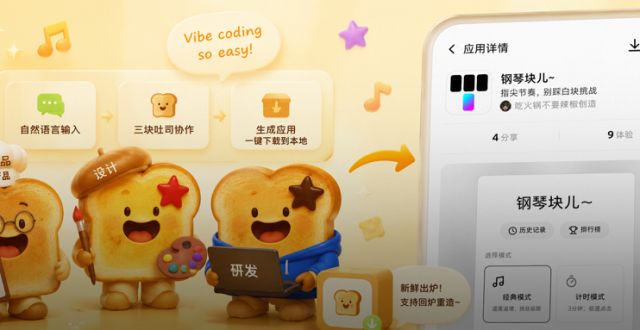
💡Build native Android apps with natural language—a major step toward no-code AI-driven software development.
⚡ 30-Second TL;DR
What Changed
Generates fully functional native Android applications from text
Why It Matters
This tool democratizes mobile app development, allowing non-technical founders to prototype and launch native apps instantly.
What To Do Next
Test Toast's capability by building a simple utility app to see if the generated code meets production-grade standards.
Key Points
- •Generates fully functional native Android applications from text
- •Requires zero coding knowledge to build and deploy apps
- •Powered by Tencent's YaoShip platform infrastructure
🧠 Deep Insight
Background and context from public sources — not the original article. 19 sources cited.
🔑 Enhanced Key Takeaways
- •Tencent's Toast is positioned as an "exploratory Vibe Coding product" and an "application generation and inspiration co-creation platform," emphasizing fun and sharing through features like an "Inspiration Square" where users can share and customize apps.
- •The app operates on a three-agent model, involving a product planning agent, a design agent, and a development agent, which sequentially process natural language input to generate a downloadable APK package.
- •During its public beta, Toast offers users five free app generations per day and allows for "remixing" or re-running the generation process with additional feedback, embodying a "freshly baked" concept.
- •Beyond Toast, Tencent has also integrated an AI post feature into its QQ platform, enabling users to publish AI-generated tools and mini-games directly as social posts.
- •Toast is built upon Tencent's broader AI strategy, which includes the Hunyuan large model as a core engine, part of a comprehensive "1+3+N" AI system that covers various platform capabilities and applications.
📊 Competitor Analysis▸ Show
| Feature / Platform | Tencent Toast | Google AI Studio (Gemini/Antigravity Agent) | Newly App | Adalo (No-Code AI) | Bubble (No-Code) | FlutterFlow (Low-Code) |
|---|---|---|---|---|---|---|
| Input Method | Natural Language | Natural Language | Natural Language | Visual Builder + AI Prompts | Visual Builder | Visual Builder |
| Output Type | Native Android (APK) | Native Android (Kotlin/Jetpack Compose) | Native Android (React Native/Expo) | Native iOS/Android, Web Apps | Web Applications | Cross-Platform (Flutter) |
| Target Audience | Consumers, Inspiration/Co-creation | Developers, Beginners (testing/personal apps) | Developers, Businesses | Entrepreneurs, Small Businesses | Complex Web App Builders | Developer-Adjacent Teams |
| Publishing | Local download, Sharing | Browser emulator, Physical device install, Play Store | Real device testing, Google Play Store | Apple App Store, Google Play Store, Web | Web Deployment | Code Export |
| Pricing Model | 5 free generations/day (public beta) | Free (for basic use) | Not specified (production-ready) | Free (basic), Paid from $40/month | Not specified (known for web apps) | Not specified |
| Key Differentiator | "Vibecoding" for quick, shareable native Android apps; social features. | Generates Kotlin/Jetpack Compose projects, browser-based emulator, direct Play Store publishing. | Production-ready apps using React Native/Expo, full Android feature access, one-click Play Store deployment. | Combines AI generation with visual canvas, publishes native apps to app stores. | Strong for complex web apps, extensive plugin ecosystem. | Visual development with Flutter, code export for developer teams. |
🛠️ Technical Deep Dive
- Toast's app generation process is orchestrated by three distinct AI agents: a product planning agent, a design agent, and a development agent.
- The output of Toast is a directly installable native Android Application Package (APK) file.
- The underlying AI infrastructure for Tencent's various AI initiatives, including potentially Toast, is powered by its proprietary Hunyuan large model.
- Tencent's Hunyuan large model has expanded to include over 30 new models, supporting multimodal generation capabilities for text, image, video, and 3D content.
- Tencent Cloud's Agent Development Platform 3.0, which supports enterprise-level intelligent agent applications, utilizes frameworks such as LLM+RAG (Large Language Model + Retrieval Augmented Generation), Workflow, and Multi-Agent collaboration.
- Tencent also employs an AI-powered coding tool called CodeBuddy, which is used by over 90% of its engineers and contributes to approximately half of all newly added code within the company.
🔮 Future ImplicationsAI analysis grounded in cited sources
⏳ Timeline
📎 Sources (19)
Factual claims are grounded in the sources below. Forward-looking analysis is AI-generated interpretation.
Weekly AI Recap
Read this week's curated digest of top AI events →
👉Related Updates


AI-curated news aggregator. All content rights belong to original publishers.
Original source: Pandaily ↗
This is a summary, not the original. Read the source, or get the weekly briefing.
The weekly digest
One email a week. Unsubscribe anytime.