Tencent Tests WeChat AI Agent Amid Industry Debate
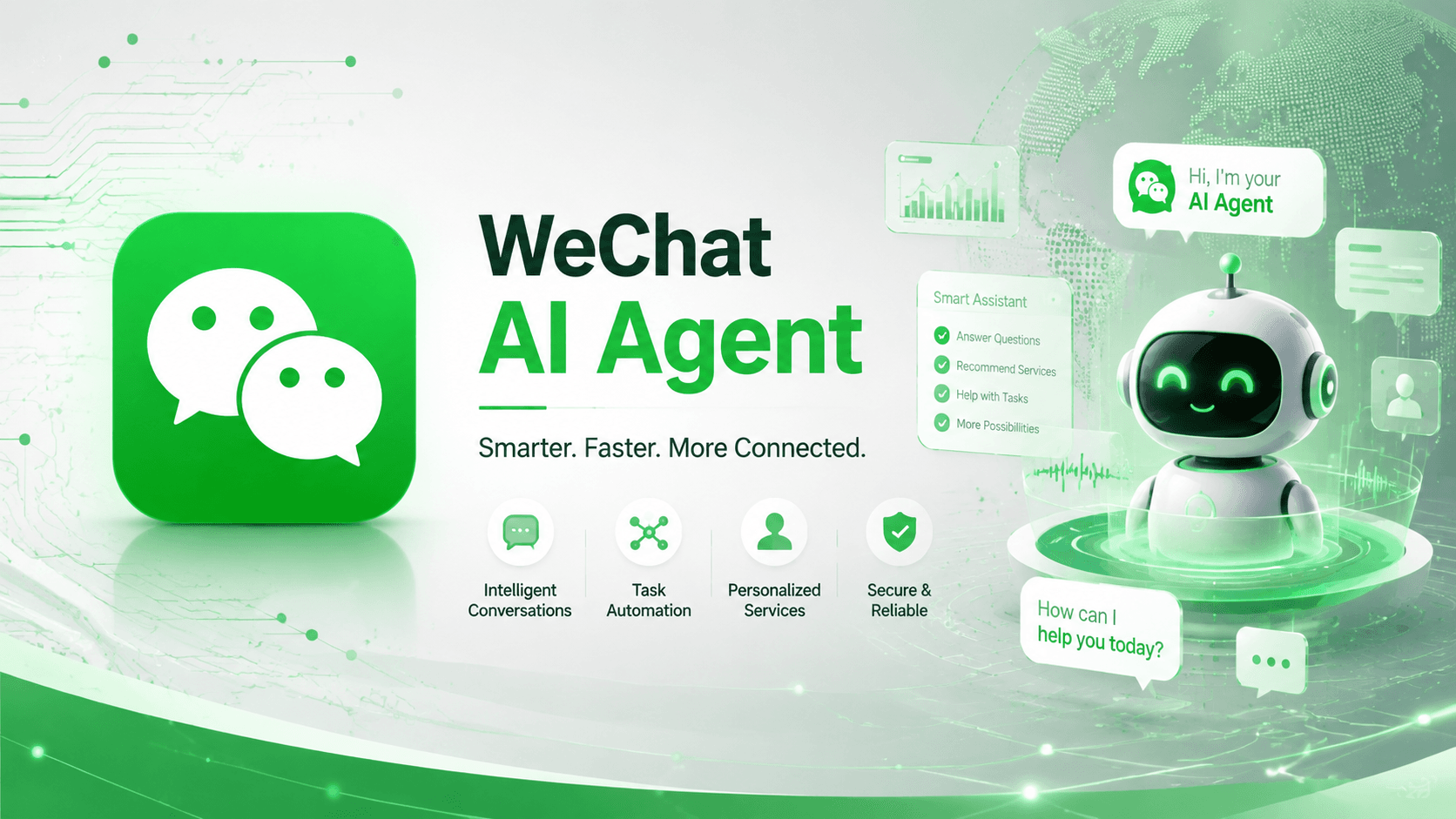
💡Understand how super-apps are evolving into AI agents and what it means for platform-level AI competition.
⚡ 30-Second TL;DR
What Changed
Tencent is integrating an AI agent directly into the WeChat interface.
Why It Matters
If successful, this could set a precedent for how super-apps integrate LLMs, potentially centralizing AI utility within closed ecosystems.
What To Do Next
Monitor Tencent's developer documentation for new API hooks related to WeChat's agentic capabilities to prepare for potential ecosystem integration.
Key Points
- •Tencent is integrating an AI agent directly into the WeChat interface.
- •Analysts are debating the balance between platform defense and user-centric innovation.
- •The move raises questions about data control and the future of AI-driven super-apps.
🧠 Deep Insight
Background and context from public sources — not the original article. 33 sources cited.
🔑 Enhanced Key Takeaways
- •Tencent's WeChat AI agent is designed to function as an "execution layer" within the super app, capable of navigating mini-programs and completing complex, multi-step tasks such as booking flights or ordering coffee.
- •WeChat has recently released guidelines for developers, enabling them to integrate their mini-programs into its AI ecosystem through both automatic and development modes, signaling a broader opening of the platform to AI capabilities.
- •Tencent is also collaborating with major Chinese smartphone manufacturers like Honor, Huawei, Xiaomi, Oppo, and Vivo to enable their built-in AI assistants to control basic WeChat functions via an Agent-to-Agent (A2A) protocol, marking a shift in Tencent's historical reluctance to open its ecosystem.
- •The underlying AI technology for WeChat's agent is rooted in Tencent's Hunyuan large model family, which encompasses text-to-text, text-to-image, text-to-video, and multimodal understanding capabilities, and utilizes a UI-Oceanus world model for mini-program operation.
- •The move to integrate an AI agent into WeChat is seen as a strategic effort to connect WeChat's five core ecosystems: communications, social networking, content, mini-programs, and payments, aiming to maintain platform dominance in the AI era.
📊 Competitor Analysis▸ Show
Competitor Analysis: AI Agents in Super Apps
| Feature/Platform | Tencent WeChat AI Agent |
|---|---|
| Core Functionality | Navigates mini-programs, executes multi-step tasks (e.g., flight booking, coffee ordering), integrates with WeChat's ecosystem (payments, social, content). |
| Underlying AI Models | Tencent Hunyuan large model family (text-to-text, text-to-image, text-to-video, multimodal), UI-Oceanus world model. |
| External Integration | Supports Agent-to-Agent (A2A) protocol with smartphone AI assistants (Honor, Huawei, Xiaomi, Oppo, Vivo) for basic WeChat functions. |
| Developer Ecosystem | Released guidelines for mini-program developers to integrate with WeChat AI ecosystem (automatic and development modes). |
| User Base | Leverages WeChat's 1.4 billion monthly active users. |
| Feature/Platform | Alibaba Quark / Accio Work |
|---|---|
| Core Functionality | Quark: Comprehensive AI assistant for chatbot, deep thinking, deep research, and task execution (e.g., academic research, document drafting, image generation, travel planning). Accio Work: AI agent platform for business outsourcing and automation (product research, supplier sourcing, marketing, content creation, e-commerce). |
| Underlying AI Models | Alibaba's Qwen-based advanced reasoning model for Quark. |
| External Integration | Quark integrates within Alibaba's ecosystem. Accio Work can connect to external services like Gmail, Instagram, Twitter, LinkedIn. |
| Developer Ecosystem | ModelScope (Alibaba's AI app store for developers) offers pre-trained models. |
| User Base | Quark has over 200 million users in China. |
| Feature/Platform | ByteDance Douyin / Doubao / Tanfan |
|---|---|
| Core Functionality | Tanfan (Douyin): Yelp-like AI assistant for restaurant recommendations, reviews, booking, and ordering. Doubao: Most-used AI chatbot in China, focused on content creation and sharing (memes, AIGC images, short videos). Prototype agentic AI smartphone (Nubia M153) can visually interpret UI and perform cross-app actions. |
| Underlying AI Models | ByteDance's Doubao large language model (LLM), Nebula-GUI (on-device model for screen actions). |
| External Integration | Doubao integrates with hardware; prototype phone has system-level AI control. |
| Developer Ecosystem | Focus on consumer-facing applications and content creation. |
| User Base | Douyin has 880 million monthly active users (as of Jan 2025). Doubao is the most-used AI chatbot in China. |
Note: Pricing information and consistent performance benchmarks for these consumer-facing AI agents are not publicly available for a direct comparison.
🛠️ Technical Deep Dive
- Tencent Hunyuan Large Model Family: A self-developed, general-purpose, and multimodal large model family covering image, 3D, and other modalities, providing enterprise-grade services.
- Hunyuan-Large (Hunyuan-MoE-A52B): An open-source Transformer-based Mixture of Experts (MoE) model with a total of 389 billion parameters and 52 billion active parameters.
- Context Window: The pre-trained Hunyuan-Large model supports text sequences up to 256K tokens, while the Instruct model supports up to 128K tokens.
- Optimization Techniques: Utilizes high-quality synthetic data for training, KV Cache Compression (using Grouped Query Attention (GQA) and Cross-Layer Attention (CLA)), and Expert-Specific Learning Rate Scaling to optimize resource consumption and performance.
- HunyuanVideo: An AI video generation model within the Hunyuan AI platform, capable of creating video from text and image prompts. It is a 13 billion parameter diffusion transformer, noted for strong Chinese language understanding, temporal coherence, and motion quality.
- WeChat AI Agent Architecture: Employs Tencent's UI-Oceanus world model to train the AI in operating mini-programs.
- Agent-to-Agent (A2A) Protocol: For integration with external smartphone AI assistants, WeChat uses an A2A protocol that involves a dual authorization structure (user and app) and encrypted channels, allowing system agents to communicate directly with WeChat's internal agent rather than relying on GUI agents that read screens.
- Tencent QClaw (Tencent Lobster): An AI agent that received an update in March 2026 to integrate directly with WeChat mini-programs, enabling features like file transfer between devices and preparing for multimodal interaction.
🔮 Future ImplicationsAI analysis grounded in cited sources
⏳ Timeline
📎 Sources (33)
Factual claims are grounded in the sources below. Forward-looking analysis is AI-generated interpretation.
- techtimes.com
- kucoin.com
- phemex.com
- chinadaily.com.cn
- chinadailyhk.com
- scmp.com
- voi.id
- kr-asia.com
- hellochinatech.com
- morphic.com
- nvidia.com
- substack.com
- tencentcloud.com
- alibabacloud.com
- reddit.com
- youtube.com
- alibabagroup.com
- youtube.com
- scmp.com
- counterpointresearch.com
- youtube.com
- huggingface.co
- arxiv.org
- github.com
- layer.ai
- fal.ai
- super-apps.ai
- substack.com
- aragonresearch.com
- mozillafoundation.org
- psu.edu
- citizenlab.ca
- gridware.com.au
Weekly AI Recap
Read this week's curated digest of top AI events →
👉Related Updates

AI-curated news aggregator. All content rights belong to original publishers.
Original source: Pandaily ↗
This is a summary, not the original. Read the source, or get the weekly briefing.
The weekly digest
One email a week. Unsubscribe anytime.