Tencent Launches WorkBuddy AI Agent for WeChat Integration
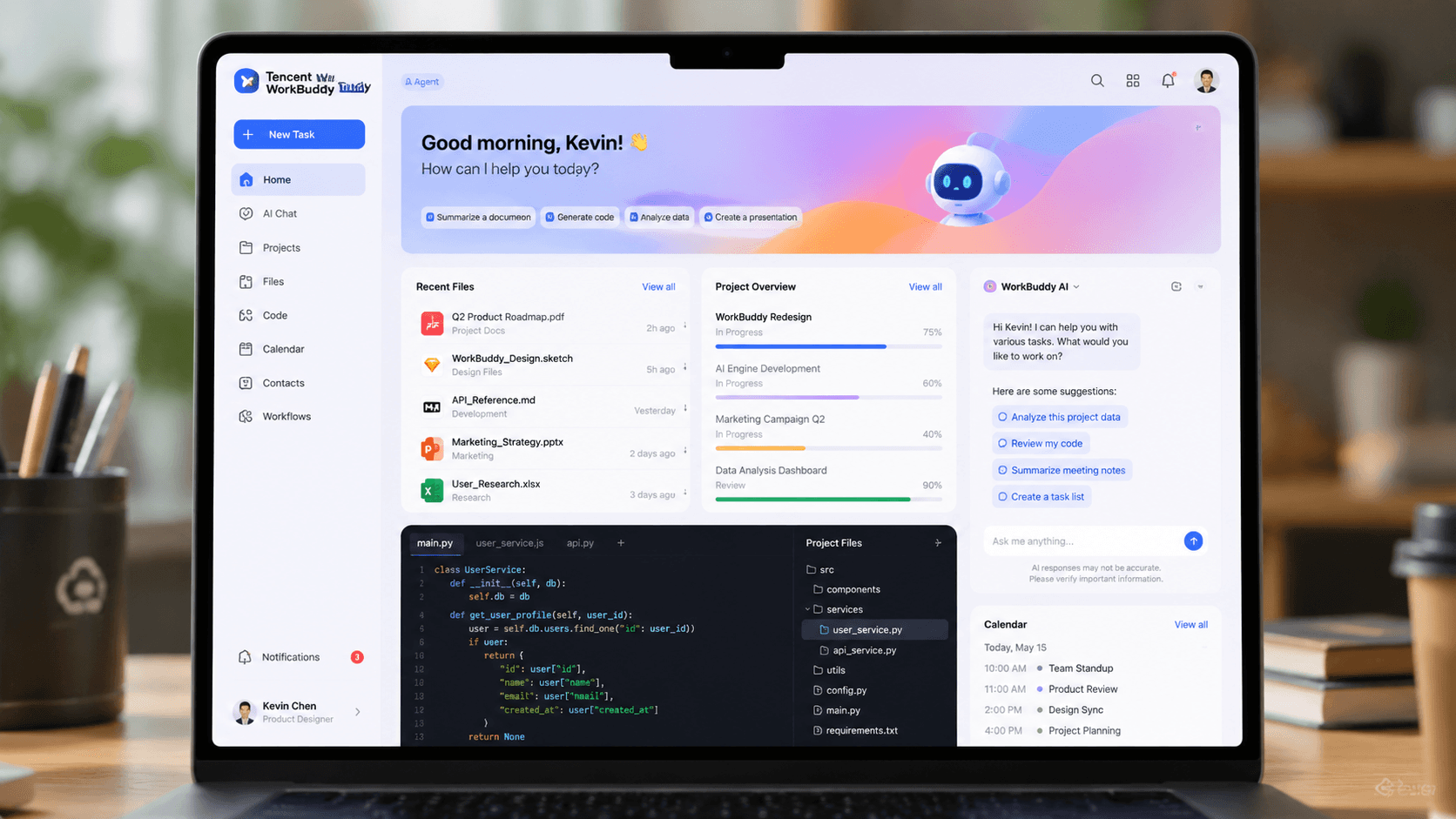
💡Tencent's new AI agent brings LLM-powered automation directly into the WeChat ecosystem for Chinese developers.
⚡ 30-Second TL;DR
What Changed
Built on the proprietary Hunyuan Hy3 model
Why It Matters
WorkBuddy lowers the barrier for enterprise automation within the WeChat ecosystem. It positions Tencent to capture significant market share in the local AI agent space.
What To Do Next
Integrate the WorkBuddy API into your internal WeChat-based workflows to test its automation capabilities for file handling.
Key Points
- •Built on the proprietary Hunyuan Hy3 model
- •Deep integration with WeChat for workflow automation
- •Focuses on local file management and coding assistance
🧠 Deep Insight
AI-generated analysis for this event — not the original article.
🔑 Enhanced Key Takeaways
- •WorkBuddy utilizes a 'Privacy-First' local execution architecture, ensuring that sensitive code snippets and file metadata are processed on-device rather than being transmitted to Tencent's cloud servers.
- •The integration leverages WeChat's Mini Program framework, allowing developers to trigger coding tasks and receive status updates directly within chat interfaces without switching contexts.
- •Tencent has implemented a proprietary 'Context-Aware Retrieval' (CAR) mechanism that allows the agent to index local project repositories and map them to WeChat conversation history for automated task tracking.
- •The Hunyuan Hy3 model powering WorkBuddy features a specialized 'Code-to-Natural-Language' fine-tuning layer, specifically optimized for Chinese-language technical documentation and developer comments.
- •Tencent is positioning WorkBuddy as a direct response to the increasing demand for 'Super App' productivity tools, aiming to capture the developer demographic currently relying on standalone IDE extensions.
📊 Competitor Analysis▸ Show
| Feature | WorkBuddy (Tencent) | GitHub Copilot | Cursor |
|---|---|---|---|
| Platform Integration | WeChat (Deep) | VS Code / IDEs | VS Code (Fork) |
| Data Privacy | Local-First / On-Device | Cloud-Based | Cloud/Local Hybrid |
| Primary Market | China / WeChat Ecosystem | Global | Global |
| Pricing | Freemium (WeChat Tier) | Subscription | Subscription |
🛠️ Technical Deep Dive
- Model Architecture: Based on the Hunyuan Hy3 large language model, utilizing a Mixture-of-Experts (MoE) architecture to balance performance and local resource consumption.
- Local Execution: Employs a lightweight runtime environment that interfaces with local file systems via a secure bridge, bypassing standard cloud API latency.
- Integration Protocol: Uses WeChat's internal WebSocket-based messaging protocol to maintain real-time synchronization between the IDE environment and the mobile/desktop WeChat client.
- Context Window: Optimized for a 32k token context window specifically tuned for repository-level awareness and cross-file dependency analysis.
🔮 Future ImplicationsAI analysis grounded in cited sources
⏳ Timeline
Weekly AI Recap
Read this week's curated digest of top AI events →
👉Related Updates


AI-curated news aggregator. All content rights belong to original publishers.
Original source: Pandaily ↗
This is a summary, not the original. Read the source, or get the weekly briefing.
The weekly digest
One email a week. Unsubscribe anytime.