Tencent invests in Keling AI while trimming Kuaishou stake
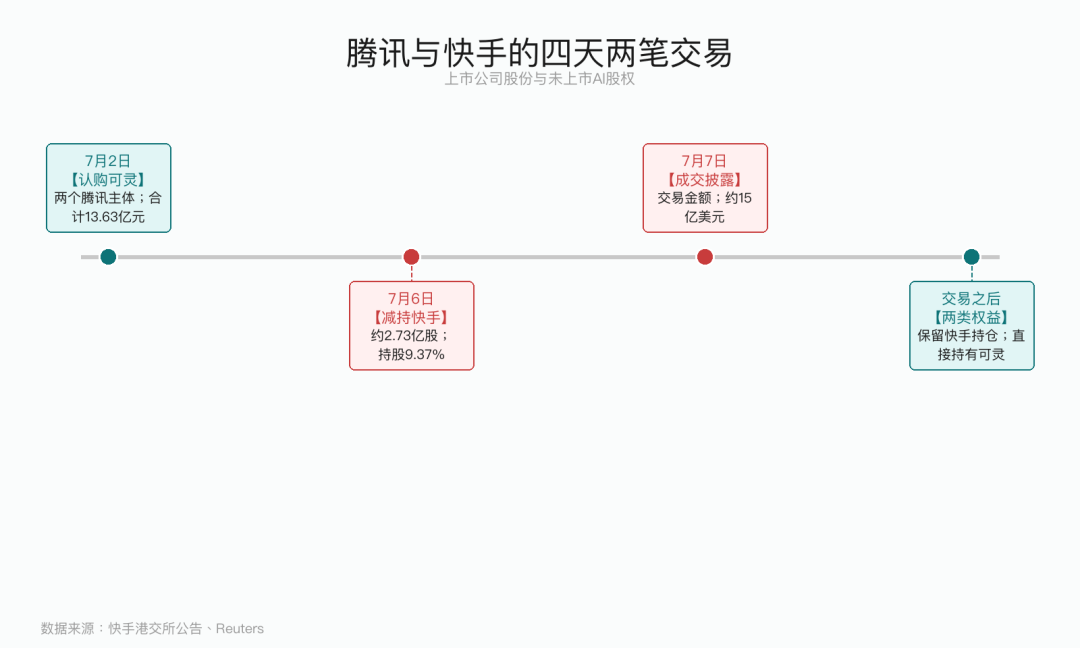
💡Understand the strategic capital flow behind China's leading AI video model developers.
⚡ 30-Second TL;DR
What Changed
Tencent invested 1.363 billion RMB into Keling AI through controlled entities.
Why It Matters
This move signals that major Chinese tech firms are treating AI video models as critical infrastructure and are willing to hedge bets across multiple model providers.
What To Do Next
Monitor Keling AI's API pricing and model capabilities as a potential alternative to Sora or Runway for high-quality video generation.
Key Points
- •Tencent invested 1.363 billion RMB into Keling AI through controlled entities.
- •The investment is structured as a separate equity stake with specific exit and repurchase clauses.
- •Keling AI faces high operational costs for compute and R&D, necessitating external funding.
- •Major tech players like Tencent, Alibaba, and Baidu are diversifying their AI model investments.
🧠 Deep Insight
AI-generated analysis for this event — not the original article.
🔑 Enhanced Key Takeaways
- •Keling AI originated from Kuaishou's Multimedia Content Understanding and Generation Lab, led by former Google researcher Dr. Wang Yaxin.
- •The investment deal includes a valuation adjustment mechanism (VAM) or 'betting' clause that ties future equity stakes to Keling AI's commercial revenue milestones.
- •Tencent's move is part of a broader 'de-risking' strategy, shifting capital from mature social media platforms like Kuaishou toward high-growth generative AI infrastructure.
- •Keling AI's core model architecture utilizes a proprietary diffusion transformer (DiT) framework optimized for long-duration video consistency, distinguishing it from earlier latent diffusion models.
- •The funding round for Keling AI also attracted participation from several state-backed venture capital funds, signaling alignment with China's national AI development priorities.
📊 Competitor Analysis▸ Show
| Feature | Keling AI | Sora (OpenAI) | Kling (Kuaishou) | Vidu (ShengShu) |
|---|---|---|---|---|
| Max Video Length | Up to 2 mins | Up to 1 min | Up to 2 mins | Up to 16 seconds |
| Architecture | Diffusion Transformer | Diffusion Transformer | Diffusion Transformer | U-Net/Transformer Hybrid |
| Primary Market | China/Global | Global | China | China |
| Pricing Model | Token-based | Subscription/API | Token-based | Freemium/API |
🛠️ Technical Deep Dive
- Model Architecture: Employs a 3D Spatio-Temporal Attention mechanism to maintain object permanence across extended video sequences.
- Training Data: Trained on a massive proprietary dataset of high-definition video clips, specifically curated for motion dynamics and physical world simulation.
- Compute Infrastructure: Utilizes a distributed training cluster optimized for high-bandwidth memory (HBM) to handle large-scale parameter updates.
- Inference Optimization: Implements custom CUDA kernels to reduce latency in the denoising process, enabling faster generation times for 1080p video output.
🔮 Future ImplicationsAI analysis grounded in cited sources
⏳ Timeline
Weekly AI Recap
Read this week's curated digest of top AI events →
👉Related Updates

AI-curated news aggregator. All content rights belong to original publishers.
Original source: 虎嗅 ↗
This is a summary, not the original. Read the source, or get the weekly briefing.
The weekly digest
One email a week. Unsubscribe anytime.