Tencent Cloud launches ADP 4.0 for global enterprise agents
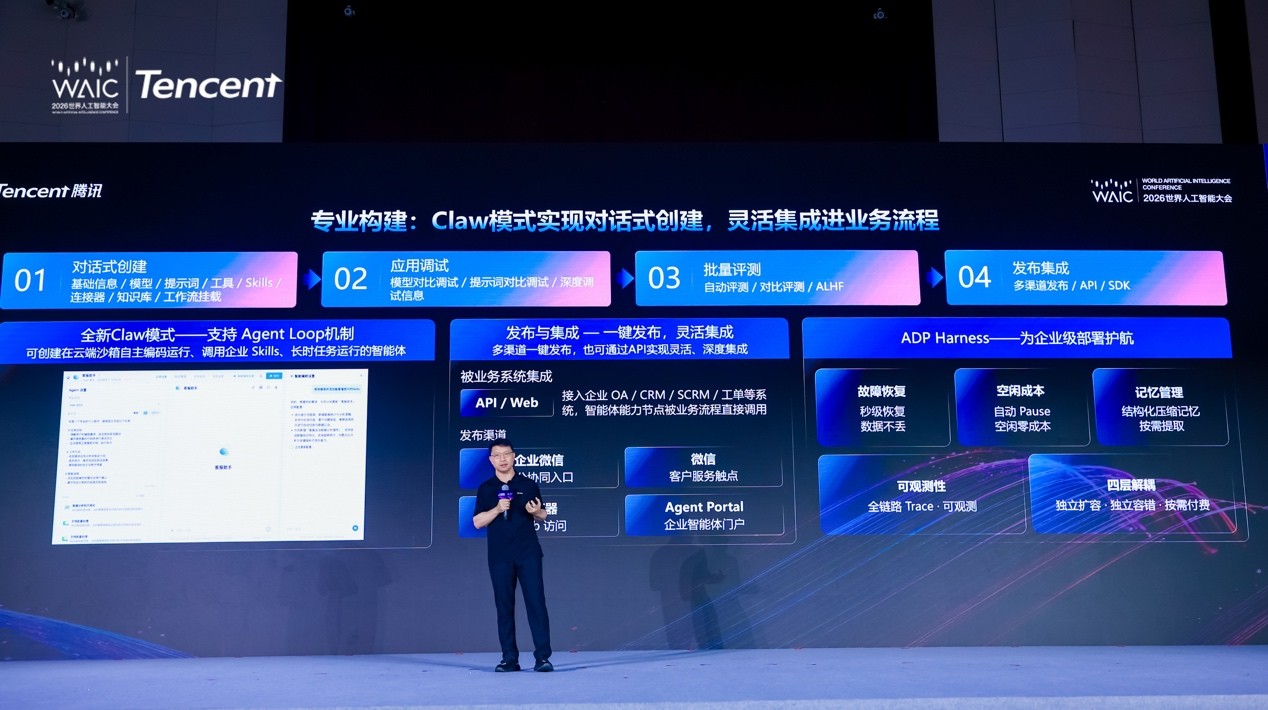
💡Tencent's enterprise agent platform goes global, offering a new alternative for managing AI workflows at scale.
⚡ 30-Second TL;DR
What Changed
Supports global social channels like LINE and Telegram via Claw mode.
Why It Matters
This move signals Tencent's intent to compete in the global enterprise AI agent market by offering a cost-effective, highly controllable alternative to Western platforms.
What To Do Next
Evaluate the ADP 4.0 hybrid Agent-Workflow architecture to see if it can reduce your current LLM token expenditure for deterministic business processes.
Key Points
- •Supports global social channels like LINE and Telegram via Claw mode.
- •Integrates with international SaaS tools including Google Workspace, Confluence, and Jira.
- •Introduces bidirectional Agent and Workflow execution to optimize token costs.
- •Provides enterprise-grade governance, auditability, and security for AI agents.
🧠 Deep Insight
AI-generated analysis for this event — not the original article.
🔑 Enhanced Key Takeaways
- •ADP 4.0 leverages Tencent's proprietary Hunyuan large model as its foundational engine, allowing for fine-tuned reasoning capabilities tailored to enterprise workflows.
- •The platform introduces a 'Low-Code Agent Orchestration' interface that enables non-technical business users to design complex multi-agent interactions without writing underlying code.
- •Tencent Cloud has implemented a localized data residency compliance framework within ADP 4.0 to meet GDPR and other regional data sovereignty requirements for overseas operations.
- •The system includes a new 'Agent Memory Management' layer that utilizes vector database integration to provide long-term context retention across disparate enterprise sessions.
- •ADP 4.0 features a native 'Human-in-the-Loop' (HITL) approval mechanism that allows enterprises to set automated triggers for human intervention during critical workflow execution steps.
📊 Competitor Analysis▸ Show
| Feature | Tencent Cloud ADP 4.0 | AWS Bedrock Agents | Microsoft Azure AI Agent Service |
|---|---|---|---|
| Primary Focus | Cross-border/Global SaaS integration | AWS ecosystem integration | Microsoft 365/Copilot integration |
| Model Support | Hunyuan (Primary) | Multi-model (Claude, Llama, Titan) | OpenAI (GPT-4o), Phi, Llama |
| Global Reach | Strong Asia/Emerging Markets | Global (High availability) | Global (Enterprise standard) |
| Governance | Enterprise-grade audit logs | IAM/CloudTrail integration | Azure Policy/Purview integration |
🛠️ Technical Deep Dive
- Architecture: Utilizes a microservices-based agent orchestration engine that decouples the reasoning layer from the execution layer to reduce latency.
- Token Optimization: Implements a dynamic context-window management system that compresses historical interaction data before passing it to the LLM, significantly lowering token consumption.
- Integration Protocol: Employs a standardized API connector framework that supports OAuth 2.0 and custom webhook configurations for seamless third-party SaaS interoperability.
- Security: Features end-to-end encryption for data in transit and at rest, alongside a sandbox environment for testing agent logic before deployment to production.
🔮 Future ImplicationsAI analysis grounded in cited sources
⏳ Timeline
Weekly AI Recap
Read this week's curated digest of top AI events →
👉Related Updates
AI-curated news aggregator. All content rights belong to original publishers.
Original source: 36氪 ↗
This is a summary, not the original. Read the source, or get the weekly briefing.
The weekly digest
One email a week. Unsubscribe anytime.