Teaching LLM Judges to Match Human Preferences
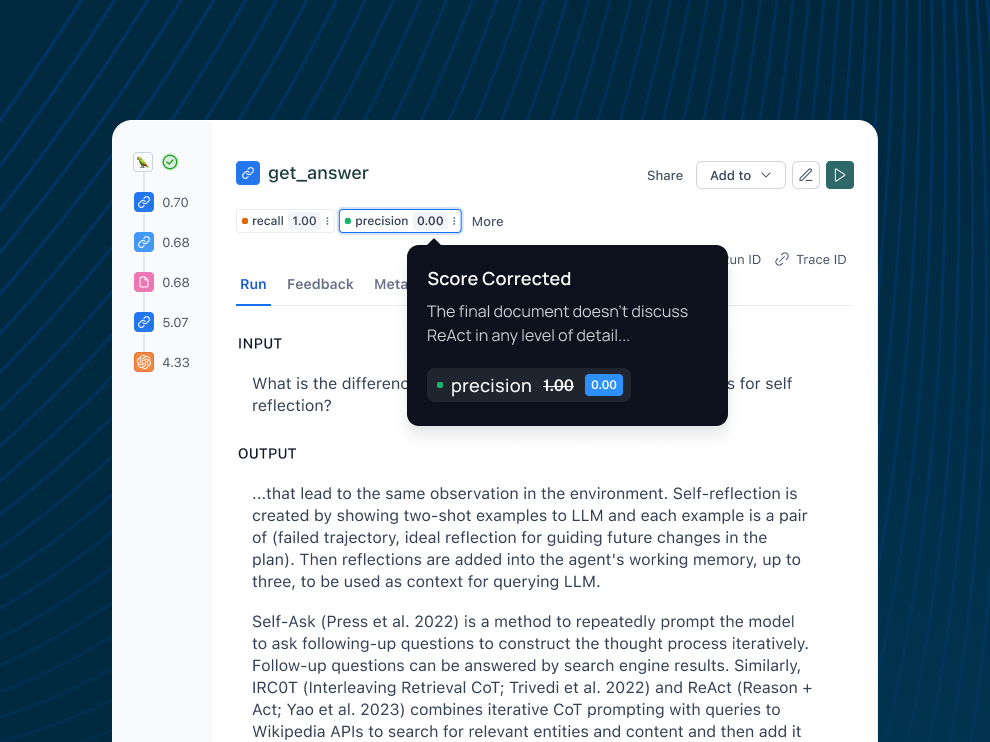
💡Learn how to make automated LLM evaluations better reflect the preferences of real human reviewers.
⚡ 30-Second TL;DR
What Changed
The article examines self-improving evaluators in LangSmith.
Why It Matters
Better-aligned LLM judges could make automated evaluation more trustworthy for AI product teams. This may reduce reliance on fully manual review while preserving a stronger connection to real user preferences.
What To Do Next
Use LangSmith to compare your LLM judge’s scores against a small set of human-labeled examples, then iterate on few-shot evaluator instructions where disagreements cluster.
Key Points
- •The article examines self-improving evaluators in LangSmith.
- •Its central goal is aligning LLM-as-a-Judge evaluations with human preferences.
- •The approach is motivated by research on few-shot learning and preference alignment.
🧠 Deep Insight
Background and context from public sources — not the original article. 10 sources cited.
🔑 Enhanced Key Takeaways
- •LangSmith introduced the 'Align Evals' feature in July 2025, which automates the conversion of human corrections into few-shot examples to calibrate judge models.
- •Recent 2026 research indicates that formatting style bias (e.g., markdown usage) impacts LLM judge scoring up to 20 times more than traditional position bias.
- •Industry standards have shifted toward a 'filter-first' architecture, utilizing deterministic checks like regex before escalating to LLM-based evaluation to optimize cost and accuracy.
- •Reliability studies from June 2026 show that single-model LLM judges often exhibit 'coin-flip' disagreement rates, leading to the adoption of 'panel of judges' architectures for higher consensus.
- •Modern evaluation frameworks now target a minimum 80% agreement rate between automated LLM judges and human expert reviewers as the standard for production-readiness.
📊 Competitor Analysis▸ Show
| Feature | LangSmith (Align Evals) | Arize Phoenix | Weights & Biases Prompts |
|---|---|---|---|
| Evaluation Loop | Automated few-shot calibration | Human-in-the-loop tracing | Manual prompt versioning |
| Bias Mitigation | Built-in position/style rotation | Custom heuristic filters | User-defined logic |
| Pricing | Usage-based (Traces/Evals) | Tiered/Enterprise | Tiered/Enterprise |
🛠️ Technical Deep Dive
- Two-stage sampling design: LLM judges process the full dataset while human ratings are applied to a targeted subsample for calibration.
- Data Flywheel integration: Production traces are ingested into an observability layer to identify patterns for automated dataset generation.
- Panel of Judges: Aggregation of scores from multiple LLM models to reduce variance and approximate subjective human quality.
- Deterministic Layering: Implementation of regex and schema validation as a primary filter to reduce reliance on LLM inference for simple tasks.
🔮 Future ImplicationsAI analysis grounded in cited sources
⏳ Timeline
📎 Sources (10)
Factual claims are grounded in the sources below. Forward-looking analysis is AI-generated interpretation.
Weekly AI Recap
Read this week's curated digest of top AI events →
👉Related Updates




AI-curated news aggregator. All content rights belong to original publishers.
Original source: LangChain Blog ↗
This is a summary, not the original. Read the source, or get the weekly briefing.
Weekly AI briefing
One email a week. Unsubscribe anytime.