TCL Zhonghuan invests 2.6 billion in BC solar technology
💡A critical look at the high-stakes transition from TOPCon to BC technology in the solar industry.
⚡ 30-Second TL;DR
What Changed
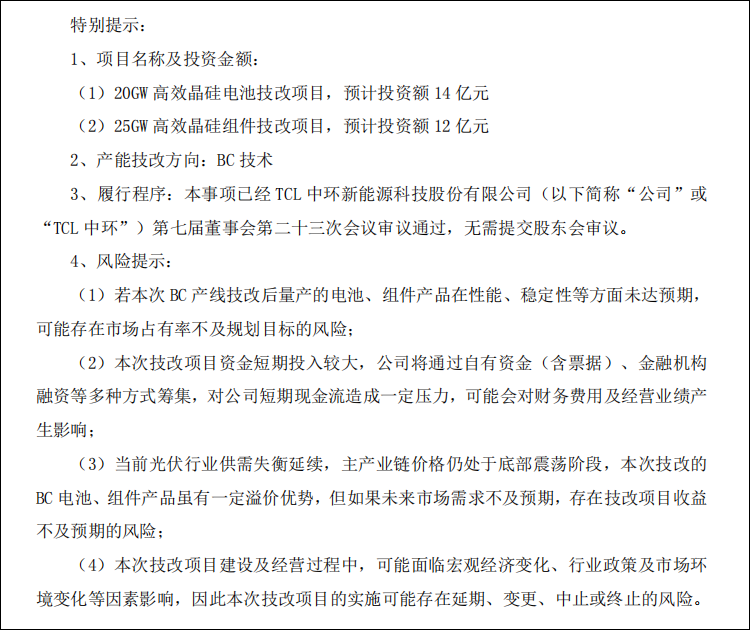
Investment of 2.6 billion RMB for BC technology capacity upgrades.
Why It Matters
The shift to BC technology by a major player like TCL Zhonghuan may accelerate the industry's transition, though financial risks remain high due to current market conditions.
What To Do Next
Analyze the cost-curve parity between BC and TOPCon technologies to determine the viability of long-term infrastructure investments.
Key Points
- •Investment of 2.6 billion RMB for BC technology capacity upgrades.
- •100% of battery capacity to be converted to BC route.
- •BC technology offers higher efficiency but faces higher production costs and complexity compared to TOPCon.
🧠 Deep Insight
AI-generated analysis for this event — not the original article.
🔑 Enhanced Key Takeaways
- •TCL Zhonghuan's pivot to BC technology is part of a broader industry trend where major Chinese manufacturers are moving away from the commoditized TOPCon market to escape severe price wars.
- •The investment specifically targets the 'TBC' (TCL Back Contact) technology, which integrates Zhonghuan's proprietary G12 large-size silicon wafer advantages with BC cell architecture.
- •Market analysts suggest this capital expenditure is intended to improve the company's gross margin profile, which has been under pressure due to the industry-wide oversupply of solar wafers.
- •The transition strategy involves a phased upgrade of existing production facilities rather than purely greenfield construction, aiming to minimize capital depreciation risks.
- •This shift aligns with TCL Zhonghuan's recent organizational restructuring aimed at streamlining its photovoltaic supply chain and increasing vertical integration efficiency.
📊 Competitor Analysis▸ Show
| Feature | TCL Zhonghuan (TBC) | LONGi Green Energy (HPBC) | Aiko Solar (ABC) |
|---|---|---|---|
| Primary Tech | G12-based TBC | HPBC (Hybrid Passivated BC) | ABC (All Back Contact) |
| Efficiency | High (Optimized for G12) | ~26.5% (Mass Production) | >27% (Lab/Pilot) |
| Market Focus | Utility/Large-scale | Distributed/Residential | High-end Distributed |
| Cost Profile | Moderate (Scale-driven) | Premium | Premium (High complexity) |
🛠️ Technical Deep Dive
- TBC (TCL Back Contact) utilizes a metal-catalyzed chemical etching process to create a textured surface on the silicon wafer for enhanced light trapping.
- The architecture eliminates front-side busbars, reducing shading losses and increasing the effective light-receiving area of the cell.
- Integration with G12 (210mm) wafers allows for higher current density and lower manufacturing costs per watt compared to smaller wafer formats.
- The process employs a specialized passivation layer to reduce surface recombination, a critical factor in achieving higher conversion efficiencies in BC cells.
- The design is compatible with standard module assembly lines, though it requires specialized interconnection technology to handle the back-contact layout.
🔮 Future ImplicationsAI analysis grounded in cited sources
⏳ Timeline
Weekly AI Recap
Read this week's curated digest of top AI events →
👉Related Updates
AI-curated news aggregator. All content rights belong to original publishers.
Original source: 虎嗅 ↗
This is a summary, not the original. Read the source, or get the weekly briefing.
The weekly digest
One email a week. Unsubscribe anytime.