Taobao Restricts 'Other Logistics' to Improve User Experience
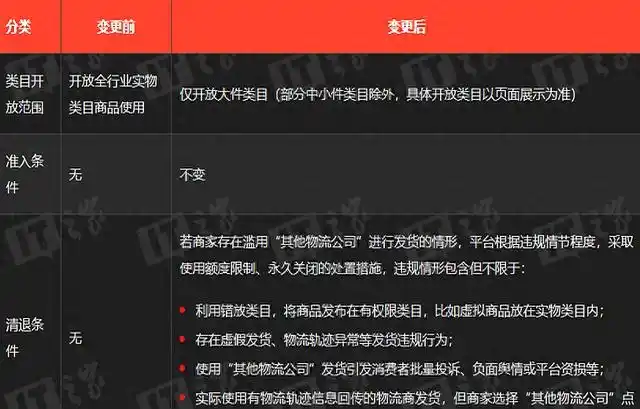
A strategic shift in e-commerce logistics that highlights the trend toward platform-enforced data transparency.
30-Second TL;DR
What Changed
Platform-wide shift towards standardized, trackable logistics to improve consumer trust.
Why It Matters
This policy change accelerates the consolidation of the logistics sector, favoring large-scale players while squeezing out niche, non-integrated providers.
What To Do Next
If building e-commerce tools, ensure your logistics module supports automated tracking via major carrier APIs rather than manual input.
Key Points
- •Platform-wide shift towards standardized, trackable logistics to improve consumer trust.
- •Small regional logistics firms face significant business risks due to loss of platform access.
- •Increased industry consolidation as platforms tighten control over the supply chain.
Deep Insight
Background and context from public sources — not the original article. 23 sources cited.
Enhanced Key Takeaways
- •Taobao's restriction on 'Other Logistics' is a strategic move by Alibaba's logistics arm, Cainiao Network, to deepen integration and standardize logistics services, shifting from a purely asset-light platform to operating its own services and infrastructure.
- •The policy change is specifically designed to combat prevalent issues such as fake shipping and the lack of reliable tracking, directly aiming to enhance consumer experience and build trust on the platform.
- •Cainiao's overarching strategy emphasizes globalization, industrialization, and digitization, with a significant focus on expanding cross-border fulfillment solutions and actively attracting external clients beyond Alibaba's immediate e-commerce ecosystem.
- •This shift aligns with a broader trend in the Chinese e-commerce industry where major platforms are increasingly investing in proprietary logistics infrastructure to ensure quality, speed, and authenticity, moving away from a sole reliance on third-party couriers.
- •The move is also influenced by recent regulatory measures in China, which aim to standardize platform rules and build a more transparent and fair digital business environment, including defining obligations for third-party service providers.
Competitor Analysis
- Logistics Model
- Open platform (C2C/B2C) leveraging Cainiao Network for integrated logistics; historically more reliant on third-party couriers, now standardizing.
- Pricing Strategy
- Focus on wide variety and competitive pricing.
- Customer Experience/Trust
- Improving through standardized, trackable logistics to combat fake shipping and enhance reliability.
- Logistics Model
- Primarily self-operated (B2C) with extensive in-house logistics (JD Logistics) and warehouses.
- Pricing Strategy
- Higher logistics costs due to self-operation, but prioritizes service quality and speed.
- Customer Experience/Trust
- High service quality, fast delivery (same/next-day in many areas), and authenticity are key differentiators.
- Logistics Model
- Social commerce/group buying model; historically asset-light but increasingly investing in warehouses and last-mile delivery stations; relies on third-party logistics but also building own network.
- Pricing Strategy
- Ultra-low prices achieved through demand aggregation and group buying.
- Customer Experience/Trust
- Focus on value-for-money and gamified shopping experience; rapid fulfillment efforts to build trust.
| Platform | Logistics Model | Pricing Strategy | Customer Experience/Trust |
|---|---|---|---|
| Taobao | Open platform (C2C/B2C) leveraging Cainiao Network for integrated logistics; historically more reliant on third-party couriers, now standardizing. | Focus on wide variety and competitive pricing. | Improving through standardized, trackable logistics to combat fake shipping and enhance reliability. |
| JD.com | Primarily self-operated (B2C) with extensive in-house logistics (JD Logistics) and warehouses. | Higher logistics costs due to self-operation, but prioritizes service quality and speed. | High service quality, fast delivery (same/next-day in many areas), and authenticity are key differentiators. |
| Pinduoduo | Social commerce/group buying model; historically asset-light but increasingly investing in warehouses and last-mile delivery stations; relies on third-party logistics but also building own network. | Ultra-low prices achieved through demand aggregation and group buying. | Focus on value-for-money and gamified shopping experience; rapid fulfillment efforts to build trust. |
Technical Deep Dive
- Cloud Infrastructure: Cainiao primarily relies on Alibaba Cloud's IaaS platform to support its operations.
- Logistics Cloud: Utilizes a proprietary "logistics cloud" for comprehensive package tracking across the entire supply chain.
- Data Analytics & AI: Employs big data analytics, artificial intelligence, and machine learning for critical functions such as route optimization, tracking supply and demand, energy optimization, and predictive equipment maintenance.
- Electronic Waybills: Introduced in May 2014, electronic shipping labels store merchant, buyer, delivery firm, and route information, significantly increasing delivery efficiency by 30%.
- Address Database: Features a four-level address database that records recipient addresses down to the village and street level, enhancing route-planning efficiency and delivery accuracy.
- Logistics Alert Radar: A system that issues warnings to help delivery firms deploy resources effectively during peak order spikes, such as during major shopping festivals.
- Real-time Data Architecture: Evolved from an initial demand-driven siloed development model to a more layered and efficient architecture, addressing issues of high computing costs and data consistency.
- Computing Engine: Upgraded its real-time computing engine to be Flink-based in 2017, moving from earlier use of Alibaba's JStorm and Spark Streaming, to better handle complex logistics and supply chain scenarios.
- Data Service Middleware: Developed a unified data service middleware called "Tiangong Data Service" to provide centralized functions like database access, authority management, data guarantee, and end-to-end monitoring across various database types (HBase, MySQL, AnalyticDB).
- Elastic Scheduling System: Implements an elastic scheduling system for stateless application clusters, capable of scaling over 3,000 containers daily, particularly crucial during high-demand periods like the Double 11 Shopping Festival.
- IoT Integration: Incorporates IoT sensors for intelligent operation centers (IOC) to enable energy optimization and predictive equipment maintenance.
Future ImplicationsAI analysis grounded in cited sources
Timeline
- 2013-05Cainiao Network inaugurated as Alibaba's logistics arm to address e-commerce logistics challenges.
- 2014-05Cainiao introduces electronic shipping labels, boosting delivery efficiency by 30%.
- 2017Cainiao fully upgrades its real-time computing engine to Flink-based technology.
- 2017-2018Cainiao begins building its own international express delivery network and prioritizes globalization and rural markets.
- 2025-02Cainiao undergoes restructuring, transferring e-commerce-related logistics services to Alibaba's Taobao and Tmall Group.
- 2026-04Taobao officially limits the use of 'Other Logistics' options for sellers, restricting it mainly to bulky goods and implementing penalties for misuse.
Sources (23)
Factual claims are grounded in the sources below. Forward-looking analysis is AI-generated interpretation.
Weekly AI Recap
Read this week's curated digest of top AI events →
AI-curated news aggregator. All content rights belong to original publishers.
Original source: 虎嗅 ↗
This is a summary, not the original. Read the source, or get the weekly briefing.
The weekly digest
One email a week. Unsubscribe anytime.