Taiwan Deploys Robot Dogs for Remote Island Patrols
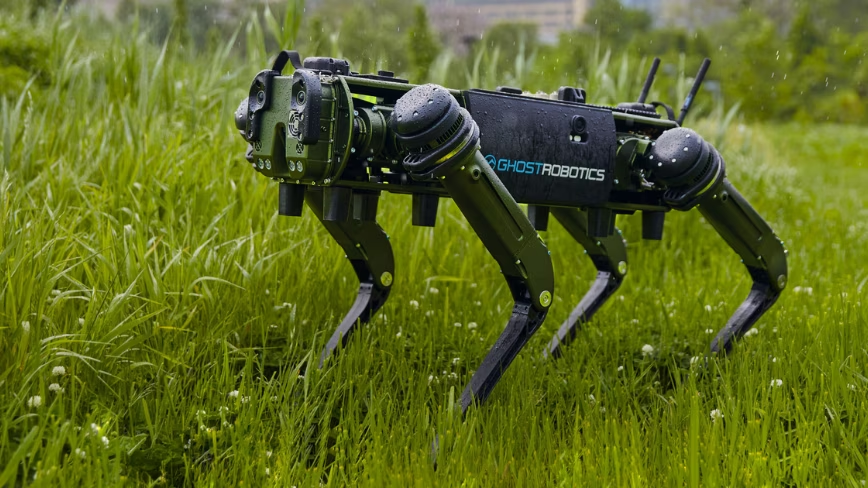
💡See how embodied AI is being adapted for autonomous military surveillance and remote defense.
⚡ 30-Second TL;DR
What Changed
Three versions of robot dogs unveiled for military use
Why It Matters
The use of quadrupedal robots in military logistics and surveillance signals a shift toward autonomous defense infrastructure. This highlights the growing role of embodied AI in harsh, remote environments.
What To Do Next
Explore the integration of ROS 2 for autonomous navigation if you are building robotics applications for unstructured environments.
Key Points
- •Three versions of robot dogs unveiled for military use
- •Designed to augment human guards on remote outposts
- •Includes an armed variant for potential defensive operations
🧠 Deep Insight
Background and context from public sources — not the original article. 12 sources cited.
🔑 Enhanced Key Takeaways
- •The robot dogs deployed by Taiwan's military research institute, NCSIST, are based on the US-made Ghost Robotics Vision 60 platform, with NCSIST integrating its own proprietary technology for specialized military applications.
- •Beyond general patrolling, the three variants include a LiDAR-equipped model for 3D mapping and continuous surveillance, and a reconnaissance model designed for target identification and tracking.
- •The armed variant incorporates AI multi-target recognition capabilities for precision strikes and is also being considered for non-lethal applications such as riot control and crowd dispersal.
- •These robotic systems are engineered for extreme environmental resilience, capable of operating in temperatures ranging from -40 C to 55 C and performing effectively in challenging terrains including rain, dust, and mud.
- •Taiwan aims to establish a non-Chinese supply chain and localized production for these advanced robotic systems, thereby enhancing its defense autonomy and reducing reliance on external sources.
📊 Competitor Analysis▸ Show
| Feature / Competitor | NCSIST Robot Dogs (Taiwan) | Ghost Robotics Vision 60 (US) | China's "Mechanical Yak" | China's Armed Robot Wolves | Unitree B2-W (China) |
|---|---|---|---|---|---|
| Platform Base | Ghost Robotics Vision 60 | Proprietary | Proprietary | Proprietary | Proprietary |
| Key Capabilities | Reconnaissance, surveillance, 3D mapping, target tracking, precision strike (armed variant), riot control, perimeter security, autonomous patrols | Perimeter security, reconnaissance, inspection, weapon-ready (experimental armed versions) | Heavy load transport, off-road capacity, military applications | Taiwan Strait assault drills, armed with rifles, swarm-capable, AI | High agility, balance, multi-terrain movement, load carrying, fast speed |
| Payload Capacity | 10 kg | (Up to 10kg, based on NCSIST's use) | Impressive load capacity (largest quadruped) | 20 kg | 40 kg |
| Speed | >2.5 m/s (9 km/h) | (Similar to NCSIST's integrated system) | (Not specified, but designed for heavy loads) | (Not specified, but used in assault drills) | 30 mph (48 km/h) |
| Noteworthy Features | NCSIST's in-house electro-optical payload, LiDAR, thermal imaging, AI multi-target recognition, remote weapon turret, non-Chinese supply chain goal | Rugged, waterproofed, modular, used by US DoD | Electrically operated, bionic, "largest and most difficult quadruped bionic robot in the world" (2022) | Debuted in live drill (Oct 2025), 100m firing range, 70kg weight | Wheeled-legged design, acrobatic balance, AI-driven, cheaper/faster production |
🛠️ Technical Deep Dive
- Base Platform: US-made Ghost Robotics Vision 60.
- Weight: Approximately 52.4 kg.
- Payload Capacity: Up to 10 kg.
- Battery Life: 8 to 10 hours of continuous operation.
- Top Speed: More than 2.5 meters per second (approximately 9 km/h).
- Mobility: Features three degrees of freedom per leg, enabling movement across diverse terrains, climbing slopes, traversing rough ground, dodging obstacles, and navigating stairs and unpaved surfaces. It also possesses automatic self-righting capabilities.
- Environmental Resilience: Designed for high-intensity, all-weather missions, capable of operating in temperatures from -40 C to 55 C, and performing effectively in rain, dust, and muddy conditions.
- Sensor & Payload Integration (NCSIST):
- LiDAR Version: Equipped with a 32-line 3D LiDAR system and thermal imaging sensors for autonomous patrols, real-time obstacle avoidance, environmental perception, heat-source detection, and 3D spatial mapping.
- Reconnaissance Model: Features NCSIST's in-house electro-optical reconnaissance payload for target search, identification, tracking, and real-time data transmission to a smart decision-making system.
- Firepower Version: Integrates a domestically developed remote weapon turret system and utilizes AI multi-target recognition for identifying and locking onto moving enemies for precision strikes.
- Connectivity: Designed for integration with unmanned ground vehicles and drones to establish a comprehensive 3D multi-domain combat system.
🔮 Future ImplicationsAI analysis grounded in cited sources
⏳ Timeline
📎 Sources (12)
Factual claims are grounded in the sources below. Forward-looking analysis is AI-generated interpretation.
Weekly AI Recap
Read this week's curated digest of top AI events →
👉Related Updates


AI-curated news aggregator. All content rights belong to original publishers.
Original source: The Next Web (TNW) ↗
This is a summary, not the original. Read the source, or get the weekly briefing.
The weekly digest
One email a week. Unsubscribe anytime.