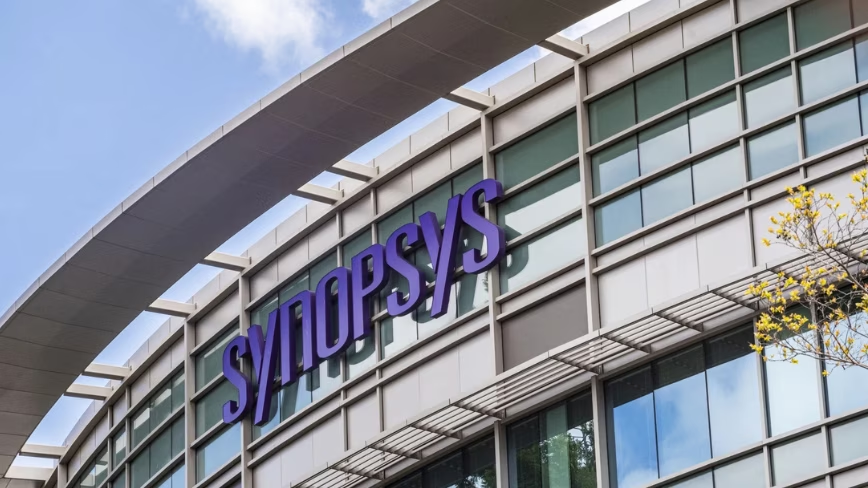
Synopsys pivots from fab software to AI chip design
💡A major EDA player shifting resources to AI chip design signals a massive market pivot toward custom AI hardware.
⚡ 30-Second TL;DR
What Changed
Exiting the manufacturing control software business
Why It Matters
This shift highlights the intense competition and high value placed on AI-specific silicon design tools. It may consolidate Synopsys's position as a key enabler for next-generation AI hardware.
What To Do Next
Keep an eye on Synopsys's new AI-focused design tool releases to optimize your custom silicon workflows.
Key Points
- •Exiting the manufacturing control software business
- •Redirecting engineering talent to AI chip design
- •Strategic move to capture higher margins in the AI sector
- •Reflects the growing importance of specialized AI hardware design
🧠 Deep Insight
AI-generated analysis for this event — not the original article.
🔑 Enhanced Key Takeaways
- •Synopsys is leveraging its 'Synopsys.ai' EDA suite, which integrates generative AI across the entire chip design stack, to replace manual optimization processes.
- •The divestiture or wind-down of the manufacturing software unit aligns with Synopsys' broader strategy to focus on high-growth 'Silicon to Systems' design solutions.
- •This pivot follows the 2024 acquisition of Ansys, which Synopsys integrated to provide multi-physics simulation capabilities essential for complex AI chip thermal and power management.
- •Market analysts note that Synopsys is shifting resources to capitalize on the 'AI-driven design' cycle, where AI tools are used to design the very chips that power AI models.
- •The company is increasingly prioritizing its IP (Intellectual Property) portfolio, specifically high-speed interface IP like UCIe and HBM3, which are critical for AI accelerator interconnects.
📊 Competitor Analysis▸ Show
| Feature | Synopsys (Synopsys.ai) | Cadence Design Systems | Siemens EDA (Mentor) |
|---|---|---|---|
| Core AI Focus | Full-stack generative AI EDA | Cerebrus AI-driven optimization | AI-enhanced digital twin simulation |
| Market Position | Leader in IP & EDA integration | Strong in custom IC & PCB design | Strong in manufacturing/fab software |
| AI Hardware Strategy | High-speed IP & System-level design | AI-optimized PPA (Power, Perf, Area) | Focus on industrial/automotive AI |
🛠️ Technical Deep Dive
- Synopsys.ai utilizes reinforcement learning (RL) agents to automate floorplanning and placement, significantly reducing the design cycle for large-scale AI accelerators.
- The platform incorporates DSO.ai (Design Space Optimization), which autonomously explores design spaces to meet aggressive PPA targets.
- Integration of Ansys multi-physics solvers allows for real-time analysis of thermal dissipation and signal integrity in 3D-IC and chiplet-based architectures.
- The shift emphasizes the use of digital twins to simulate manufacturing outcomes before physical tape-out, effectively replacing some legacy manufacturing control software functions with predictive design-side modeling.
🔮 Future ImplicationsAI analysis grounded in cited sources
⏳ Timeline
Weekly AI Recap
Read this week's curated digest of top AI events →
👉Related Updates


AI-curated news aggregator. All content rights belong to original publishers.
Original source: The Next Web (TNW) ↗
This is a summary, not the original. Read the source, or get the weekly briefing.
The weekly digest
One email a week. Unsubscribe anytime.