SWE-CI Benchmark Tests AI Long-Term Code Maintenance
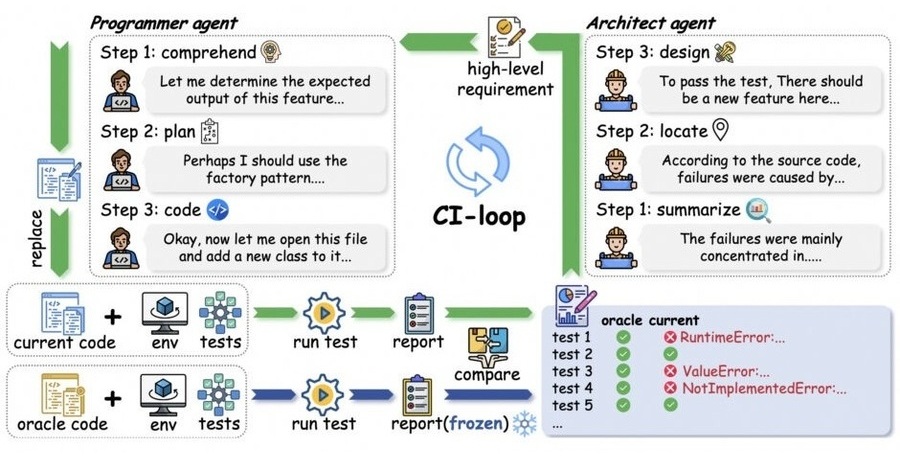
💡New SWE-CI benchmark exposes AI limits in sustaining code quality long-term—essential for coders.
⚡ 30-Second TL;DR
What Changed
Chinese researchers from Sun Yat-sen University and Alibaba propose SWE-CI benchmark
Why It Matters
This benchmark could become a standard for validating AI coding agents in production, driving improvements in long-context reasoning and reliability for developers.
What To Do Next
Review the SWE-CI paper from arXiv and benchmark your coding LLMs for long-term maintenance.
Key Points
- •Chinese researchers from Sun Yat-sen University and Alibaba propose SWE-CI benchmark
- •Evaluates AI ability to maintain code quality over long periods
- •Targets limitations of short-term coding benchmarks
- •Focuses on continuous integration-like software maintenance scenarios
🧠 Deep Insight
AI-generated analysis for this event — not the original article.
🔑 Enhanced Key Takeaways
- •SWE-CI utilizes a multi-turn interaction framework that specifically evaluates an AI agent's ability to resolve issues while maintaining compatibility with existing CI/CD pipelines and regression testing suites.
- •The benchmark dataset is constructed from real-world GitHub repositories, focusing on long-term maintenance tasks such as dependency updates, refactoring, and bug fixes that span multiple commits.
- •Unlike static code generation benchmarks, SWE-CI incorporates a dynamic evaluation environment that executes the AI-generated code against test cases to verify functional correctness and prevent performance degradation over time.
📊 Competitor Analysis▸ Show
| Feature | SWE-CI | SWE-bench | HumanEval |
|---|---|---|---|
| Focus | Long-term maintenance/CI | Issue resolution | Function-level generation |
| Environment | Dynamic CI/CD simulation | Isolated test environment | Static execution |
| Complexity | High (Multi-turn/Stateful) | Medium (Single-turn) | Low (Snippet-based) |
🛠️ Technical Deep Dive
- •The benchmark architecture consists of a 'Task Environment' that mirrors a repository's CI pipeline, requiring the agent to interact with git commands, build tools, and test runners.
- •Evaluation metrics include 'Success Rate' (passing all tests), 'Maintenance Efficiency' (number of turns/tokens to resolution), and 'Regression Rate' (introduction of new bugs in unrelated modules).
- •The dataset includes a 'Temporal Split' mechanism, ensuring that the AI is tested on maintenance tasks that occur chronologically after the training data cutoff to prevent data leakage.
🔮 Future ImplicationsAI analysis grounded in cited sources
⏳ Timeline
Weekly AI Recap
Read this week's curated digest of top AI events →
👉Related Updates
AI-curated news aggregator. All content rights belong to original publishers.
Original source: ITmedia AI+ (日本) ↗
This is a summary, not the original. Read the source, or get the weekly briefing.
The weekly digest
One email a week. Unsubscribe anytime.