StepX launches AI-native smartphone with Step AOS
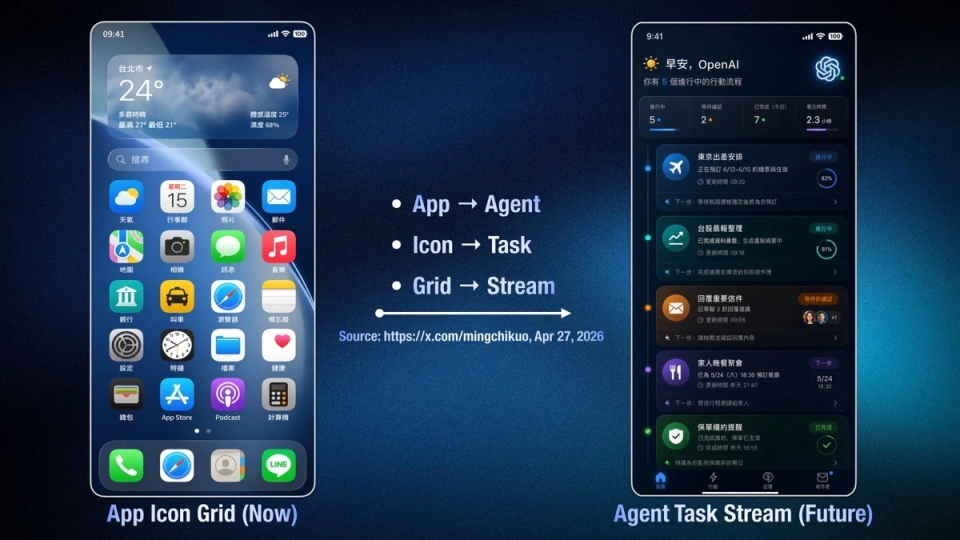
💡A major AI model firm is entering the hardware space to bypass mobile OS limitations for autonomous agents.
⚡ 30-Second TL;DR
What Changed
Step AOS features a 'dual-domain, three-step' memory structure for user and agent context.
Why It Matters
This move signals a trend where AI model companies are vertically integrating into hardware to overcome OS-level restrictions on agent autonomy. It challenges existing mobile ecosystems by attempting to redefine how users interact with apps.
What To Do Next
Evaluate the feasibility of building agentic workflows that require OS-level permissions versus standard API-based integrations.
Key Points
- •Step AOS features a 'dual-domain, three-step' memory structure for user and agent context.
- •Implements a 'cloud-edge' hybrid model architecture for efficient task execution and privacy.
- •Designed for cross-app agent control, bypassing traditional app sandbox limitations.
- •Strategic shift from pure B2B model provider to integrated hardware-software ecosystem.
🧠 Deep Insight
AI-generated analysis for this event — not the original article.
🔑 Enhanced Key Takeaways
- •LeapOcean (阶跃星辰) was founded by former ByteDance AI lab head Jiang Daming, leveraging his background in large-scale model training to drive the Step AOS development.
- •The STEPX Neo utilizes a proprietary NPU-optimized inference engine that reportedly reduces token latency by 40% compared to standard Android-based AI implementations.
- •The device integrates a 'Privacy Vault' hardware chip that ensures local-only processing for sensitive user context, addressing regulatory concerns regarding AI data sovereignty in China.
- •Step AOS utilizes a unique 'Agent-as-a-Service' (AaaS) framework that allows third-party developers to register intent-based APIs, facilitating deeper system integration than standard intent-based app linking.
- •The launch marks LeapOcean's transition from providing foundational models (Step-1/Step-2) to a vertical integration strategy, aiming to capture the 'AI-native' hardware premium market.
📊 Competitor Analysis▸ Show
| Feature | STEPX Neo | Apple iPhone (AI-enabled) | Samsung Galaxy (AI-enabled) |
|---|---|---|---|
| OS Architecture | Step AOS (Agent-Native) | iOS (App-Centric) | Android/OneUI (Hybrid) |
| Agent Capability | Cross-App System Control | Limited to Siri/App Intents | Limited to Bixby/App Intents |
| Model Deployment | Cloud-Edge Hybrid | Cloud-Edge Hybrid | Cloud-Edge Hybrid |
| Pricing | Mid-to-High Tier | Premium | Premium |
🛠️ Technical Deep Dive
- Memory Structure: The dual-domain, three-step memory architecture separates 'Short-term Working Memory' (active task), 'Long-term Episodic Memory' (user history), and 'Semantic Knowledge Base' (system/app logic).
- Inference Architecture: Employs a tiered model approach where small-parameter models (SLMs) handle real-time UI interactions, while larger models (Step-2 series) are triggered via cloud for complex reasoning.
- Sandbox Bypass: Uses a kernel-level hook system that intercepts UI events and API calls, allowing the agent to simulate user touches and input text across application boundaries without requiring specific app-side integration.
- Hardware Integration: Custom silicon optimization for the Step-1 series models, focusing on INT8 quantization to maintain high throughput on mobile NPUs.
🔮 Future ImplicationsAI analysis grounded in cited sources
⏳ Timeline
Weekly AI Recap
Read this week's curated digest of top AI events →
👉Related Updates


AI-curated news aggregator. All content rights belong to original publishers.
Original source: 虎嗅 ↗
This is a summary, not the original. Read the source, or get the weekly briefing.
The weekly digest
One email a week. Unsubscribe anytime.