Starlink pauses new subscriptions in Kenya due to demand
💡Understand the scaling limits of satellite infrastructure that powers remote AI and edge computing deployments.
⚡ 30-Second TL;DR
What Changed
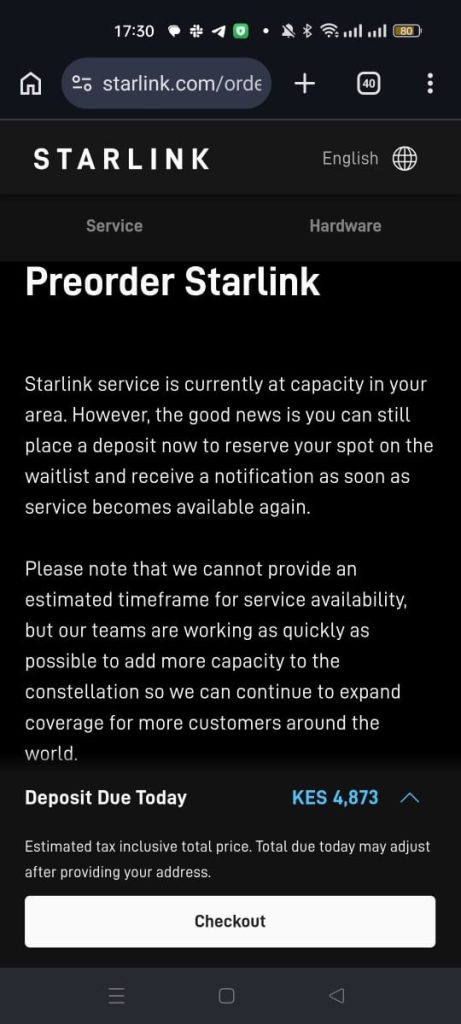
Starlink stopped accepting new customers in seven Kenyan counties.
Why It Matters
This indicates that even major satellite constellations face significant bandwidth bottlenecks, which could impact edge computing and remote AI deployment strategies that rely on Starlink connectivity.
What To Do Next
If building remote AI applications, evaluate alternative backhaul options or implement local caching to mitigate potential satellite network latency and availability issues.
Key Points
- •Starlink stopped accepting new customers in seven Kenyan counties.
- •The pause is due to demand outstripping available network capacity.
- •The move reflects infrastructure strain during rapid global expansion.
🧠 Deep Insight
AI-generated analysis for this event — not the original article.
🔑 Enhanced Key Takeaways
- •The restriction specifically targets high-density urban and peri-urban areas where Starlink's 'Best Effort' or standard residential capacity has reached saturation limits.
- •Starlink has been actively lobbying the Communications Authority of Kenya (CA) to allow for direct satellite-to-cell connectivity, which would bypass traditional ground station limitations.
- •Local Kenyan ISPs have previously petitioned the regulator to investigate Starlink's pricing and licensing, citing concerns over market disruption and competitive fairness.
- •The pause in subscriptions is a localized implementation of Starlink's 'Network Management Policy,' which allows the company to throttle or restrict sign-ups in cells where bandwidth demand exceeds satellite throughput.
- •Starlink's expansion in Kenya has been characterized by aggressive pricing strategies, including the introduction of rental options for hardware to lower the barrier to entry for lower-income households.
📊 Competitor Analysis▸ Show
| Feature | Starlink | Safaricom (Home Fibre) | Mawingu Networks |
|---|---|---|---|
| Technology | LEO Satellite | FTTH / 4G/5G | Fixed Wireless / Fiber |
| Latency | 25-50ms | <10ms | 30-80ms |
| Pricing Model | High CapEx (Hardware) + Monthly | Low CapEx + Monthly | Low CapEx + Monthly |
| Coverage | Nationwide (Rural focus) | Urban/Peri-urban | Regional/Rural |
🛠️ Technical Deep Dive
- Starlink utilizes a constellation of LEO satellites operating in the Ku and Ka bands to provide broadband connectivity.
- Network capacity is managed via 'cells' (hexagonal geographic areas), where each satellite beam has a finite amount of bandwidth allocated to a specific ground footprint.
- The congestion in Kenya is primarily due to the 'backhaul' limitation, where the number of active user terminals (UTs) exceeds the available throughput of the satellites passing over those specific cells.
- Starlink employs dynamic beamforming to steer capacity toward high-demand areas, but this is physically constrained by the total satellite density in the orbital plane over East Africa.
🔮 Future ImplicationsAI analysis grounded in cited sources
⏳ Timeline
Weekly AI Recap
Read this week's curated digest of top AI events →
👉Related Updates

AI-curated news aggregator. All content rights belong to original publishers.
Original source: TechCabal ↗
This is a summary, not the original. Read the source, or get the weekly briefing.
Weekly AI briefing
One email a week. Unsubscribe anytime.