SpaceX Starship V3 Launch: Ambition and Technical Hurdles
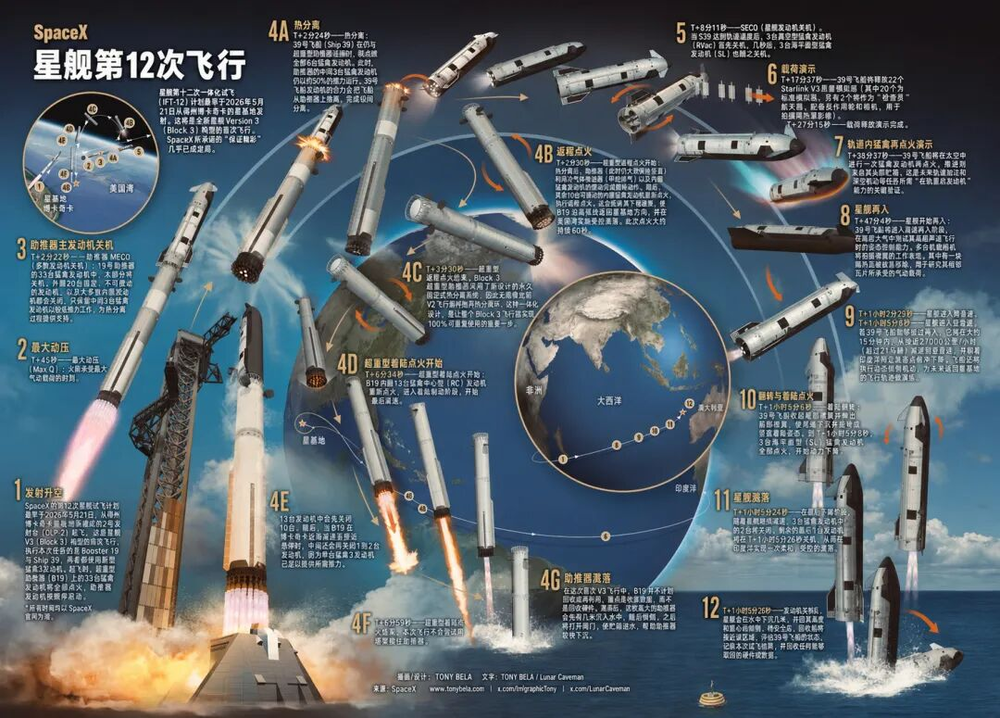
See how SpaceX's aggressive hardware iteration and 'simplify-to-scale' strategy drives the future of space infrastructur
30-Second TL;DR
What Changed
V3 Starship features Raptor 3 engines with simplified architecture and higher thrust-to-weight ratios.
Why It Matters
The rapid evolution of Starship hardware is critical for the future of satellite deployment and lunar exploration, setting a new benchmark for aerospace engineering speed.
What To Do Next
Study the 'design-out-the-problem' approach used in Raptor 3 to simplify your own system architecture for better reliability.
Key Points
- •V3 Starship features Raptor 3 engines with simplified architecture and higher thrust-to-weight ratios.
- •Structural optimizations, including replacing internal tanks with a tunnel pipe, significantly increased payload capacity.
- •The mission successfully tested new orbital refueling interfaces and thermal protection systems.
- •Despite technical glitches, the rapid iteration cycle remains the core of SpaceX's strategy for a $2 trillion valuation.
Deep Insight
Background and context from public sources — not the original article. 26 sources cited.
Enhanced Key Takeaways
- •The V3 Starship and Super Heavy V3 booster, unveiled on May 12, 2026, feature a redesigned hot-staging architecture that integrates the system directly into the vehicle structure, utilizing internal fuel tank pressure and specialized shielding to protect the booster during stage separation.
- •The Raptor 3 engine, powering the V3 Starship, achieves a sea-level thrust of 250 metric tons (551,000 lbf) and a vacuum thrust of 275 metric tons (606,000 lbf), while reducing engine mass to 1,525 kg, partly due to the elimination of external heat shields through full regenerative cooling and internally integrated sensors and controllers.
- •Starship V3 is designed to achieve a payload capacity of 200 tons to Low Earth Orbit (LEO) with full reusability, a substantial increase aimed at supporting rapid deployment of Starlink satellites and future deep-space missions.
- •SpaceX is targeting a $1.75 trillion valuation for its planned Initial Public Offering (IPO) in June 2026, which would be the largest in history, with recent financial disclosures revealing significant investments in AI and substantial losses in Q1 2026, partly attributed to the xAI merger.
- •The V3 Starship incorporates four docking drogues and a high-voltage electrically actuated cryogenic recirculation system, alongside a dedicated system for managing cryogenic propellant interactions during extended space coasts, all crucial for the planned ship-to-ship orbital refueling demonstrations in 2026.
Competitor Analysis
- SpaceX Starship V3
- Fully reusable super heavy-lift for Mars/Moon/LEO
- Blue Origin New Glenn
- Partially reusable heavy-lift for LEO/GEO
- ULA Vulcan Centaur
- Expendable heavy-lift for LEO/GEO/Deep Space
- DLR RLV C5 (Concept)
- Partially reusable heavy-lift for Europe
- SpaceX Starship V3
- Full (Booster & Ship)
- Blue Origin New Glenn
- Partial (First Stage)
- ULA Vulcan Centaur
- None (currently)
- DLR RLV C5 (Concept)
- Partial (Booster)
- SpaceX Starship V3
- 200 tons
- Blue Origin New Glenn
- 45 tons
- ULA Vulcan Centaur
- N/A
- DLR RLV C5 (Concept)
- 70+ tons
- SpaceX Starship V3
- Raptor 3 (Methalox)
- Blue Origin New Glenn
- BE-4 (Methalox)
- ULA Vulcan Centaur
- BE-4 (Methalox)
- DLR RLV C5 (Concept)
- LOX/Liquid Hydrogen
- SpaceX Starship V3
- ~9,000 tons (33x Raptor 3)
- Blue Origin New Glenn
- ~2,500 tons (7x BE-4)
- ULA Vulcan Centaur
- ~2,500 tons (2x BE-4)
- DLR RLV C5 (Concept)
- N/A
- SpaceX Starship V3
- Unprecedented payload, full reusability, rapid iteration
- Blue Origin New Glenn
- Large fairing, established government contracts
- ULA Vulcan Centaur
- Reliability, certified for national security payloads
- DLR RLV C5 (Concept)
- High payload efficiency (74% mass-to-orbit)
| Feature/Company | SpaceX Starship V3 | Blue Origin New Glenn | ULA Vulcan Centaur | DLR RLV C5 (Concept) |
|---|---|---|---|---|
| Primary Goal | Fully reusable super heavy-lift for Mars/Moon/LEO | Partially reusable heavy-lift for LEO/GEO | Expendable heavy-lift for LEO/GEO/Deep Space | Partially reusable heavy-lift for Europe |
| Reusability | Full (Booster & Ship) | Partial (First Stage) | None (currently) | Partial (Booster) |
| Payload to LEO (Reusable) | 200 tons | 45 tons | N/A | 70+ tons |
| Engines | Raptor 3 (Methalox) | BE-4 (Methalox) | BE-4 (Methalox) | LOX/Liquid Hydrogen |
| Thrust (Sea Level) | ~9,000 tons (33x Raptor 3) | ~2,500 tons (7x BE-4) | ~2,500 tons (2x BE-4) | N/A |
| Key Advantage | Unprecedented payload, full reusability, rapid iteration | Large fairing, established government contracts | Reliability, certified for national security payloads | High payload efficiency (74% mass-to-orbit) |
Technical Deep Dive
- Raptor 3 Engine:
- Full-flow staged combustion cycle, powered by cryogenic liquid methane and liquid oxygen (methalox).
- Sea-level thrust: 250 tf (551,000 lbf); Vacuum thrust: 275 tf (606,000 lbf).
- Dry mass: 1,525 kg.
- Operational chamber pressure: 330 bar (target 350 bar).
- Thrust-to-weight ratio: 163.9.
- Features full regenerative cooling, eliminating the need for external heat shields.
- Internally integrated sensors and controllers, removing individual engine shrouds and the CO2 fire suppression system.
- Redesigned ignition system across all engine variants.
- Starship V3 (Upper Stage):
- Height: 124.4 meters (408.1 feet) for the full stack.
- Clean-sheet redesign of propulsion systems for a new Raptor startup method and increased propellant tank volume.
- Improved reaction control system (RCS) for steering, designed for long-duration flights.
- Includes isolation valves for high-pressure gases, 100% vacuum jacketing coverage of the header feed system, and a high-voltage electrically actuated cryogenic recirculation system.
- Dedicated system for managing cryogenic propellant interactions with engines during extended space coasts.
- Four docking drogues on the leeward side for ship-to-ship propellant transfer.
- Aft flap actuation system upgraded from two actuators per flap to a single actuator with three motors.
- Super Heavy V3 (Booster):
- Reduced from four to three grid fins, each 50% larger and stronger, repositioned lower to mitigate heat exposure during hot-staging.
- Grid fin shaft, actuator, and fixed structure moved inside the booster's main fuel tank for enhanced protection.
- Integrated hot stage replaces the previous single-use protective interstage.
- Completely redesigned fuel transfer system, now roughly the size of a Falcon 9 first stage, enabling simultaneous startup of all 33 engines.
- Thermal Protection System (TPS):
- Flight 12 (V3 debut) intentionally removed one heat shield tile and painted several others white to measure aerodynamic load differences and serve as imaging targets for re-entry analysis.
Future ImplicationsAI analysis grounded in cited sources
Timeline
- 2023-04-20First integrated flight test of a full Starship vehicle (Block 1), ending in explosion.
- 2024-01United Launch Alliance's (ULA) Vulcan Centaur rocket made its successful debut.
- 2025-03Raptor 3 engine specifications detailed, showcasing increased thrust and efficiency.
- 2025-10-13Last flight of a Block 2 Starship (Flight 11).
- 2026-02-02xAI joins SpaceX, forming a combined entity.
- 2026-05-12SpaceX officially introduces Starship V3 and Super Heavy V3, powered by Raptor 3 engines.
- 2026-05-22First launch of Starship V3 (Flight 12) from a new launch pad.
Sources (26)
Factual claims are grounded in the sources below. Forward-looking analysis is AI-generated interpretation.
Weekly AI Recap
Read this week's curated digest of top AI events →
AI-curated news aggregator. All content rights belong to original publishers.
Original source: 虎嗅 ↗
This is a summary, not the original. Read the source, or get the weekly briefing.
The weekly digest
One email a week. Unsubscribe anytime.