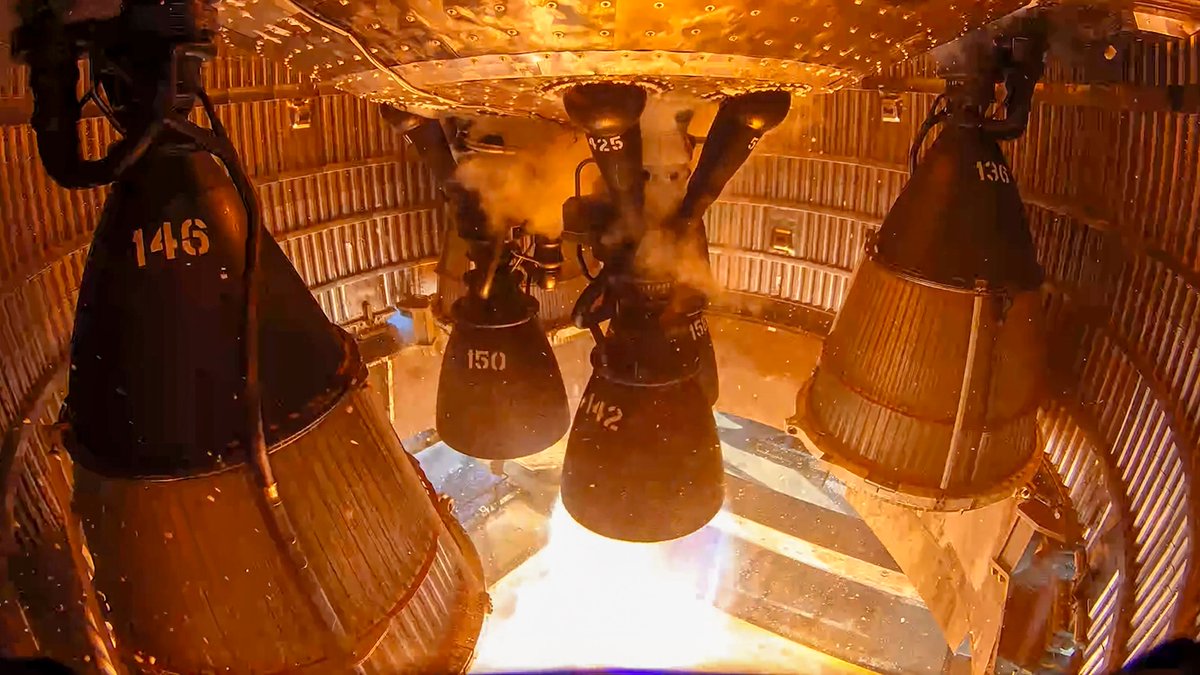
SpaceX Starship Ship 40 Completes Static Fire Test
SpaceX's rapid iteration cycle provides a blueprint for hardware-software integration in complex autonomous systems.
30-Second TL;DR
What Changed
Ship 40 is the designated upper stage for the upcoming Flight 13 mission.
Why It Matters
Continued rapid iteration of Starship hardware is critical for lowering launch costs and enabling future deep-space missions, which indirectly supports the infrastructure for large-scale AI data centers in space.
What To Do Next
Monitor SpaceX's launch cadence to assess the availability of heavy-lift launch capacity for future satellite-based AI infrastructure projects.
Key Points
- •Ship 40 is the designated upper stage for the upcoming Flight 13 mission.
- •The test involved a single-engine static fire to verify propulsion system readiness.
- •This marks the beginning of the formal ground testing phase for the next Starship launch.
Deep Insight
AI-generated analysis for this event — not the original article.
Enhanced Key Takeaways
- •Ship 40 incorporates updated Raptor 3 engine configurations, focusing on increased thrust-to-weight ratios and simplified plumbing compared to previous iterations.
- •The static fire test was conducted at SpaceX's Starbase facility in Boca Chica, Texas, utilizing the newly upgraded Suborbital Pad B.
- •Flight 13 is expected to feature an expanded payload capacity test, aiming to demonstrate orbital refueling capabilities for the Artemis program.
- •Ship 40 features enhanced thermal protection system (TPS) tiles, utilizing a new bonding agent designed to reduce tile loss during atmospheric reentry.
- •The test campaign for Flight 13 is accelerating, with SpaceX targeting a shorter turnaround time between static fire and launch compared to the Flight 12 mission.
Competitor Analysis
- SpaceX Starship
- Operational/Testing
- Blue Origin New Glenn
- Initial Flight Testing
- Rocket Lab Neutron
- Development
- SpaceX Starship
- Full (Ship & Booster)
- Blue Origin New Glenn
- Partial (Booster)
- Rocket Lab Neutron
- Partial (Booster)
- SpaceX Starship
- 100t+ (Fully Reusable)
- Blue Origin New Glenn
- ~45t
- Rocket Lab Neutron
- ~13t-15t
- SpaceX Starship
- Methalox
- Blue Origin New Glenn
- Methalox
- Rocket Lab Neutron
- Methalox
| Feature | SpaceX Starship | Blue Origin New Glenn | Rocket Lab Neutron |
|---|---|---|---|
| Status | Operational/Testing | Initial Flight Testing | Development |
| Reusability | Full (Ship & Booster) | Partial (Booster) | Partial (Booster) |
| Payload to LEO | 100t+ (Fully Reusable) | ~45t | ~13t-15t |
| Primary Fuel | Methalox | Methalox | Methalox |
Technical Deep Dive
- Propulsion: Raptor 3 engines utilizing full-flow staged combustion cycle with increased chamber pressure.
- Structure: Stainless steel alloy 304L construction with integrated header tanks for landing propellant.
- Thermal Protection: Hexagonal ceramic tile array with improved mechanical attachment points to mitigate vibration-induced shedding.
- Avionics: Triple-redundant flight computers with Starlink-integrated telemetry for real-time data downlink during high-velocity phases.
Future ImplicationsAI analysis grounded in cited sources
Timeline
- 2025-03Starship Flight 10 achieves successful orbital insertion and controlled splashdown.
- 2025-09SpaceX completes the first successful mid-air capture of a Super Heavy booster.
- 2026-01Flight 11 demonstrates advanced heat shield durability during high-energy reentry.
- 2026-04Flight 12 mission concludes with successful landing of both Ship and Booster.
Weekly AI Recap
Read this week's curated digest of top AI events →
Related Updates

AI-curated news aggregator. All content rights belong to original publishers.
Original source: cnBeta (Full RSS) ↗
This is a summary, not the original. Read the source, or get the weekly briefing.
The weekly digest
One email a week. Unsubscribe anytime.