SpaceX Secures $70B in AI Compute Rental Deals
💡SpaceX's pivot to a $26B/year compute rental business signals a major shift in AI infrastructure economics.
⚡ 30-Second TL;DR
What Changed
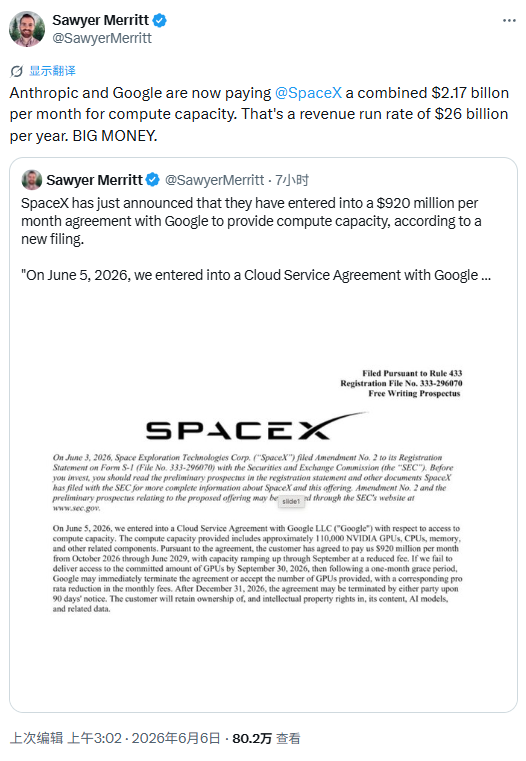
SpaceX signed a $70B+ compute rental deal with Anthropic and Google.
Why It Matters
The shift suggests that compute scarcity remains a massive market opportunity, forcing even AI-focused companies to become infrastructure providers to sustain their capital-intensive operations.
What To Do Next
Monitor the availability of large-scale GPU clusters in the cloud market as major players like SpaceX shift toward infrastructure-as-a-service models.
Key Points
- •SpaceX signed a $70B+ compute rental deal with Anthropic and Google.
- •Annualized revenue from compute rentals is estimated at $26 billion.
- •xAI faces internal challenges including talent loss and training infrastructure design flaws.
- •SpaceX is leveraging its Colossus data centers to monetize idle compute resources.
🧠 Deep Insight
Background and context from public sources — not the original article. 36 sources cited.
🔑 Enhanced Key Takeaways
- •SpaceX's deal with Anthropic secures access to its entire Colossus 1 data center, comprising over 220,000 NVIDIA GPUs and 300 megawatts of capacity, for $1.25 billion per month through May 2029.
- •The agreement with Google grants access to approximately 110,000 NVIDIA GPUs and related infrastructure for $920 million per month, starting October 2026 and extending through June 2029.
- •Both the Anthropic and Google compute rental agreements include 90-day termination clauses that can be exercised after December 31, 2026, providing flexibility for both parties.
- •SpaceX is positioning itself to address a projected $26.5 trillion opportunity within the AI infrastructure market, which includes ambitious plans for orbital AI compute at scale.
- •The Colossus 1 data center, originally built for xAI, had an inefficient mixed-architecture design with various NVIDIA GPUs (H100, H200, GB200), leading to low utilization (reportedly 11%) for training Grok, making it more suitable for leasing out for inference workloads.
📊 Competitor Analysis▸ Show
While SpaceX is entering the AI compute rental market with its unique infrastructure, it faces competition from established cloud providers and specialized GPU rental services:
| Feature/Provider | SpaceX (Colossus) | AWS / Azure / GCP | CoreWeave / RunPod / Vast.ai |
|---|---|---|---|
| Primary Offering | Large-scale dedicated GPU clusters (NVIDIA GPUs) for lease, future orbital compute. | Full-suite cloud services with GPU instances (A100, H100, TPUs, Trainium). | Specialized high-performance GPU cloud, peer-to-peer marketplaces. |
| Scale | Massive, multi-gigawatt terrestrial clusters (Colossus 1: 300MW, 220,000+ GPUs), plans for orbital data centers. | Hyperscale global infrastructure, vast but shared resources. | Varies; some specialized providers offer large clusters, marketplaces aggregate diverse hardware. |
| Pricing Model | Long-term, multi-billion dollar contracts (monthly payments). | On-demand, reserved instances, spot pricing; often premium. | Competitive, often lower hourly rates, market-driven for peer-to-peer. |
| Hardware Focus | Primarily NVIDIA GPUs (H100, H200, GB200 in Colossus 1; Blackwell for Colossus 2). | Diverse, including NVIDIA GPUs, AMD GPUs, Google TPUs, AWS Trainium. | Wide range, from consumer-grade (RTX) to enterprise (A100, H100). |
| Unique Selling Proposition | Leveraging existing infrastructure built for xAI, potential for orbital data centers, direct access to large, dedicated clusters. | Integrated ecosystem of cloud services, global reach, diverse hardware options. | Cost-effectiveness, flexibility, developer-centric tools, specialized high-performance for AI. |
| Target Customer | Frontier AI labs needing massive, dedicated compute (Anthropic, Google). | Enterprises, startups, developers across various industries. | AI/ML engineers, researchers, startups, cost-sensitive users. |
🛠️ Technical Deep Dive
- Colossus 1 Data Center: Located in Memphis, Tennessee, this facility houses over 220,000 NVIDIA GPUs and provides more than 300 megawatts of compute capacity.
- Colossus 1 Architecture Challenges: The initial design of Colossus 1 featured a mixed architecture, including NVIDIA H100, H200, and GB200 GPUs. This heterogeneous setup reportedly led to significant inefficiencies for AI model training due to the 'straggler effect,' where faster chips wait for slower ones, resulting in a low real-world GPU utilization of approximately 11%. This inefficiency is cited as a key reason for leasing out the facility for inference workloads.
- Colossus 2 Plans: SpaceX is reportedly planning Colossus 2 to be a more optimized facility, specifically designed with a Blackwell-only GPU architecture to avoid the inefficiencies encountered in Colossus 1 and to support frontier AI training.
- Orbital Data Centers Concept: SpaceX is pursuing the development of orbital data centers, envisioning Starlink V3 satellites equipped with Tesla AI chips. These satellites would be solar-powered, offering continuous energy and natural cooling in space, aiming to overcome terrestrial constraints on power grids, water, and land. SpaceX has filed for FCC approval to launch up to 1 million such satellites.
🔮 Future ImplicationsAI analysis grounded in cited sources
⏳ Timeline
📎 Sources (36)
Factual claims are grounded in the sources below. Forward-looking analysis is AI-generated interpretation.
- stocktwits.com
- slashdot.org
- channelnewsasia.com
- fifthrow.com
- anthropic.com
- aa.com.tr
- businessinsider.com
- note.com
- idc.com
- pluang.com
- thenextweb.com
- pulse2.com
- wccftech.com
- latimes.com
- benzinga.com
- stratechery.com
- tomshardware.com
- cryptobriefing.com
- anthropic.com
- thundercompute.com
- ciodive.com
- anthropic.com
- dataoorts.com
- fluence.network
- digitalocean.com
- hyperstack.cloud
- pymnts.com
- medium.com
- teslahubs.com
- medium.com
- youtube.com
- forbes.com
- qz.com
- astutegroup.com
- edtechinnovationhub.com
- broadbandbreakfast.com
Weekly AI Recap
Read this week's curated digest of top AI events →
👉Related Updates



AI-curated news aggregator. All content rights belong to original publishers.
Original source: 虎嗅 ↗
This is a summary, not the original. Read the source, or get the weekly briefing.
The weekly digest
One email a week. Unsubscribe anytime.