SpaceX IPO: A $2 Trillion AI-Space Infrastructure Play
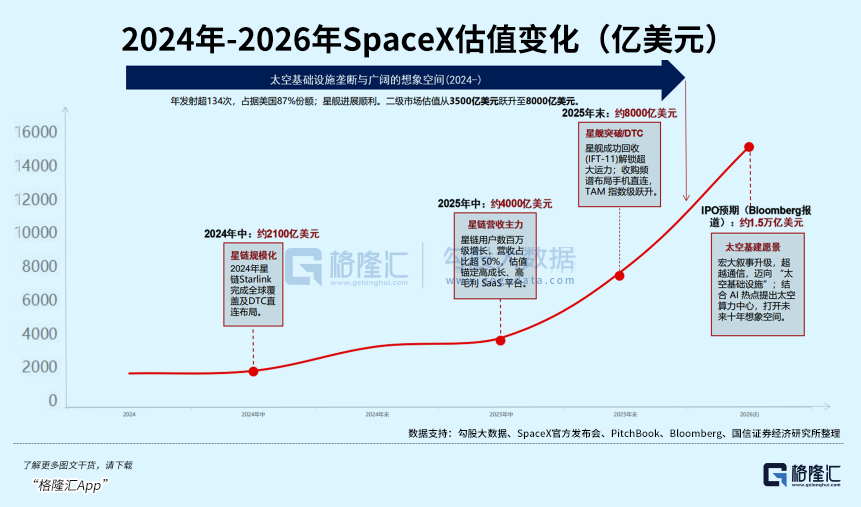
💡Understand how the convergence of space tech and AI compute is driving a $2 trillion valuation narrative.
⚡ 30-Second TL;DR
What Changed
SpaceX plans a $70-75 billion IPO, targeting a $2 trillion valuation.
Why It Matters
The potential merger of space-based connectivity and massive AI compute could redefine edge computing, enabling real-time AI processing in orbit for global enterprise and military applications.
What To Do Next
Evaluate the feasibility of deploying edge AI workloads on satellite-connected infrastructure as orbital compute becomes a viable commercial reality.
Key Points
- •SpaceX plans a $70-75 billion IPO, targeting a $2 trillion valuation.
- •Starlink contributes 77% of revenue, serving as the primary cash cow for expansion.
- •The integration of xAI's Colossus data centers with space infrastructure aims to create a new 'AI space compute' market.
- •Anthropic is gaining enterprise market share over OpenAI due to token-based billing and superior long-context performance.
🧠 Deep Insight
Web-grounded analysis with 32 cited sources.
🔑 Enhanced Key Takeaways
- •SpaceX acquired xAI on February 2, 2026, in an all-stock transaction valued at $250 billion, integrating xAI's assets like Grok and the X social media platform into a new 'SpaceXAI' division.
- •SpaceX is preparing for an IPO in June 2026, targeting a valuation between $1.75 trillion and $2 trillion and aiming to raise $70-75 billion, which would make it the largest initial public offering in history.
- •Starlink's revenue reached $11.4 billion in 2025 with a 63% EBITDA margin, establishing it as SpaceX's sole profitable segment, and its subscriber base grew to over 10 million active users by February 2026.
- •xAI's Colossus supercomputer, operational since July 2024, is recognized as the world's largest AI supercomputer, currently featuring over 220,000 NVIDIA GPUs (H100, H200, GB200) with plans to expand to 1 million GPUs.
- •Anthropic has surpassed OpenAI in enterprise AI adoption, securing a 34.4% market share by April 2026, driven by its Claude models' strong long-context performance, coding capabilities, and competitive pricing.
📊 Competitor Analysis▸ Show
| Feature/Metric | Anthropic (Claude) | OpenAI (GPT) |
|---|---|---|
| Enterprise Market Share (April 2026) | 34.4% | 32.3% |
| Key Strengths | Long-context reasoning, coding performance, safety controls, API reliability, competitive pricing (Haiku, Sonnet tiers) | Ecosystem maturity, multimodal capabilities, Microsoft integration depth |
| Enterprise Adoption Drivers | Reliability, safety controls, long-context reasoning, coding performance | Early market lead, consumer popularity translating to enterprise |
| 2025 Revenue | ~$10B actual | $13.1B actual |
| 2026 Revenue Projection | ~$26B-$40B (4x growth) | ~$29B (2.2x growth) |
🛠️ Technical Deep Dive
- Colossus Supercomputer (xAI):
- Location: Memphis, Tennessee, with expansion to Southaven, Mississippi.
- Operational Date: July 2024.
- Current Scale: Over 220,000 NVIDIA GPUs, including H100, H200, and GB200 accelerators.
- Build Timeline: Initial 100,000 NVIDIA Hopper GPUs built in 122 days, doubled to 200,000 in an additional 92 days.
- Expansion Roadmap: Public roadmap targets 1 million GPUs at the Memphis facility.
- Power Consumption: Currently draws approximately 250 megawatts, supported by 35 gas turbines (420 MW capacity) and Tesla Megapack battery systems.
- Networking: Utilizes NVIDIA Spectrum-X Ethernet networking platform for Remote Direct Memory Access (RDMA).
- Performance Metrics: Features 194 PB/s total memory bandwidth, 3.6 Tbps network bandwidth per server, and over 1 exabyte of storage capacity.
- Primary Purpose: To train xAI's Grok chatbot and provide computing support to the X social media platform and other Elon Musk ventures like SpaceX.
- Starlink Satellite Network (SpaceX):
- Constellation Size (March 2026): Consists of over 10,020 satellites in Low Earth Orbit (LEO).
- Planned Expansion: Nearly 12,000 satellites are planned, with a potential extension to 34,400.
- Satellite Variants: Includes v0.9 (227 kg), v1 (260 kg), v1.5 (approx. 306 kg), v2 mini (approx. 740 kg), and v2 (approx. 1,250 kg) spacecraft types.
- Onboard Equipment: Features Ku-, Ka-, and E-band phased array antennas, laser transponders (on some units), and Hall-effect thrusters.
- Operational Altitude: Operates at altitudes such as 550 kilometers, approved by the FCC for lower operations than initially planned.
- Direct-to-Cell Capability: First six direct-to-cell satellites launched on January 2, 2024, with commercial messaging services becoming available in the United States and New Zealand by February 2025, and voice and data functionality expected in 2025.
🔮 Future ImplicationsAI analysis grounded in cited sources
⏳ Timeline
📎 Sources (32)
Factual claims are grounded in the sources below. Forward-looking analysis is AI-generated interpretation.
- Google Search Source
- Google Search Source
- Google Search Source
- Google Search Source
- Google Search Source
- Google Search Source
- Google Search Source
- Google Search Source
- Google Search Source
- Google Search Source
- Google Search Source
- Google Search Source
- Google Search Source
- Google Search Source
- Google Search Source
- Google Search Source
- Google Search Source
- Google Search Source
- Google Search Source
- Google Search Source
- Google Search Source
- Google Search Source
- Google Search Source
- Google Search Source
- Google Search Source
- Google Search Source
- Google Search Source
- Google Search Source
- Google Search Source
- Google Search Source
- Google Search Source
- Google Search Source
📰 Event Coverage
Weekly AI Recap
Read this week's curated digest of top AI events →
👉Related Updates


AI-curated news aggregator. All content rights belong to original publishers.
Original source: 虎嗅 ↗