SpaceX IPO Flags Orbital AI Data Risks
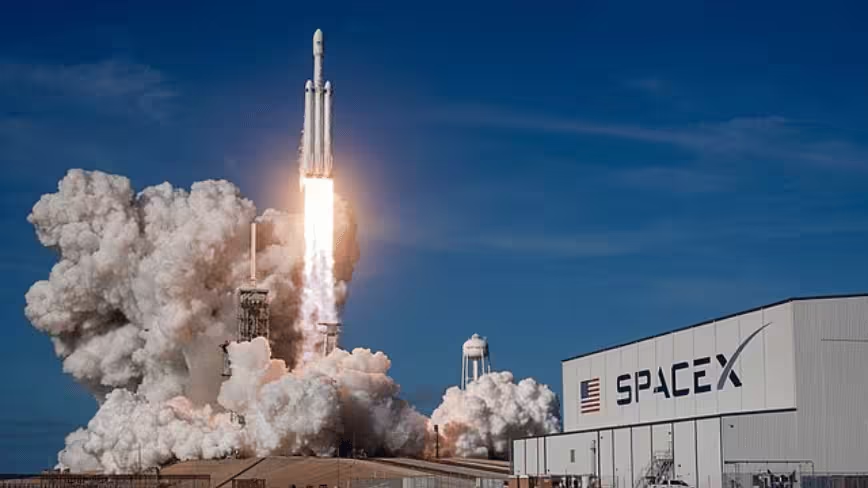
💡SpaceX IPO admits orbital AI data centers may flop, vs Musk's hype—key for infra bets.
⚡ 30-Second TL;DR
What Changed
S-1 filing highlights 'significant technical complexity' in orbital AI data centers
Why It Matters
This tempers hype around space-based AI infrastructure, signaling high risks for investors and practitioners eyeing orbital compute. It underscores the gap between visionary claims and regulatory disclosures.
What To Do Next
Download SpaceX S-1 filing to assess orbital compute risks for AI workloads.
Key Points
- •S-1 filing highlights 'significant technical complexity' in orbital AI data centers
- •Contradicts Musk's 'no-brainer' claim from three months ago at Davos
- •SpaceX targets $1.75T valuation amid these risk disclosures
🧠 Deep Insight
Background and context from public sources — not the original article. 9 sources cited.
🔑 Enhanced Key Takeaways
- •The S-1 filing reveals that SpaceX's orbital AI ambitions are heavily dependent on the successful scaling and high-cadence reusability of the Starship rocket, with any delays in the vehicle's development posing a material risk to the company's growth strategy.
- •SpaceX's IPO prospectus discloses a dual-class share structure that grants Elon Musk and insiders super-voting control, allowing Musk to retain approximately 79% of the voting power despite holding only 42% of the equity.
- •The company's valuation narrative is significantly bolstered by the February 2026 merger with xAI, which integrated Grok LLMs into SpaceX's infrastructure and repositioned the firm as an 'AI plus space' platform, despite the S-1 filing admitting that orbital compute remains speculative and lacks a working prototype.
🛠️ Technical Deep Dive
- •Orbital compute constraints: The S-1 filing identifies specific engineering challenges including the need for radiation hardening of hardware, complex thermal management in vacuum environments, and the requirement for components capable of surviving high-vibration launch conditions.
- •Cooling strategy: Proposed orbital data centers aim to leverage the extreme cold of space (approx. 3 Kelvin in shadow) using radiators pointed away from the sun to achieve efficient passive cooling.
- •Power architecture: The system relies on constant solar energy access, avoiding terrestrial day-night cycles and atmospheric attenuation, which Musk claims provides five times the energy effectiveness compared to ground-based solar panels.
- •Infrastructure integration: The 'K2' corporate restructuring integrated xAI's Grok models into SpaceX's operational architecture, with current efforts focused on utilizing Starlink satellite constellations as a distributed edge-computing platform.
🔮 Future ImplicationsAI analysis grounded in cited sources
⏳ Timeline
📎 Sources (9)
Factual claims are grounded in the sources below. Forward-looking analysis is AI-generated interpretation.
Weekly AI Recap
Read this week's curated digest of top AI events →
👉Related Updates

AI-curated news aggregator. All content rights belong to original publishers.
Original source: The Next Web (TNW) ↗
This is a summary, not the original. Read the source, or get the weekly briefing.
The weekly digest
One email a week. Unsubscribe anytime.