Southeast Asia Plans a Fourfold Data Centre Expansion
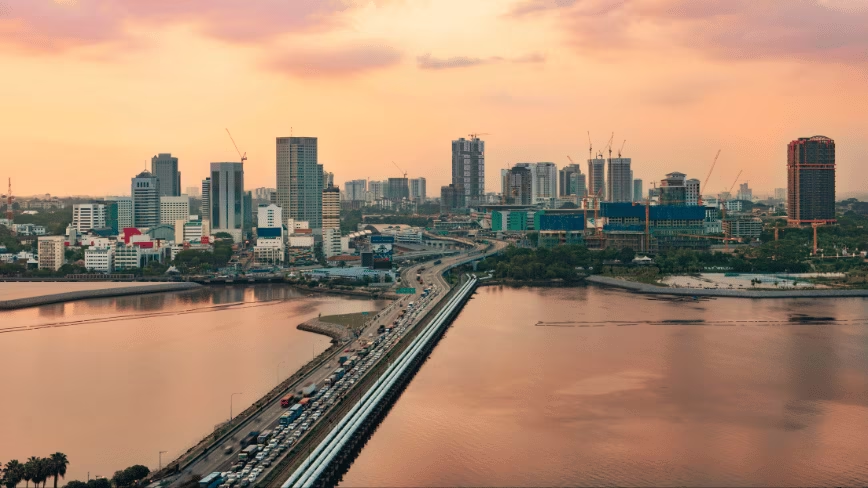
💡A fourfold capacity pipeline could reshape where AI teams train and serve models in Southeast Asia.
⚡ 30-Second TL;DR
What Changed
306 data centres are currently operating across Southeast Asia.
Why It Matters
The expansion could improve regional access to compute, storage, and AI inference capacity while intensifying competition for power, land, and connectivity. AI companies may gain more options for lower-latency deployments in Southeast Asian markets.
What To Do Next
Compare AWS and Google Cloud GPU-region availability, latency, and pricing across Southeast Asia before selecting an AI deployment region.
Key Points
- •306 data centres are currently operating across Southeast Asia.
- •Another 173 facilities are in the development pipeline.
- •Planned capacity is nearly four times the region’s existing capacity.
- •Investment is forecast to rise from $15.72 billion in 2025 to $35.08 billion by 2031.
🧠 Deep Insight
Background and context from public sources — not the original article. 6 sources cited.
🔑 Enhanced Key Takeaways
- •Malaysia has emerged as the regional leader in announced capacity, specifically targeting over 6 gigawatts of IT load, with a major concentration of development in the Johor region.
- •The expansion is primarily driven by the high-density power requirements of AI workloads and national sovereign data mandates rather than standard cloud migration alone.
- •Capital expenditure for regional data center construction is currently estimated between $7 million and $11 million per megawatt, depending on local power access and land availability.
- •Singapore is shifting its strategic focus toward hosting mission-critical operations that prioritize low latency and high security, effectively capping its physical expansion due to resource constraints.
- •The industry is experiencing a surge in M&A activity during 2026 as operators seek to bypass the lengthy processes of securing land, power, and regulatory permits for greenfield projects.
🛠️ Technical Deep Dive
- Implementation of advanced water-cooling solutions, including river water treatment systems, to manage thermal loads in high-density AI environments.
- Transition toward Power Purchase Agreements (PPAs) to mitigate the environmental impact of reliance on fossil-fuel-based electricity grids.
- Development of AI-grade infrastructure designed to support high-density rack configurations that exceed traditional enterprise data center power requirements.
🔮 Future ImplicationsAI analysis grounded in cited sources
⏳ Timeline
📎 Sources (6)
Factual claims are grounded in the sources below. Forward-looking analysis is AI-generated interpretation.
Weekly AI Recap
Read this week's curated digest of top AI events →
👉Related Updates



AI-curated news aggregator. All content rights belong to original publishers.
Original source: The Next Web (TNW) ↗
This is a summary, not the original. Read the source, or get the weekly briefing.
Weekly AI briefing
One email a week. Unsubscribe anytime.