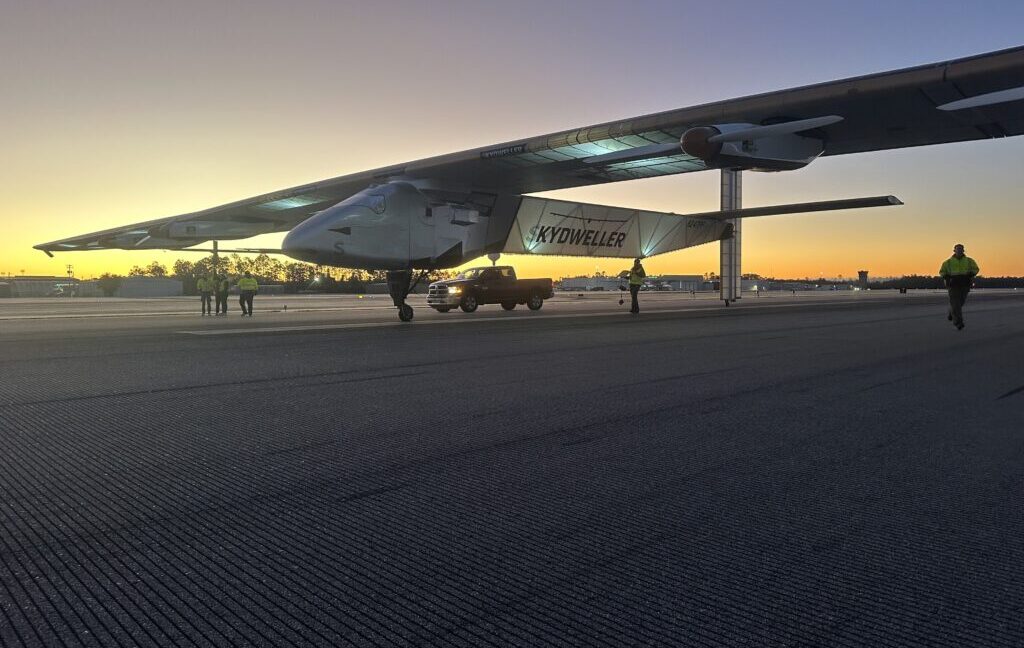
Solar drone breaks flight record before crashing
Understand the failure modes of long-endurance autonomous systems in high-altitude solar flight.
30-Second TL;DR
What Changed
The solar-powered drone achieved a significant endurance flight record.
Why It Matters
This event serves as a case study for the reliability of autonomous systems in extreme, long-duration environments. It emphasizes the need for better fail-safe mechanisms in high-altitude, long-endurance (HALE) drone development.
What To Do Next
Review the telemetry data logs of the flight to identify potential sensor drift or control loop failures that led to the crash.
Key Points
- •The solar-powered drone achieved a significant endurance flight record.
- •The aircraft featured a wingspan comparable to a commercial jumbo jet.
- •The mission concluded with a crash, underscoring the complexity of autonomous long-endurance flight.
Deep Insight
Background and context from public sources — not the original article. 16 sources cited.
Enhanced Key Takeaways
- •The record-breaking flight in 2022 by the Airbus Zephyr S lasted 64 days, significantly surpassing its previous record of 25 days and 23 hours.
- •During its 64-day mission, the Zephyr S accumulated 1,500 flight hours and traversed over 30,000 nautical miles (approximately 35,000 miles), covering regions across the southern U.S., the Gulf of Mexico, and South America.
- •Operating in the stratosphere at altitudes between 60,000 and 70,000 feet (around 21 kilometers), the drone flies above conventional air traffic and weather systems.
- •The Zephyr S is categorized as a High Altitude Platform Station (HAPS), designed to offer persistent, satellite-like services for intelligence, surveillance, reconnaissance (ISR), and communications.
- •The crash in August 2022, which occurred over the Arizona desert, was attributed to "unforeseen events" and a rapid descent, though no personal injuries were reported.
Competitor Analysis
- Airbus Zephyr S/8
- 25 m (82 ft)
- Prismatic PHASA-35
- 35 m
- SoftBank Sunglider
- 78 m
- Airbus Zephyr S/8
- 60-75 kg (130-165 lb)
- Prismatic PHASA-35
- Not specified (larger beast)
- SoftBank Sunglider
- Not specified
- Airbus Zephyr S/8
- 5 kg (11 lb)
- Prismatic PHASA-35
- 15 kg
- SoftBank Sunglider
- Not specified (designed for more cellphone antennas)
- Airbus Zephyr S/8
- Solar cells, lithium-sulfur batteries
- Prismatic PHASA-35
- Solar-electric
- SoftBank Sunglider
- Solar-electric
- Airbus Zephyr S/8
- Two electric motors, two-bladed propellers
- Prismatic PHASA-35
- Not specified (10 electric propellers for Sunglider)
- SoftBank Sunglider
- 10 electric propellers
- Airbus Zephyr S/8
- Up to 200-300 days (targeted)
- Prismatic PHASA-35
- Around 180 days (striving for)
- SoftBank Sunglider
- Ideally 200 days persistence (AALTO)
- Airbus Zephyr S/8
- ~70,000 ft (21 km), max 76,100 ft
- Prismatic PHASA-35
- ~66,000 ft
- SoftBank Sunglider
- ~62,500 ft
- Airbus Zephyr S/8
- ISR, communications relay, maritime/border surveillance, environmental monitoring
- Prismatic PHASA-35
- Persistent surveillance, telecom augmentation
- SoftBank Sunglider
- Internet delivery
| Feature/Company | Airbus Zephyr S/8 | Prismatic PHASA-35 | SoftBank Sunglider |
|---|---|---|---|
| Wingspan | 25 m (82 ft) | 35 m | 78 m |
| Weight | 60-75 kg (130-165 lb) | Not specified (larger beast) | Not specified |
| Payload Capacity | 5 kg (11 lb) | 15 kg | Not specified (designed for more cellphone antennas) |
| Power Source | Solar cells, lithium-sulfur batteries | Solar-electric | Solar-electric |
| Propulsion | Two electric motors, two-bladed propellers | Not specified (10 electric propellers for Sunglider) | 10 electric propellers |
| Target Endurance | Up to 200-300 days (targeted) | Around 180 days (striving for) | Ideally 200 days persistence (AALTO) |
| Operational Altitude | ~70,000 ft (21 km), max 76,100 ft | ~66,000 ft | ~62,500 ft |
| Key Applications | ISR, communications relay, maritime/border surveillance, environmental monitoring | Persistent surveillance, telecom augmentation | Internet delivery |
Technical Deep Dive
- Wingspan: 25 meters (82 ft)
- Weight: 60-75 kg (130-165 lb)
- Power Source: High-efficiency ELO-based solar cells covering the entire wing, recharging high-power lithium-sulfur batteries for night flight.
- Battery Technology: Amprius lithium-ion batteries with silicon nanowire anodes, providing a specific energy of 435 Wh/kg.
- Motors: Two solar-powered electric motors, each driving a two-bladed propeller mounted on the wings.
- Operational Altitude: Average of 70,000 feet (21 kilometers) in the stratosphere, with a record absolute altitude of 76,100 feet (23,200 m).
- Payload Capacity: Up to 5 kg (11 lb), with a larger variant expected to double this capacity.
- Payload Types: Includes lightweight, high-definition optical/infrared video cameras (NIIRS 6, 18cm resolution), Automatic Identification System (AIS), narrowband mobile communications network (100Mbps data rate), radar, LIDAR, hyperspectral sensors, and early warning systems.
- Construction Materials: Built using carbon fiber composite materials, making it 30% lighter than its predecessor, Zephyr 7.
- Operational Range: Capable of covering local or regional footprints, transmitting real-time imagery, voice, and data over areas up to 1,000 km².
- Operational Flexibility: Designed for year-round operation between 40 degrees North and South latitudes.
Future ImplicationsAI analysis grounded in cited sources
Timeline
- 2010-07Zephyr 7 sets a flight duration record of 14 days, 22 minutes, and 8 seconds.
- 2013-03The Zephyr project is acquired by EADS Astrium (now Airbus Defence and Space) from QinetiQ.
- 2016-02UK Ministry of Defence awards Airbus a contract for the production and operation of two Zephyr S solar-powered UAS.
- 2018-07-11Zephyr S begins its maiden flight from Arizona, ultimately setting a new endurance record of over 25 days.
- 2021-09-13Zephyr S concludes a successful 2021 test flight campaign, achieving 36 days of stratospheric flight across two missions and setting a new altitude record of 76,100 ft.
- 2022-06-15Zephyr S (Zephyr 8 UAS) launches from Yuma Proving Ground, Arizona, for its record-breaking 64-day flight.
- 2022-08-18The Zephyr S crashes in Arizona, ending its 64-day record-breaking flight.
- 2025-04-28Another Zephyr hull loss is reported in the Indian Ocean due to a battery issue.
Sources (16)
Factual claims are grounded in the sources below. Forward-looking analysis is AI-generated interpretation.
Weekly AI Recap
Read this week's curated digest of top AI events →
AI-curated news aggregator. All content rights belong to original publishers.
Original source: Ars Technica ↗
This is a summary, not the original. Read the source, or get the weekly briefing.
The weekly digest
One email a week. Unsubscribe anytime.