SoftBank’s OpenAI Bet Faces an Earnings Reckoning
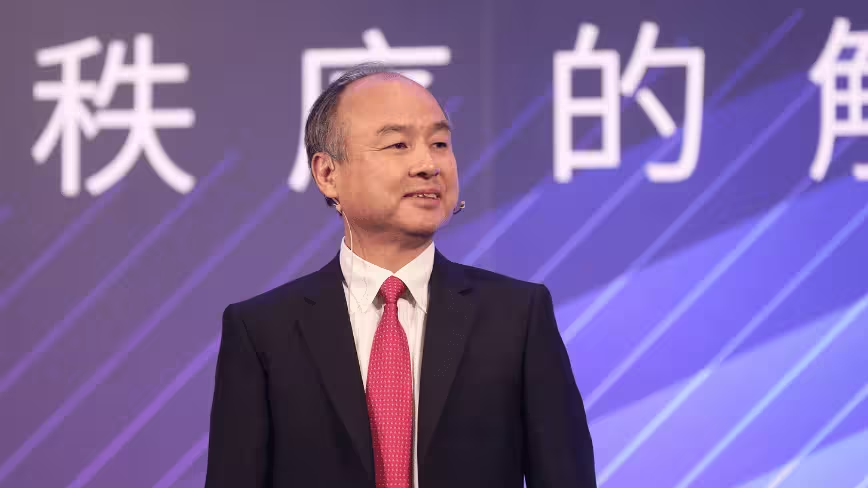
SoftBank’s results could signal whether the AI funding boom can withstand debt and valuation pressure.
30-Second TL;DR
What Changed
Analysts expect approximately ¥148 billion in quarterly net profit.
Why It Matters
A more cautious SoftBank could affect the pace and structure of future AI infrastructure and model investments. AI founders should pay attention to whether financing conditions change for OpenAI-related projects and the broader AI market.
What To Do Next
Audit your OpenAI API dependency and prepare a second-provider fallback in case financing pressure affects pricing, capacity, or roadmap stability.
Key Points
- •Analysts expect approximately ¥148 billion in quarterly net profit.
- •SoftBank has accumulated major funding commitments linked to OpenAI.
- •The earnings report will test the sustainability of Masayoshi Son’s debt-backed AI strategy.
Deep Insight
AI-generated analysis for this event — not the original article.
Enhanced Key Takeaways
- •SoftBank's Vision Fund 2 has increasingly pivoted toward AI infrastructure, specifically targeting semiconductor and data center investments to support OpenAI's compute-heavy requirements.
- •The ¥148 billion profit estimate reflects a recovery in SoftBank's portfolio valuations, though this is partially offset by the high cost of capital associated with its aggressive debt-financing model.
- •Masayoshi Son has reportedly been exploring a massive $100 billion semiconductor venture, codenamed 'Izanagi,' intended to create an AI chip ecosystem that competes with Nvidia and supplies OpenAI.
- •SoftBank's stake in Arm Holdings remains a critical hedge, as Arm's architecture is increasingly central to the custom silicon designs being pursued by OpenAI and other AI labs.
- •Credit rating agencies have expressed concerns regarding SoftBank's leverage ratios, noting that the concentration of capital in speculative AI ventures increases the company's sensitivity to market volatility.
Competitor Analysis
- SoftBank (Vision Fund)
- Venture/Growth Equity
- Blackstone (AI Infrastructure)
- Data Center Real Estate
- Brookfield Asset Management
- Renewable Energy/Data Centers
- SoftBank (Vision Fund)
- Compute & Foundation Models
- Blackstone (AI Infrastructure)
- Physical Infrastructure
- Brookfield Asset Management
- Power/Energy for AI
- SoftBank (Vision Fund)
- High (Debt-fueled/Speculative)
- Blackstone (AI Infrastructure)
- Moderate (Asset-backed)
- Brookfield Asset Management
- Low/Moderate (Utility-linked)
| Feature | SoftBank (Vision Fund) | Blackstone (AI Infrastructure) | Brookfield Asset Management |
|---|---|---|---|
| Primary Strategy | Venture/Growth Equity | Data Center Real Estate | Renewable Energy/Data Centers |
| AI Focus | Compute & Foundation Models | Physical Infrastructure | Power/Energy for AI |
| Risk Profile | High (Debt-fueled/Speculative) | Moderate (Asset-backed) | Low/Moderate (Utility-linked) |
Future ImplicationsAI analysis grounded in cited sources
Timeline
- 2016-10SoftBank announces the launch of the first Vision Fund with $100 billion in capital.
- 2023-09Arm Holdings completes its IPO on the Nasdaq, significantly boosting SoftBank's balance sheet.
- 2024-02Reports emerge regarding Masayoshi Son's 'Izanagi' project to build a $100 billion AI chip company.
- 2025-05SoftBank reports a return to profitability driven by the surge in AI-related asset valuations.
Weekly AI Recap
Read this week's curated digest of top AI events →
Related Updates

AI-curated news aggregator. All content rights belong to original publishers.
Original source: The Next Web (TNW) ↗
This is a summary, not the original. Read the source, or get the weekly briefing.
The weekly digest
One email a week. Unsubscribe anytime.