Sodium Batteries Target AI Data Centers
💡AI data centers need safer, longer-lived storage, and sodium batteries may become a practical alternative to LFP.
⚡ 30-Second TL;DR
What Changed
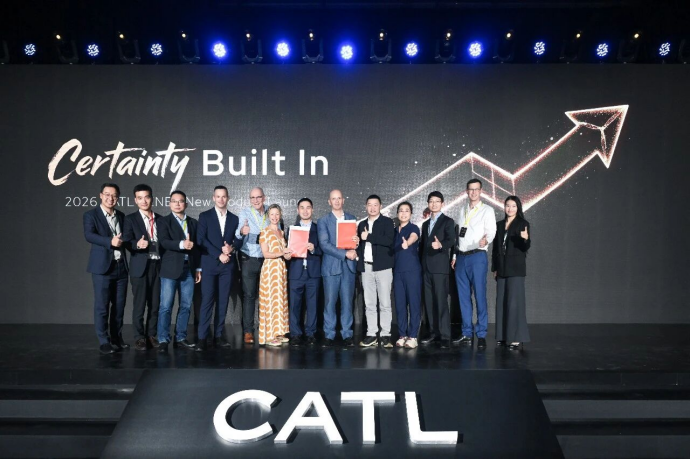
CATL signed agreements for 5 GWh of sodium-storage deployment with Alfen in Europe and another 2 GWh with Solarpro.
Why It Matters
The growth of AI data centers increases demand for backup power that can operate safely across long duty cycles and harsh environments. If sodium-ion systems achieve the reported cost and reliability targets, they could diversify the energy stack supporting AI infrastructure and reduce dependence on lithium supply chains.
What To Do Next
Evaluate sodium-ion storage alongside LFP for your AI data-center design, comparing LCOS, thermal-management energy, cycle life, and 72-hour backup requirements.
Key Points
- •CATL signed agreements for 5 GWh of sodium-storage deployment with Alfen in Europe and another 2 GWh with Solarpro.
- •Hithium’s sodium-storage solution claims over 96% capacity retention at 4P discharge, system efficiency of at least 94%, and more than 20,000 cycles.
- •Sodium-ion batteries are gaining traction for AI data centers because of safety, low-temperature performance, long life, and less concentrated raw-material supply.
- •Domestic Chinese sodium-ion capacity planning exceeded 80 GWh in the first half of 2026, with 35 GWh already commissioned and utilization rising to 58%.
- •Morgan Stanley forecasts sodium-ion batteries could represent 20% of global battery deployments by 2030.
🧠 Deep Insight
Background and context from public sources — not the original article. 8 sources cited.
🔑 Enhanced Key Takeaways
- •General Motors has entered the sodium-ion space through a strategic partnership with Peak Energy, aiming for commercial-scale deployment by 2028 to diversify energy storage options.
- •ESS Tech introduced a 1.2-MWh modular sodium-ion 'building-block' system in July 2026, specifically targeting the data center market with over $1 billion in identified customer opportunities.
- •Inlyte Energy is currently piloting iron-sodium battery technology in the U.S. and Switzerland, focusing on utilizing abundant iron to further reduce supply chain dependencies.
- •Sodium-ion systems are enabling the removal of energy-intensive active cooling infrastructure required by traditional LFP batteries, directly improving the Power Usage Effectiveness (PUE) of data centers.
- •The adoption of sodium-ion technology in the U.S. is being accelerated by federal mandates to avoid 'Foreign Entity of Concern' supply chain risks associated with lithium and cobalt.
📊 Competitor Analysis▸ Show
| Feature | CATL (Sodium) | ESS Tech (Sodium) | Inlyte Energy (Fe-Na) |
|---|---|---|---|
| Target Market | Grid & Data Center | Data Center/Utility | Industrial/Data Center |
| Architecture | Dedicated Grid Cell | 1.2-MWh Modular | Iron-Sodium Chemistry |
| Status | Commercialized | Launch (July 2026) | Pilot Phase (2026) |
🛠️ Technical Deep Dive
- Thermal Stability: Sodium-ion cells exhibit superior thermal runaway resistance compared to LFP, allowing for simplified passive cooling designs.
- Efficiency: System-level efficiency is optimized by eliminating the power draw of active thermal management systems.
- Chemistry: Shift toward iron-based sodium cathodes (Inlyte) to leverage low-cost, abundant raw materials.
- Modularity: Adoption of 1.2-MWh building-block architectures (ESS Tech) to facilitate rapid scaling in data center environments.
🔮 Future ImplicationsAI analysis grounded in cited sources
⏳ Timeline
📎 Sources (8)
Factual claims are grounded in the sources below. Forward-looking analysis is AI-generated interpretation.
Weekly AI Recap
Read this week's curated digest of top AI events →
👉Related Updates
AI-curated news aggregator. All content rights belong to original publishers.
Original source: 虎嗅 ↗
This is a summary, not the original. Read the source, or get the weekly briefing.
Weekly AI briefing
One email a week. Unsubscribe anytime.