Snapmaker Secures 1 Billion RMB for 3D Printing AI
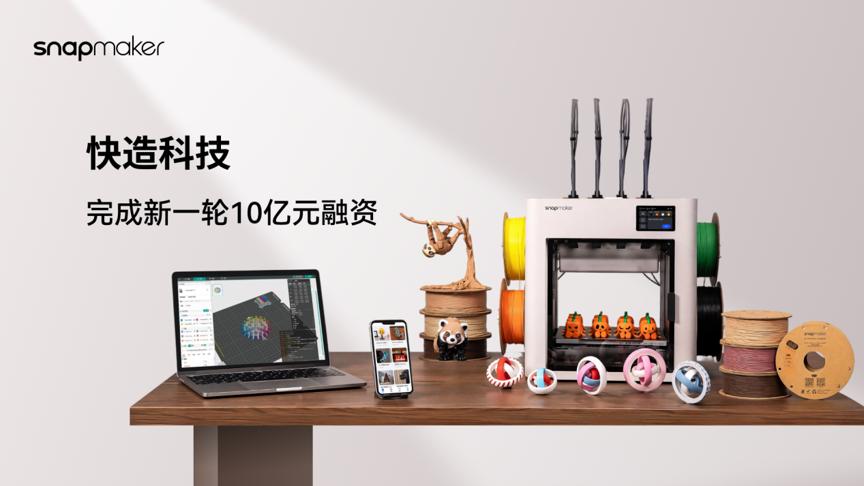
💡Snapmaker's 1B RMB funding highlights the convergence of 3D printing hardware and generative AI for creators.
⚡ 30-Second TL;DR
What Changed
Secured 1 billion RMB in funding led by Cathay Capital.
Why It Matters
This funding signals a major industry shift from pure hardware manufacturing to AI-integrated creative ecosystems in the consumer 3D printing market.
What To Do Next
Explore integrating generative AI models into your 3D design workflows to automate complex geometry generation.
Key Points
- •Secured 1 billion RMB in funding led by Cathay Capital.
- •U1 flagship utilizes 4-toolhead architecture for 5x efficiency and 80% less waste.
- •Strategic shift toward AI-assisted design tools and model community building.
🧠 Deep Insight
AI-generated analysis for this event — not the original article.
🔑 Enhanced Key Takeaways
- •The funding round was specifically designated as a Series C+ investment, marking a significant valuation milestone for the Shenzhen-based hardware manufacturer.
- •Snapmaker's AI integration focuses on 'Text-to-3D' generative workflows, allowing users to bypass traditional CAD software by utilizing natural language prompts to create printable geometries.
- •The company is expanding its R&D facility in Shenzhen to focus on 'Smart Material' sensing, which allows the U1 flagship to automatically adjust extrusion parameters based on real-time filament density analysis.
- •This capital injection includes a strategic partnership with cloud computing providers to host a proprietary 'Snapmaker Cloud' platform, enabling remote AI-driven print monitoring and failure detection.
- •Snapmaker has announced plans to open its API to third-party developers, aiming to create an 'App Store' model for 3D printing plugins and AI design agents.
📊 Competitor Analysis▸ Show
| Feature | Snapmaker (U1) | Bambu Lab (X1-Series) | Prusa Research (MK4) |
|---|---|---|---|
| Architecture | 4-Toolhead Modular | Multi-Material System (AMS) | Single Toolhead |
| AI Integration | Generative Design/Text-to-3D | Vision-based Failure Detection | Basic Sensor Monitoring |
| Target Market | Prosumer/Creative/Maker | Prosumer/Industrial | Professional/Education |
| Pricing (Est.) | $2,500+ | $1,200 - $1,500 | $800 - $1,100 |
🛠️ Technical Deep Dive
- 4-Toolhead Architecture: Utilizes a proprietary quick-swap mechanism that allows for simultaneous multi-material and multi-process (printing, laser engraving, CNC) operation without manual recalibration.
- AI Model Architecture: Employs a transformer-based generative model trained on a proprietary dataset of 3D printable meshes to optimize support structures and infill density automatically.
- Smart Sensing: Integrates high-frequency vibration sensors and optical flow cameras to achieve a claimed 80% reduction in material waste through real-time print-path correction.
- Cloud Integration: Leverages edge computing on the printer's mainboard combined with cloud-based rendering to process complex AI design tasks in under 60 seconds.
🔮 Future ImplicationsAI analysis grounded in cited sources
⏳ Timeline
Weekly AI Recap
Read this week's curated digest of top AI events →
👉Related Updates
AI-curated news aggregator. All content rights belong to original publishers.
Original source: 36氪 ↗
This is a summary, not the original. Read the source, or get the weekly briefing.
Weekly AI briefing
One email a week. Unsubscribe anytime.