Snap launches $2,195 AR glasses for consumers
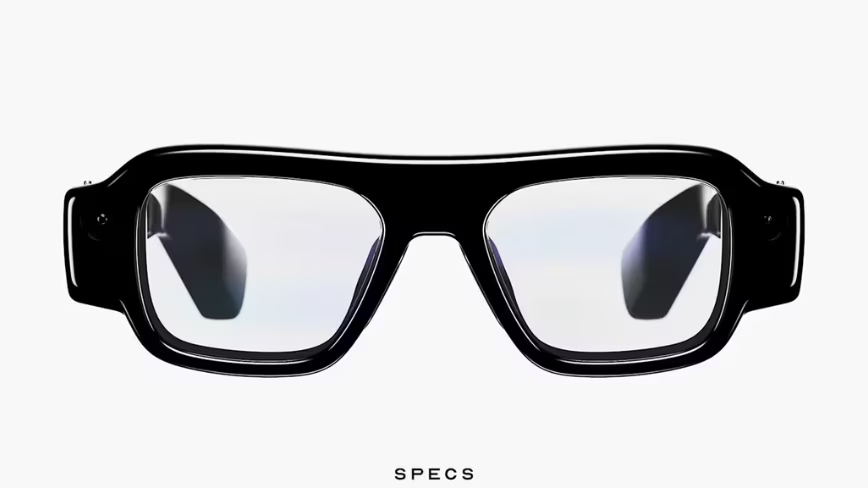
💡Snap's high-stakes entry into consumer AR hardware could redefine the spatial computing landscape for developers.
⚡ 30-Second TL;DR
What Changed
Snap Specs AR glasses are priced at $2,195 with a $200 refundable deposit required for preorders.
Why It Matters
This launch signals a major strategic pivot for Snap toward hardware-integrated spatial computing. It challenges competitors like Meta to prove that high-end AR can achieve mass-market consumer adoption.
What To Do Next
Evaluate the Snap AR SDK documentation if you are building spatial applications to see if it supports cross-platform deployment.
Key Points
- •Snap Specs AR glasses are priced at $2,195 with a $200 refundable deposit required for preorders.
- •The product is positioned as a consumer device rather than a developer-only kit.
- •Initial market availability includes the United States, the United Kingdom, and France.
🧠 Deep Insight
Background and context from public sources — not the original article. 17 sources cited.
🔑 Enhanced Key Takeaways
- •Snap's Specs are fully standalone and wireless, distinguishing them from many current AR display glasses that require a tethered connection to a smartphone or compute puck.
- •The glasses are powered by two Qualcomm Snapdragon processors, with one dedicated to computer vision and the other to running AR experiences, known as 'Lenses,' and managing display, hand tracking, and interactivity.
- •Specs feature electrochromic lenses that can transition from clear to tinted in just 10 seconds, a capability designed to optimize the viewing experience for both indoor and outdoor environments.
- •The device offers a 51-degree diagonal field of view (FOV) and utilizes proprietary Liquid Crystal on Silicon (LCoS) displays, developed in-house, capable of rendering 16 million colors per pixel.
- •Weighing between 132 and 136 grams depending on the frame size, Specs are significantly lighter than previous developer-focused Spectacles, aiming for a more wearable form factor for everyday use.
📊 Competitor Analysis▸ Show
| Feature/Category | Snap Specs | Apple Vision Pro | Meta Ray-Ban Display | Xreal One Pro |
|---|---|---|---|---|
| Pricing | $2,195 (consumer) | Starting at $3,499 (consumer) | $799 (consumer) | $649 (consumer) |
| Form Factor | Standalone AR glasses | Mixed reality headset | Smart glasses (HUD) | Tethered display glasses |
| Field of View (FOV) | 51 degrees diagonal | Unmatched (wide) | 20 degrees (monocular) | 52 degrees diagonal |
| Weight | 132-136 grams | Heavy for long-term wear | 69-70 grams | 80 grams |
| Key Features | Hand tracking, electrochromic lenses, dual Snapdragon processors, Snap OS, AI assistance, 7ms latency | Unmatched resolution & passthrough, best-in-class hand & eye tracking, robust ecosystem | Meta AI with visuals, 12MP camera, 5-mic array | 4K resolution per eye, 3DoF tracking, Google Android XR partnership |
| Battery Life | Up to 4 hours (mixed use), 20 hours with charging case | Not specified (known to be external battery pack) | 6 hours (per charge), 30 hours with case | Tethered (power from connected device) |
🛠️ Technical Deep Dive
- Displays: Proprietary Liquid Crystal on Silicon (LCoS) displays, developed in-house (likely from 2022 Compound Photonics acquisition), capable of displaying 16 million colors per pixel. Resolution is not yet revealed.
- Field of View (FOV): 51 degrees diagonal.
- Processors: Two Qualcomm Snapdragon processors; one dedicated to computer vision, and the other for running Lenses, display, hand tracking, and interactivity.
- Latency: 7-millisecond motion-to-photon latency, designed to make digital content feel anchored in the real world.
- Input: Supports hand tracking for gesture control and voice input.
- Lenses: Electrochromic lenses that can transition from clear to tinted in 10 seconds, offering adaptability for various lighting conditions.
- Frame Material: Crafted from high-performance Swiss TR90 polymer, contributing to its lightweight design.
- Weight: 132 grams for the 47mm frame size and 136 grams for the 51mm frame size.
- Battery Life: Up to 4 hours of mixed-use battery life, extendable to 20 hours with the included charging case.
- Audio: Custom stereo speakers and six high-SNR MEMS microphones.
- Operating System: Runs on Snap OS, Snap's proprietary operating system.
- Developer Tools: Supports a Native Development Kit (NDK) allowing developers to integrate native C and C++ code and libraries into Lenses for advanced spatial mapping, physics, audio, networking, and navigation.
- Manufacturing: Utilizes Snap's in-house custom waveguide manufacturing facility.
🔮 Future ImplicationsAI analysis grounded in cited sources
⏳ Timeline
📎 Sources (17)
Factual claims are grounded in the sources below. Forward-looking analysis is AI-generated interpretation.
Weekly AI Recap
Read this week's curated digest of top AI events →
👉Related Updates
AI-curated news aggregator. All content rights belong to original publishers.
Original source: The Next Web (TNW) ↗
This is a summary, not the original. Read the source, or get the weekly briefing.
Weekly AI briefing
One email a week. Unsubscribe anytime.