🐯虎嗅•Stalecollected in 12m
Slash Token Costs in 1M Context Coding
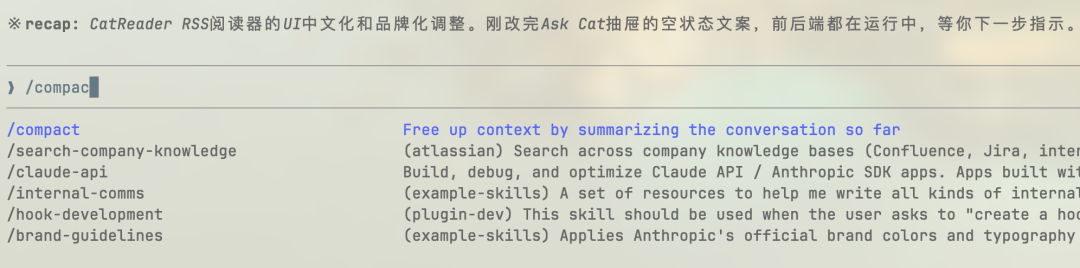
💡1M ctx Coding Agents burn tokens fast—proven session tricks save 50%+ costs
⚡ 30-Second TL;DR
What Changed
Start new sessions for distinct tasks to prevent context pollution.
Why It Matters
Enables sustainable use of long-context LLMs for production coding, reducing costs by avoiding token burnout.
What To Do Next
Apply /compact with 'focus on X module' in your Claude Code sessions today.
Who should care:Developers & AI Engineers
Key Points
- •Start new sessions for distinct tasks to prevent context pollution.
- •Use rewind in Claude Code to erase failed paths while keeping files.
- •Deploy sub-agents for noisy sub-tasks, returning only conclusions.
- •Proactively compact contexts with task-focused instructions.
🧠 Deep Insight
AI-generated analysis for this event.
🔑 Enhanced Key Takeaways
- •Context window management is shifting toward 'RAG-lite' architectures where developers use vector databases to dynamically inject only relevant code snippets into the 1M context, rather than loading entire repositories.
- •The emergence of 'Context Caching' APIs allows developers to store prompt prefixes (like system instructions or core library definitions) at a lower cost, significantly reducing the overhead of repeated 1M token prompts.
- •Token-efficient coding agents are increasingly utilizing 'Chain-of-Thought' (CoT) pruning, where the model is instructed to summarize its internal reasoning steps before outputting the final code to minimize output token consumption.
📊 Competitor Analysis▸ Show
| Feature | Claude 4.x (Anthropic) | DeepSeek V4 | Gemini 1.5 Pro (Google) |
|---|---|---|---|
| Context Window | 1M+ Tokens | 1M+ Tokens | 2M Tokens |
| Context Caching | Supported | Supported | Supported |
| Pricing Model | Tiered Input/Output | High Efficiency/Low Cost | Pay-per-token/Cache-discounted |
🛠️ Technical Deep Dive
- •Context Caching Implementation: Models utilize a KV-cache (Key-Value cache) mechanism where the prefix of a prompt is computed once and stored in GPU memory, allowing subsequent requests to skip redundant attention calculations.
- •Attention Mechanism Optimization: Models with 1M+ context windows typically employ Sparse Attention or FlashAttention-3 to handle the quadratic complexity of long-sequence processing.
- •Sub-agent Orchestration: Implementation often involves a 'Manager' agent that maintains a global state while spawning 'Worker' agents with restricted context windows to prevent token bloat and maintain focus.
🔮 Future ImplicationsAI analysis grounded in cited sources
Context window size will become a secondary metric to 'Context Retrieval Efficiency'.
As models reach 1M+ tokens, the bottleneck shifts from capacity to the latency and cost of retrieving and processing relevant information within that window.
Agentic workflows will replace monolithic prompt engineering.
The complexity of managing 1M tokens exceeds human capability, necessitating autonomous agents that manage their own context lifecycle.
⏳ Timeline
2024-02
Google announces Gemini 1.5 Pro with a 1M token context window, setting the industry standard.
2024-06
Anthropic introduces Claude 3.5 Sonnet, optimizing for coding performance and context handling.
2025-01
DeepSeek releases V3/V4 series, emphasizing cost-efficiency in large-scale context processing.
2026-02
Anthropic launches Claude Code, an agentic tool specifically designed for managing long-context coding sessions.
📰
Weekly AI Recap
Read this week's curated digest of top AI events →
👉Related Updates

AI-curated news aggregator. All content rights belong to original publishers.
Original source: 虎嗅 ↗