🐯虎嗅•Stalecollected in 25m
AI Hardware: GPU to TPU Evolution
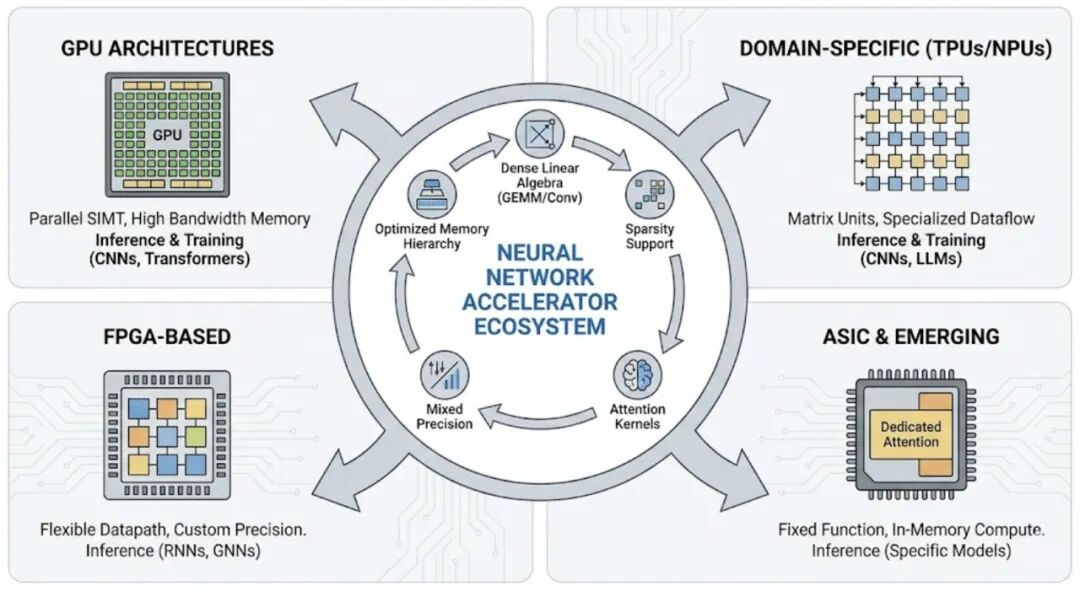
💡Deep dive into GPU/TPU/ASIC tradeoffs optimizes your AI training/inference stack
⚡ 30-Second TL;DR
What Changed
GPU leverages SIMT, deep threading for matrix parallelism and CUDA ecosystem
Why It Matters
Guides hardware selection for AI workloads, highlighting why no universal best—impacts model training costs and inference deployment.
What To Do Next
Benchmark your Transformer model on TPU Pod for KV cache handling improvements.
Who should care:Researchers & Academics
Key Points
- •GPU leverages SIMT, deep threading for matrix parallelism and CUDA ecosystem
- •TPU systolic arrays maximize dense tensor reuse, ideal for CNN but Transformer-challenged
- •ASICs hardwire dataflows for peak efficiency in fixed ops like convolutions
🧠 Deep Insight
AI-generated analysis for this event.
🔑 Enhanced Key Takeaways
- •The emergence of 'Domain-Specific Architectures' (DSAs) has shifted the focus from general-purpose acceleration to hardware-software co-design, where compilers like XLA (Accelerated Linear Algebra) are as critical as the silicon itself for optimizing memory bandwidth.
- •Modern AI hardware is increasingly integrating 'Near-Memory Computing' and High Bandwidth Memory (HBM3e/HBM4) to alleviate the 'memory wall' bottleneck, which often limits performance more severely than raw FLOPs in large-scale Transformer training.
- •The industry is transitioning toward heterogeneous computing clusters where specialized NPUs (Neural Processing Units) handle inference at the edge, while massive-scale training remains anchored to high-TDP GPU/TPU clusters, necessitating unified interconnect standards like CXL (Compute Express Link).
📊 Competitor Analysis▸ Show
| Feature | NVIDIA H200 (GPU) | Google TPU v5p | Groq LPU (ASIC) |
|---|---|---|---|
| Architecture | Hopper (SIMT) | Systolic Array | Tensor Streaming (Dataflow) |
| Primary Strength | Ecosystem/CUDA Versatility | Dense Matrix Throughput | Deterministic Low Latency |
| Memory | 141GB HBM3e | 95GB HBM3 | SRAM-centric (On-chip) |
| Best Use Case | General LLM Training | Large-scale Dense Training | Real-time LLM Inference |
🛠️ Technical Deep Dive
- Systolic Array Mechanics: TPUs utilize a grid of processing elements that pass data directly to neighbors, minimizing register file access and maximizing data reuse for matrix multiplication.
- SIMT (Single Instruction, Multiple Threads): NVIDIA GPUs utilize a warp-based execution model where 32 threads execute the same instruction on different data, optimized for high-throughput parallel floating-point arithmetic.
- Dataflow Architectures: ASICs like Groq's LPU eliminate traditional instruction scheduling overhead by pre-calculating data movement, allowing for deterministic latency in inference tasks.
- Quantization Support: Modern hardware now includes dedicated hardware blocks for FP8 and INT8 arithmetic, significantly increasing throughput for inference without proportional increases in power consumption.
🔮 Future ImplicationsAI analysis grounded in cited sources
Hardware-software co-design will become the primary differentiator over raw transistor count.
As process nodes approach physical limits, performance gains are increasingly derived from compiler-level optimizations and custom dataflow mapping rather than just clock speed.
On-chip SRAM capacity will replace HBM bandwidth as the primary bottleneck for inference.
To achieve real-time latency for massive models, minimizing off-chip memory access via massive on-chip memory buffers is becoming the dominant architectural trend.
⏳ Timeline
2016-05
Google announces the first-generation TPU at Google I/O.
2017-12
NVIDIA introduces the Volta architecture with dedicated Tensor Cores.
2020-05
NVIDIA releases the A100 GPU, standardizing the modern AI training accelerator.
2023-12
Google announces TPU v5p, its most powerful AI accelerator to date.
2024-03
NVIDIA unveils the Blackwell architecture, focusing on massive-scale multi-GPU interconnects.
📰
Weekly AI Recap
Read this week's curated digest of top AI events →
👉Related Updates

AI-curated news aggregator. All content rights belong to original publishers.
Original source: 虎嗅 ↗