Shenzhen Longgang Launches Major 'All in AI' Strategy Upgrade
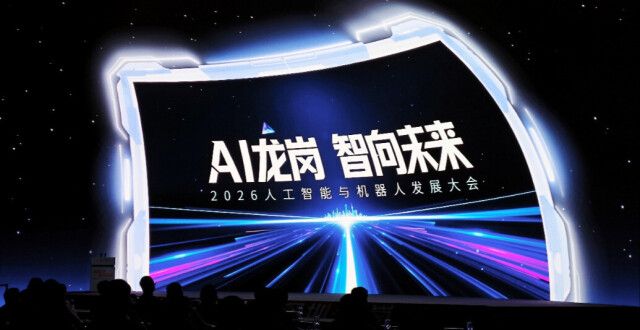
💡Learn how China's top industrial district is mandating 'AI-Native' integration to scale robotics and manufacturing.
⚡ 30-Second TL;DR
What Changed
Longgang District is prioritizing 'AI-Native' development to integrate intelligence into industrial workflows.
Why It Matters
This policy shift signals significant government-backed investment opportunities for AI and robotics startups in Shenzhen. It may lead to new infrastructure grants and industrial pilot programs for companies operating in the region.
What To Do Next
If your company specializes in industrial robotics or AI software, research the specific grant application criteria for the Longgang District AI development fund.
Key Points
- •Longgang District is prioritizing 'AI-Native' development to integrate intelligence into industrial workflows.
- •The strategy emphasizes the convergence of AI and robotics to boost manufacturing efficiency.
- •The initiative aims to establish Longgang as a premier 'AI Power District' within China's industrial landscape.
🧠 Deep Insight
Background and context from public sources — not the original article. 16 sources cited.
🔑 Enhanced Key Takeaways
- •Longgang has launched a "Long Dazi" AI product matrix covering seven major scenarios, including smart manufacturing (LongShift), education (LongTeacher), healthcare (LongDoctor), urban governance (LongAssistant), low-altitude economy (LongFlyer), daily living (LongButler), and cultural tourism (LongGuide), signifying a shift from "AI accompaniment" to "AI-native" integration.
- •The district is actively fostering "One-Person Company" (OPC) development, offering substantial subsidies, free computing resources, data services, office space, and equity investment up to 10 million yuan for seed-stage OPC projects, particularly those leveraging the OpenClaw open-source AI agent platform.
- •Longgang has significantly scaled its computing infrastructure, with nearly 20,000 petaflops (P) of installed computing power and over 50,000P of schedulable social AI computing resources, supporting its two flagship AI clusters: Bantian and Dayun.
- •The "AI Hub Global Smart Hardware Valley," a 20-kilometer smart hardware manufacturing ecosystem, has been established to provide full "one concept in, one product out" lifecycle services for AI startups, guiding them from idea generation to finished hardware products.
📊 Competitor Analysis▸ Show
| Feature/Focus | Shenzhen (Overall) | Longgang District (Shenzhen) | Beijing | Shanghai |
|---|---|---|---|---|
| Primary AI Focus | Manufacturing-oriented AI city, AI clusters based on Huawei Ascend chips, robotics industry, smart terminals. | "AI-Native" and "AI-Robot" integration, "One-Person Company" (OPC) model, OpenClaw agent, smart hardware manufacturing, embodied intelligence. | Core algorithm development, foundational technology R&D, robust talent pool, LLM development. | AI finance and industrial AI platforms. |
| Key Initiatives/Policies | 10 billion yuan AI and robotics industry fund (2025), "AI plus" advanced manufacturing action plan, 100,000 sqm "One Person Company" communities by 2027. | "All in AI" strategy upgrade, "Long Dazi" AI product matrix, "AI Hub Global Smart Hardware Valley," "Ten Lobster Measures" for OpenClaw/OPC, China's first dedicated AI and robotics administration. | Strong emphasis on core algorithm development and foundational technology R&D. | Over 100 policies since 2019, first provincial-level AI regulation, Five-Year Plan for AI. |
| Computing Power | Multiple computing clusters across districts like Nanshan, Bao'an, Longgang, Qianhai. | Nearly 20,000 petaflops (P) installed, over 50,000P schedulable social AI computing resources. | Strong in basic research and LLM development. | Focus on building AI finance and industrial AI platforms. |
| Industry Output/Targets | Core AI industry revenue ~220 billion yuan (2025), projected >10% growth (2026), aims for 1 trillion yuan in smart terminal output by 2026. | Aims for over 100 billion yuan in AI industry output by 2027. | Leads in general algorithms (19.29% market share in 2023). | Aims to surpass US$350 billion in AI core industry scale by 2025, total industry scale expected to reach US$560 billion. |
🛠️ Technical Deep Dive
- AI-Native Development: This core pillar signifies a fundamental shift where AI is embedded as the primary operating paradigm rather than merely an add-on tool. It moves beyond "AI accompaniment" to integrate intelligence directly into industrial workflows and urban governance.
- OpenClaw AI Agent Integration: Longgang's strategy heavily supports the OpenClaw open-source AI agent platform.
- Functionality: OpenClaw connects large language models (LLMs) to real-world tools, enabling autonomous operations such as desktop control, API calls, file management, and execution of multi-step workflows.
- LLM Compatibility: It supports major LLMs, including GPT-4o, Claude, and DeepSeek.
- Platform Integration: OpenClaw integrates with popular messaging applications like WeChat, DingTalk, and Feishu, allowing users to drive AI tasks through natural language chat interfaces.
- Deployment Flexibility: The agent can be deployed both locally and in cloud environments.
- Embodied AI Hardware: The district encourages the integration of OpenClaw with embodied AI hardware, offering subsidies for developers and for the purchase of "Lobster Box" (AI NAS) devices, which are smart storage devices pre-installed with the AI agent for local data processing and enhanced privacy.
🔮 Future ImplicationsAI analysis grounded in cited sources
⏳ Timeline
📎 Sources (16)
Factual claims are grounded in the sources below. Forward-looking analysis is AI-generated interpretation.
Weekly AI Recap
Read this week's curated digest of top AI events →
👉Related Updates

AI-curated news aggregator. All content rights belong to original publishers.
Original source: Pandaily ↗
This is a summary, not the original. Read the source, or get the weekly briefing.
The weekly digest
One email a week. Unsubscribe anytime.