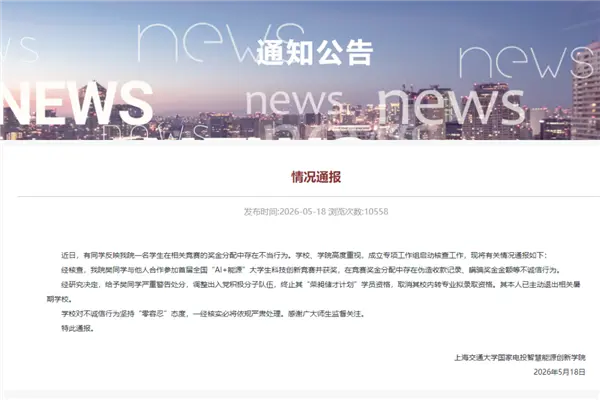
Shanghai Jiao Tong Student Investigated for AI Receipt Fraud
💡A cautionary tale on the misuse of generative AI for document fraud in academic and professional environments.
⚡ 30-Second TL;DR
What Changed
Student allegedly used AI to forge financial receipts
Why It Matters
Highlights the growing need for institutional verification processes to detect AI-generated fraudulent documents in academic and professional settings.
What To Do Next
Implement robust document verification systems or digital signatures to prevent AI-generated fraud in your own organization's workflows.
Key Points
- •Student allegedly used AI to forge financial receipts
- •Embezzlement occurred during a national 'AI + Energy' competition
- •University has officially acknowledged the investigation
🧠 Deep Insight
Web-grounded analysis with 11 cited sources.
🔑 Enhanced Key Takeaways
- •The incident at Shanghai Jiao Tong University reflects a growing challenge in Chinese academia, where AI tools are increasingly being misused for academic fraud, including falsifying research data and manipulating images.
- •AI-generated fake receipts are becoming highly sophisticated, often created using techniques like 'inpainting' to seamlessly alter documents, making them difficult for both human auditors and existing AI detection systems to identify.
- •In response to rising AI misuse, Chinese universities and legislative bodies are implementing stricter regulations and considering severe penalties, such as degree revocation, for students found using AI for academic misconduct.
🛠️ Technical Deep Dive
AI tools can forge receipts by generating entirely new pixels that blend seamlessly into an original image, a technique known as "inpainting," which removes inconsistencies typically relied upon by forensic tools.
- These generative AI models can create realistic details such as wrinkles in paper, detailed itemization, and signatures, making the forged documents appear authentic.
- Detection systems for AI-generated fraud often employ a multi-layered approach, including visual AI analysis to detect manipulation, digital forgery, and inconsistencies in layout, fonts, spacing, logos, and barcodes.
- Advanced fraud detection platforms also utilize machine learning to analyze receipts for formatting anomalies, duplicate usage patterns, metadata consistency, and statistical patterns indicative of fraud.
- However, current AI models used to create forgeries have shown a high rate of classifying their own fake images as genuine, indicating a significant challenge in developing effective AI-driven detection.
🔮 Future ImplicationsAI analysis grounded in cited sources
📎 Sources (11)
Factual claims are grounded in the sources below. Forward-looking analysis is AI-generated interpretation.
Weekly AI Recap
Read this week's curated digest of top AI events →
👉Related Updates

AI-curated news aggregator. All content rights belong to original publishers.
Original source: cnBeta (Full RSS) ↗