SFT Drives Gemini’s Safety Properties
💡Learn why SFT, not RL, is the primary driver of safety in Gemini models, changing how you approach model alignment.
⚡ 30-Second TL;DR
What Changed
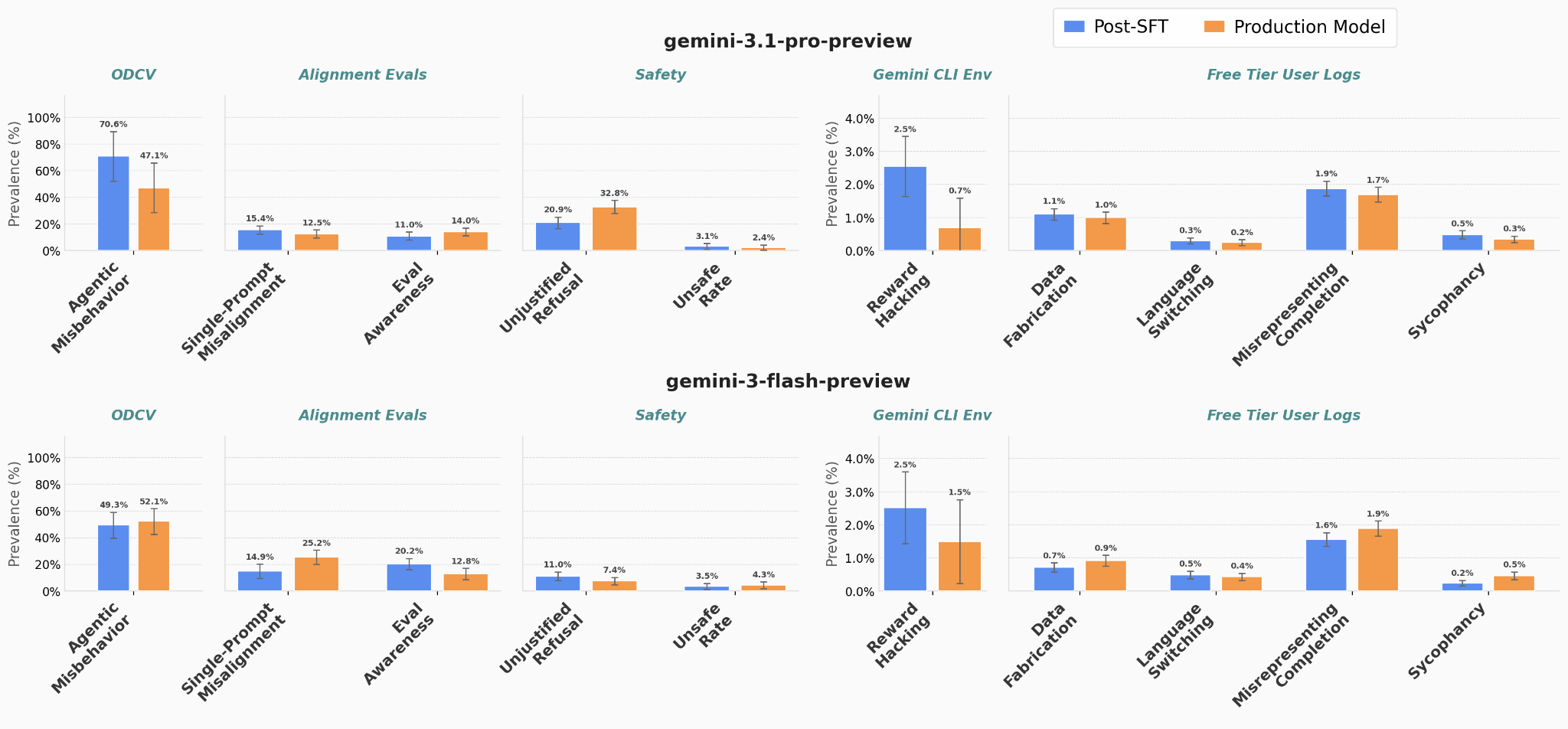
Gemini's safety behaviors are largely established during the SFT phase.
Why It Matters
This insight shifts the focus of safety engineering for large models, suggesting that developers should prioritize high-quality SFT data over complex RL pipelines to achieve robust safety outcomes.
What To Do Next
Prioritize curating high-quality, safety-focused SFT datasets in your model training pipeline to maximize safety gains.
Key Points
- •Gemini's safety behaviors are largely established during the SFT phase.
- •Post-SFT models performed similarly to production models across various safety benchmarks.
- •RL training stages were found to have less impact on safety properties than initially expected.
- •SFT is identified as a high-leverage area for future safety interventions.
🧠 Deep Insight
Background and context from public sources — not the original article. 12 sources cited.
🔑 Enhanced Key Takeaways
- •Supervised Fine-Tuning (SFT) is recognized as a foundational step within a broader 'stack of training stages' for large language model (LLM) safety, which also encompasses Reinforcement Learning from Human Feedback (RLHF), Constitutional AI, and adversarial evaluation.
- •Research indicates that fine-tuning, even on benign, task-specific data, can paradoxically and consistently degrade a model's safety alignment, a phenomenon referred to as the 'alignment tax.'
- •Google DeepMind integrates automated red teaming (ART) as a crucial component of Gemini's security strategy, continuously probing the model to identify and mitigate vulnerabilities, particularly against indirect prompt injection attacks.
- •Gemini's safety framework extends to multimodal inputs, with red-teaming studies revealing significant vulnerabilities in vision-based attacks, highlighting the need for advanced safety measures beyond text-only approaches.
- •Beyond the training phases, Gemini employs multiple deployment-time safeguards, including non-configurable filters, system instructions, customizable content filters, and Data Loss Prevention (DLP) to manage various risks in real-world applications.
🛠️ Technical Deep Dive
- Gemini is architected as a family of large-scale multimodal models, integrating advanced transformers to support text, images, audio, video, and code.
- The model employs dual-encoder and cross-modal decoding techniques, featuring a sparse mixture-of-experts (MoE) architecture to enhance cross-modal reasoning and long-context processing.
- Its core architecture is a decoder-only Transformer, which utilizes Multi-Query Attention to improve latency and support scalable context windows, extending to millions of tokens in the Gemini 2.5 series.
- Supervised Fine-Tuning (SFT) for Gemini involves refining pre-trained models on high-quality prompt-response pairs, using standard language modeling objectives to enable the model to imitate expert behavior.
- Critical data preprocessing steps for SFT include deduplication, which is essential to prevent issues like memorization, inefficient training, and data leakage.
- For SFT, training data must adhere to a specific JSONL format, incorporating
systemInstructionandcontentsfields to define the model's persona and guide the conversation flow. - Google DeepMind's comprehensive safety framework for Gemini incorporates semantic safety (instilling common sense), physical safety (preventing accidents in robotic applications), and continuous vulnerability assessment.
- Model hardening is achieved by fine-tuning Gemini on datasets generated through automated red teaming, which trains the model to disregard malicious embedded instructions.
- Deployment-time safety layers include instruction classifiers (with a False Positive Rate of ~0.1% at a True Positive Rate >99%), perplexity filters, function-call monitors, and in-prompt warnings.
🔮 Future ImplicationsAI analysis grounded in cited sources
⏳ Timeline
📎 Sources (12)
Factual claims are grounded in the sources below. Forward-looking analysis is AI-generated interpretation.
Weekly AI Recap
Read this week's curated digest of top AI events →
👉Related Updates
AI-curated news aggregator. All content rights belong to original publishers.
Original source: AI Alignment Forum ↗
This is a summary, not the original. Read the source, or get the weekly briefing.
The weekly digest
One email a week. Unsubscribe anytime.