Serve Robotics Becomes US Delivery’s Robot Layer
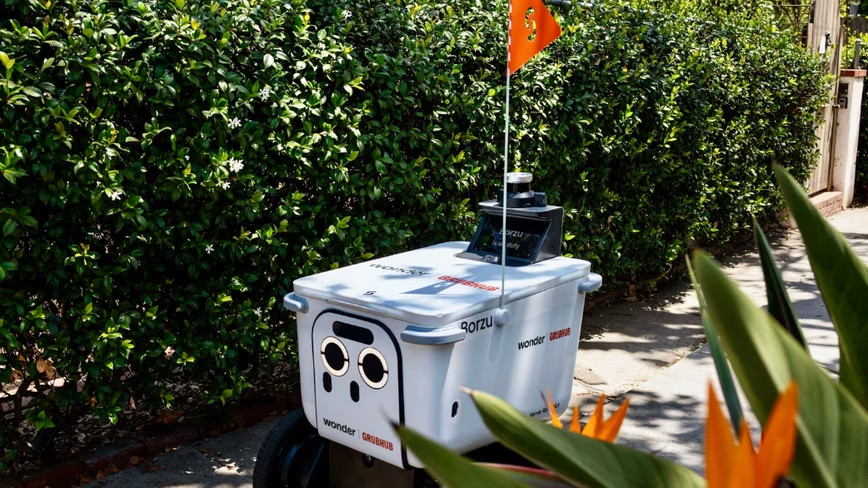
💡Serve’s Grubhub deal shows how one robot fleet could serve multiple US delivery platforms.
⚡ 30-Second TL;DR
What Changed
Grubhub is joining Serve Robotics’ delivery-partner network.
Why It Matters
A shared robot network could improve utilization and make autonomous delivery more scalable across multiple ordering platforms. For AI and robotics builders, the partnership also demonstrates the importance of platform interoperability, fleet operations, and real-world deployment density.
What To Do Next
Prototype a delivery-platform adapter around Serve Robotics’ partner integration model, focusing on order dispatch, fleet status, routing, and exception handling.
Key Points
- •Grubhub is joining Serve Robotics’ delivery-partner network.
- •The partnership is structured through Wonder, Grubhub’s parent company.
- •Serve’s cooler-sized sidewalk robots will carry Grubhub takeaway orders.
- •The deal positions Serve as shared infrastructure for US food-delivery robotics.
🧠 Deep Insight
AI-generated analysis for this event.
🔑 Enhanced Key Takeaways
- •Serve Robotics went public via a reverse merger with a Special Purpose Acquisition Company (SPAC) in 2024, trading on the Nasdaq under the ticker symbol SERV.
- •The partnership with Wonder is strategically significant because Wonder acquired Grubhub from Just Eat Takeaway in 2025, consolidating delivery operations under a new integrated platform.
- •Serve Robotics maintains a long-standing commercial agreement with Uber Eats, which remains a primary investor and partner alongside the new Grubhub integration.
- •The company utilizes NVIDIA's Jetson edge AI platform to power its robots' onboard perception and navigation systems, enabling real-time obstacle avoidance.
- •Serve Robotics has focused its operational footprint primarily in dense urban environments like Los Angeles, where it has logged thousands of hours of autonomous delivery data.
📊 Competitor Analysis▸ Show
| Feature | Serve Robotics | Starship Technologies | Kiwibot |
|---|---|---|---|
| Primary Market | US Urban Centers | University Campuses/Europe | University Campuses |
| Navigation | NVIDIA Jetson/LiDAR | Computer Vision/GPS | GPS/Computer Vision |
| Business Model | Platform-as-a-Service | Direct Fleet Operations | Leasing/Managed Services |
| Scale | High-density urban focus | Global/Campus dominant | Campus/Small-scale urban |
🛠️ Technical Deep Dive
- Navigation System: Employs a multi-modal sensor suite including LiDAR, ultrasonic sensors, and multiple cameras for 360-degree situational awareness.
- Compute Architecture: Powered by NVIDIA Jetson modules, allowing for low-latency inference of deep learning models for pedestrian detection and path planning.
- Autonomy Level: Operates at SAE Level 4 autonomy in designated geofenced areas, with remote human intervention capabilities for edge cases.
- Chassis Design: Features a modular, temperature-controlled cargo bay designed to maintain food quality during transit.
- Connectivity: Utilizes 5G cellular networks for real-time telemetry, remote monitoring, and fleet management communication.
🔮 Future ImplicationsAI analysis grounded in cited sources
⏳ Timeline
Weekly AI Recap
Read this week's curated digest of top AI events →
👉Related Updates


AI-curated news aggregator. All content rights belong to original publishers.
Original source: The Next Web (TNW) ↗