Gravis Robotics Raises Record $200M
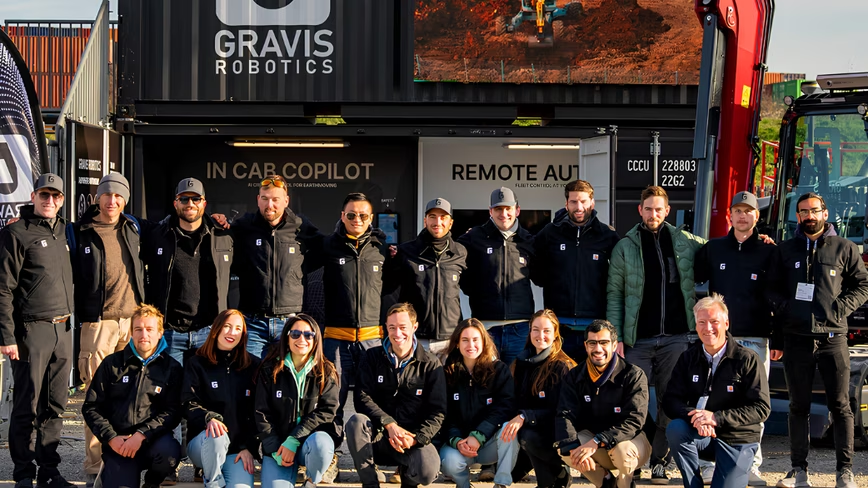
💡A record funding round highlights where embodied AI is heading beyond warehouses and cars.
⚡ 30-Second TL;DR
What Changed
SoftBank led Gravis Robotics’ $200 million Series A.
Why It Matters
The investment signals strong confidence in embodied AI for heavy construction equipment. It could accelerate deployment of autonomous machinery in dangerous, labor-intensive worksites while increasing competition among industrial robotics startups.
What To Do Next
Evaluate Gravis Robotics’ autonomy stack and construction-site integration requirements if you are building perception, planning, or control systems for heavy equipment.
Key Points
- •SoftBank led Gravis Robotics’ $200 million Series A.
- •The company builds software for autonomous excavators and diggers.
- •Gravis Robotics was founded in 2022 as an ETH Zurich spinout.
- •The round is billed as the largest ever in construction robotics.
🧠 Deep Insight
AI-generated analysis for this event.
🔑 Enhanced Key Takeaways
- •Gravis Robotics utilizes a proprietary 'digital twin' simulation environment that allows their autonomous systems to learn complex earth-moving tasks in virtual space before deployment.
- •The company's technology stack is designed to be hardware-agnostic, enabling retrofitting onto existing heavy machinery from major OEMs like Caterpillar and Komatsu rather than requiring custom-built robots.
- •The Series A funding will be specifically allocated to scaling their 'Gravis Core' software platform and expanding operations into the North American market, where labor shortages in construction are most acute.
- •Gravis Robotics has established strategic partnerships with several major European construction firms to conduct long-term field testing in real-world, unstructured environments.
- •The company's leadership team includes former researchers from the Autonomous Systems Lab at ETH Zurich, focusing on computer vision and path planning for heavy-duty industrial applications.
📊 Competitor Analysis▸ Show
| Feature | Gravis Robotics | Built Robotics | SafeAI |
|---|---|---|---|
| Primary Approach | Hardware-agnostic software retrofit | Exoskeleton/kit-based autonomy | Autonomous haulage systems |
| Target Machinery | Excavators & Diggers | Excavators & Trenchers | Mining Haul Trucks |
| Deployment Focus | General Construction | Solar/Infrastructure | Mining & Quarrying |
| Key Differentiator | Advanced digital twin simulation | Established field deployment | Heavy-duty fleet management |
🛠️ Technical Deep Dive
- Utilizes deep reinforcement learning (DRL) for adaptive control of hydraulic actuators in varying soil conditions.
- Employs multi-modal sensor fusion combining LiDAR, stereo cameras, and GNSS for centimeter-level positioning accuracy.
- Implements a safety-critical middleware layer that enforces geofencing and obstacle detection with sub-100ms latency.
- Features a cloud-based fleet management interface that provides real-time telemetry and remote intervention capabilities.
🔮 Future ImplicationsAI analysis grounded in cited sources
⏳ Timeline
Weekly AI Recap
Read this week's curated digest of top AI events →
👉Related Updates



AI-curated news aggregator. All content rights belong to original publishers.
Original source: The Next Web (TNW) ↗