🐼Pandaily•Freshcollected in 18m
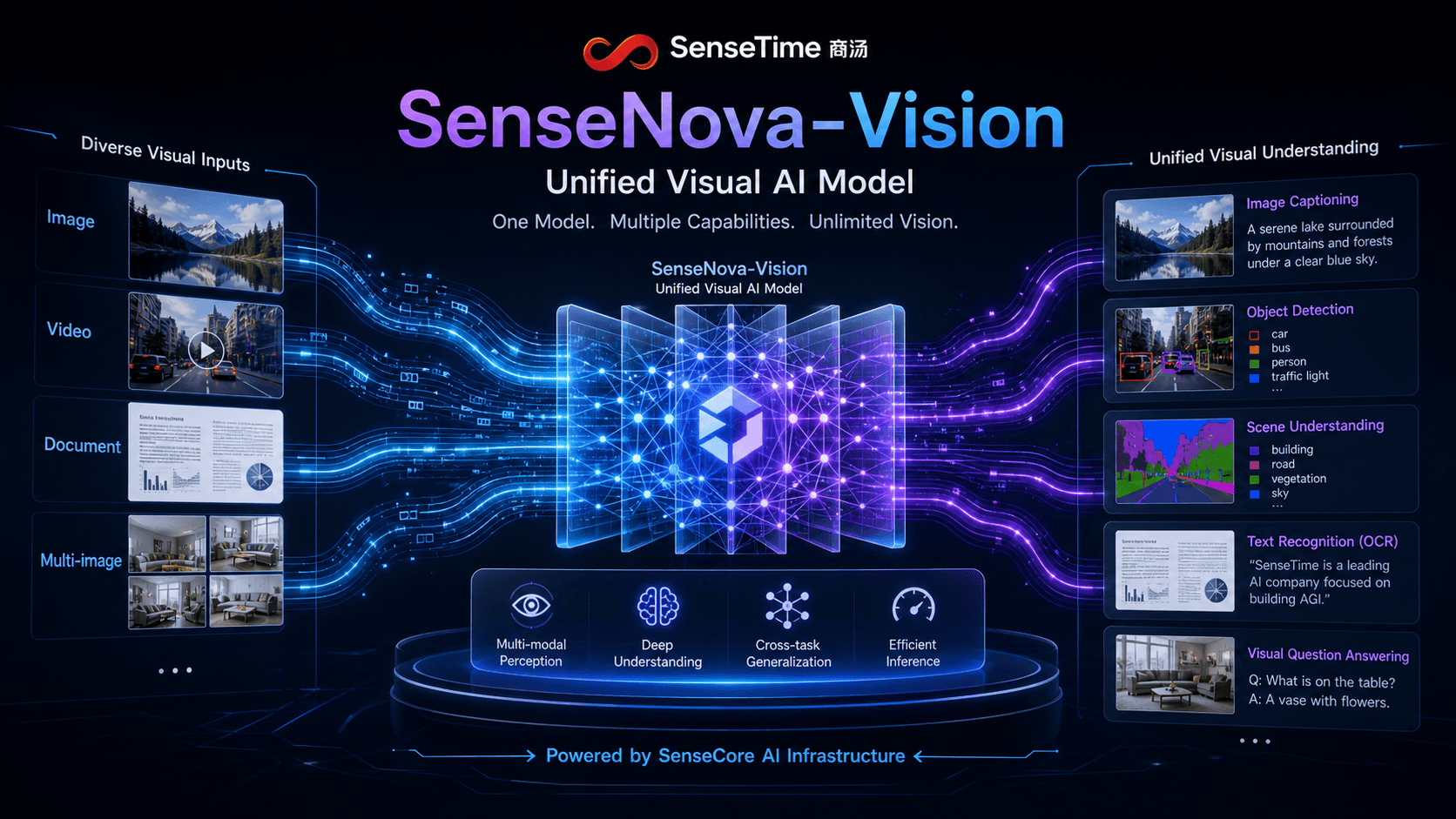
SenseTime Releases Unified Vision Model SenseNova-Vision
💡A unified vision model topping HuggingFace leaderboards could replace your fragmented computer vision stack.
⚡ 30-Second TL;DR
What Changed
Unifies multiple computer vision tasks into a single model architecture
Why It Matters
This unified approach reduces the complexity of maintaining separate pipelines for different vision tasks, potentially lowering inference costs and development overhead.
What To Do Next
Visit the HuggingFace repository to benchmark SenseNova-Vision against your current specialized vision pipelines.
Who should care:Developers & AI Engineers
Key Points
- •Unifies multiple computer vision tasks into a single model architecture
- •Supports detection, segmentation, depth prediction, and 3D reconstruction
- •Achieved top ranking on the HuggingFace Any-to-Any leaderboard
🧠 Deep Insight
AI-generated analysis for this event.
🔑 Enhanced Key Takeaways
- •SenseNova-Vision utilizes a novel 'Any-to-Any' tokenization strategy that converts diverse visual outputs into a unified sequence format, enabling cross-task learning.
- •The model architecture is built upon a foundation of SenseTime's proprietary large-scale visual pre-training, leveraging billions of image-text pairs for enhanced zero-shot generalization.
- •SenseNova-Vision incorporates a dynamic prompt-tuning mechanism that allows users to switch between tasks like 3D reconstruction and segmentation without requiring task-specific model weights.
- •The open-source release includes a lightweight version optimized for edge deployment, specifically targeting autonomous driving and robotics applications.
- •The model demonstrates significant reduction in computational overhead by sharing a common visual encoder across all supported vision tasks, compared to traditional multi-model pipelines.
📊 Competitor Analysis▸ Show
| Feature | SenseNova-Vision | Meta Segment Anything (SAM 2) | Google Unified-IO 2 |
|---|---|---|---|
| Primary Focus | Unified Vision/3D | Segmentation | Any-to-Any Modality |
| 3D Reconstruction | Native Support | Limited | Limited |
| Open Source | Yes | Yes | Yes |
| HuggingFace Rank | #1 (Any-to-Any) | High (Segmentation) | High (Multimodal) |
🛠️ Technical Deep Dive
- Architecture: Employs a Transformer-based backbone with a unified tokenization layer that maps heterogeneous visual outputs (masks, depth maps, point clouds) into a shared latent space.
- Training Strategy: Utilizes a multi-task objective function that balances loss across detection, segmentation, and 3D reconstruction tasks simultaneously.
- Inference: Supports dynamic task switching via task-specific prompt tokens, allowing the model to adapt to different visual queries without re-initialization.
- Optimization: Implements model distillation techniques to compress the unified architecture for deployment on resource-constrained hardware.
🔮 Future ImplicationsAI analysis grounded in cited sources
Unified vision models will replace specialized pipelines in autonomous driving systems by 2027.
The ability to perform detection, depth prediction, and 3D reconstruction in a single pass significantly reduces latency and hardware requirements for real-time navigation.
SenseNova-Vision will trigger a shift toward 'Generalist' vision models in the open-source community.
By demonstrating top-tier performance on the Any-to-Any leaderboard, the model provides a new benchmark that prioritizes task versatility over single-task accuracy.
⏳ Timeline
2023-04
SenseTime officially launches the SenseNova foundation model series.
2024-07
SenseTime upgrades SenseNova to version 5.0, focusing on multimodal capabilities.
2026-07
SenseTime releases SenseNova-Vision as an open-source unified vision model.
📰
Weekly AI Recap
Read this week's curated digest of top AI events →
👉Related Updates
AI-curated news aggregator. All content rights belong to original publishers.
Original source: Pandaily ↗