Secure OAuth Code Flow for AgentCore Gateway MCP Clients
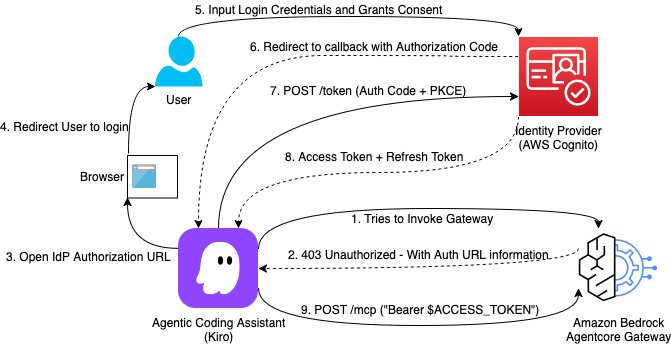
💡Learn how to secure your AI agent infrastructure by implementing standard OAuth flows for MCP clients.
⚡ 30-Second TL;DR
What Changed
Implement OAuth Code flow as an inbound auth mechanism for MCP servers
Why It Matters
This integration allows enterprises to enforce strict identity management for AI agents, reducing the risk of unauthorized access in production environments.
What To Do Next
Review your organization's identity provider configuration and follow the guide to map user identity tokens to your AgentCore Gateway MCP endpoints.
Key Points
- •Implement OAuth Code flow as an inbound auth mechanism for MCP servers
- •Integrate with organization-specific identity providers for user verification
- •Ensure production-ready security for AI assistant interactions on Amazon Bedrock
🧠 Deep Insight
Background and context from public sources — not the original article. 20 sources cited.
🔑 Enhanced Key Takeaways
- •The OAuth 2.0 Authorization Code flow, supported by Amazon Bedrock AgentCore Identity, allows AI agents to securely access protected Model Context Protocol (MCP) servers and other resources on behalf of a user, eliminating the need to embed credentials in application code or manually manage token lifecycles.
- •AgentCore Gateway acts as a centralized MCP tool server, unifying access to various tool types including Lambda functions, OpenAPI specifications, Smithy models, and existing MCP servers, while handling authentication, request routing, and protocol translation.
- •Beyond user authentication, AgentCore Identity also supports machine-to-machine authentication (OAuth 2.0 client credentials grant) and on-behalf-of token exchange, providing flexible authentication patterns for diverse AI agent use cases.
- •The security architecture for AI agents on Bedrock involves multiple layers, including fine-grained access control with AWS IAM, content filtering with Amazon Bedrock Guardrails, and encryption of agent session data and custom models using AWS KMS Customer Managed Keys (CMKs).
- •AgentCore Gateway integrates with existing network architectures, supporting managed VPC resource mode to connect to private endpoints (like internal APIs or databases) without exposing them to the public internet, by provisioning Elastic Network Interfaces (ENIs) within the customer's VPC.
📊 Competitor Analysis▸ Show
A Markdown table comparing this with competitors (Feature/Pricing/Benchmarks). Return null if not applicable (e.g. op-ed, interview, single-product announcement with no clear competitors).
🛠️ Technical Deep Dive
- Model Context Protocol (MCP): A protocol designed to standardize the interaction between an AI 'host/client' and external systems that provide tools and context. An MCP server exposes these capabilities.
- AgentCore Gateway Functionality: Transforms existing REST APIs (OpenAPI, Smithy) and AWS Lambda functions into MCP-compatible tools. It handles authentication, request routing, and protocol translation between MCP and the target APIs.
- Inbound Authentication: For MCP servers, the OAuth 2.0 Authorization Code flow is implemented via Amazon Bedrock AgentCore Identity. This involves AgentCore Identity generating an authorization URL, the user granting consent, and AgentCore Identity fetching and storing the access token in a Token Vault.
- Session Binding: To prevent token hijacking, the system verifies that the user who initiates an authorization request is the same user who grants consent, using a registered HTTPS application endpoint for verification.
- Credential Storage: Access tokens obtained through OAuth 2.0 flows are securely stored in the AgentCore Identity Token Vault, encrypted using AWS Key Management Service (AWS KMS) keys, with support for customer-managed keys.
- Multi-tenancy Support: AgentCore Gateway validates JWTs using AgentCore Identity, extracts tenant context, routes tool calls to pooled backend resources, and enforces tool-level isolation through tenant-scoped credentials and configuration.
- VPC Egress: AgentCore Gateway supports connecting to private endpoints within a customer's VPC using a managed VPC resource mode. This provisions Elastic Network Interfaces (ENIs) directly inside the Amazon VPC, routing traffic through a Resource Gateway that remains within the AWS network.
- Policy and Lambda Interceptors: AgentCore Gateway allows for layered security using Policy for deterministic access control and Lambda interceptors for dynamic validation, payload enrichment, token exchange, and response filtering.
- IAM Integration: Amazon Bedrock and AgentCore integrate deeply with AWS Identity and Access Management (IAM) for fine-grained, least-privilege access control to models, agents, and underlying AWS resources. Dedicated IAM roles per agent are recommended.
🔮 Future ImplicationsAI analysis grounded in cited sources
⏳ Timeline
📎 Sources (20)
Factual claims are grounded in the sources below. Forward-looking analysis is AI-generated interpretation.
Weekly AI Recap
Read this week's curated digest of top AI events →
👉Related Updates
AI-curated news aggregator. All content rights belong to original publishers.
Original source: AWS Machine Learning Blog ↗
This is a summary, not the original. Read the source, or get the weekly briefing.
The weekly digest
One email a week. Unsubscribe anytime.