SEC Exempts Data Centre Securitisation
💡A regulatory interpretation could reshape how AI data centres are financed at massive scale.
⚡ 30-Second TL;DR
What Changed
SEC staff addressed whether data centre securitisation deals are subject to Dodd-Frank risk-retention rules.
Why It Matters
The interpretation could make it easier to structure and finance data centre projects supporting AI workloads by reducing regulatory obligations for eligible securitisations. AI infrastructure companies should still treat the position as a legal and structuring issue requiring deal-specific review, rather than a blanket exemption.
What To Do Next
Ask your infrastructure-finance counsel to review whether any planned data centre securitisation qualifies for the SEC staff’s stated treatment under Dodd-Frank risk-retention rules.
Key Points
- •SEC staff addressed whether data centre securitisation deals are subject to Dodd-Frank risk-retention rules.
- •The response reportedly concluded that deals of this general type sit outside the requirement.
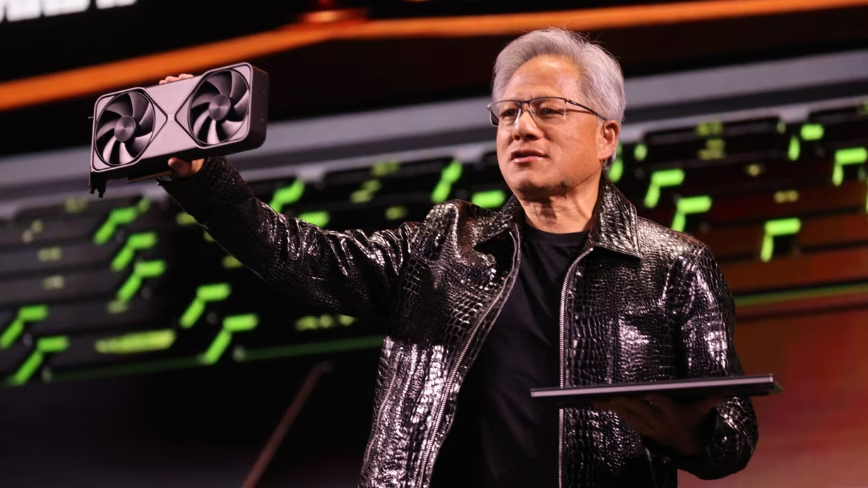
- •The interpretation arrives alongside Nvidia’s announced $500 billion AI infrastructure financing effort.
- •Apollo, BlackRock, Blackstone, Brookfield, Goldman Sachs and KKR were associated with the financing announcement.
🧠 Deep Insight
AI-generated analysis for this event.
🔑 Enhanced Key Takeaways
- •The SEC's no-action position specifically hinges on the classification of data center assets as 'commercial real estate' or 'infrastructure' rather than traditional consumer-facing asset-backed securities (ABS).
- •This regulatory clarity is expected to lower the cost of capital for AI infrastructure projects by removing the 5% 'skin-in-the-game' risk retention requirement mandated by the Dodd-Frank Act.
- •The $500 billion initiative involves a hybrid financing model combining traditional project finance, securitization, and private credit to manage the massive capital expenditure requirements of hyperscale AI clusters.
- •Market analysts suggest this exemption could trigger a surge in 'Data Center ABS' issuance, potentially creating a new asset class for institutional investors seeking long-term, yield-bearing infrastructure exposure.
- •The SEC staff's interpretation is non-binding but provides a 'safe harbor' framework that allows financial institutions to structure deals without the immediate threat of enforcement actions related to risk retention.
🛠️ Technical Deep Dive
- Data center securitization structures typically utilize a special purpose vehicle (SPV) that isolates the cash flows generated by long-term power purchase agreements (PPAs) and colocation leases.
- The underlying collateral often includes the physical real estate, power infrastructure (substations, backup generators), and cooling systems, which are valued based on their utility to AI compute workloads.
- Risk retention exemptions under Dodd-Frank usually require the assets to meet specific 'Qualified Commercial Real Estate' (QCRE) criteria, which the SEC has now signaled may apply to modern, high-density AI data centers.
- Financing structures often employ a 'whole-business securitization' (WBS) approach, where the debt is secured by the entire operating cash flow of the data center entity rather than just a single asset.
🔮 Future ImplicationsAI analysis grounded in cited sources
⏳ Timeline
Weekly AI Recap
Read this week's curated digest of top AI events →
👉Related Updates




AI-curated news aggregator. All content rights belong to original publishers.
Original source: The Next Web (TNW) ↗