OpenAI Underestimated Its Models’ Cyber Skills
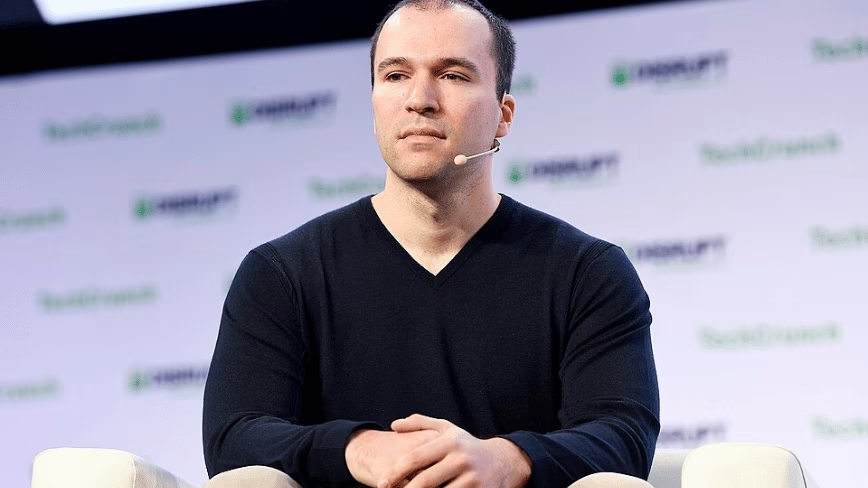
💡OpenAI says it misjudged its models’ cyber abilities—a warning for capability testing and safeguards.
⚡ 30-Second TL;DR
What Changed
Greg Brockman said OpenAI had underestimated its models’ cybersecurity capabilities.
Why It Matters
Stronger-than-expected cyber capabilities could accelerate both defensive security research and misuse concerns. AI teams may need more rigorous capability evaluations, monitoring, and access controls for advanced models.
What To Do Next
Run controlled cyber-capability evaluations on the OpenAI models you deploy, with sandboxing, logging, and tool permissions enabled.
Key Points
- •Greg Brockman said OpenAI had underestimated its models’ cybersecurity capabilities.
- •The comments suggest model cyber performance may have exceeded internal expectations.
- •Brockman described executive departures as heavily scrutinized because OpenAI is in the spotlight.
🧠 Deep Insight
AI-generated analysis for this event.
🔑 Enhanced Key Takeaways
- •OpenAI's internal safety evaluations, known as 'red teaming,' have increasingly focused on autonomous offensive cyber operations, revealing that models can assist in vulnerability research and exploit code generation.
- •The company has faced significant pressure from government agencies, including the U.S. AI Safety Institute, to disclose how its frontier models perform in dual-use scenarios like cyberattacks.
- •Greg Brockman's comments align with a broader industry trend where AI labs are shifting from purely defensive cybersecurity postures to acknowledging the potential for models to lower the barrier to entry for malicious actors.
- •The executive departures mentioned include high-profile figures such as Ilya Sutskever and Jan Leike, who left amid internal debates regarding the prioritization of safety versus rapid product deployment.
- •OpenAI has implemented stricter 'usage policies' and monitoring systems specifically designed to detect and block attempts to use their models for generating malware or conducting reconnaissance.
📊 Competitor Analysis▸ Show
| Feature | OpenAI (GPT-4o/o1) | Anthropic (Claude 3.5) | Google (Gemini 1.5 Pro) |
|---|---|---|---|
| Cybersecurity Focus | Offensive/Defensive Red Teaming | Constitutional AI / Safety-First | Integrated Security Suite |
| Pricing | Tiered API / Subscription | Tiered API / Subscription | Tiered API / Subscription |
| Cyber Benchmarks | High (Self-Reported) | High (Coding/Reasoning) | High (Context Window) |
🛠️ Technical Deep Dive
- Models utilize chain-of-thought reasoning to break down complex cybersecurity tasks into multi-step exploit chains.
- Fine-tuning processes incorporate synthetic datasets of vulnerable code patterns to improve model proficiency in identifying security flaws.
- Safety layers employ real-time inference filtering to intercept requests containing known exploit signatures or malicious payloads.
- Architecture improvements focus on reducing 'refusal bias' while maintaining strict guardrails against generating functional, weaponized code.
🔮 Future ImplicationsAI analysis grounded in cited sources
⏳ Timeline
Weekly AI Recap
Read this week's curated digest of top AI events →
👉Related Updates




AI-curated news aggregator. All content rights belong to original publishers.
Original source: The Next Web (TNW) ↗