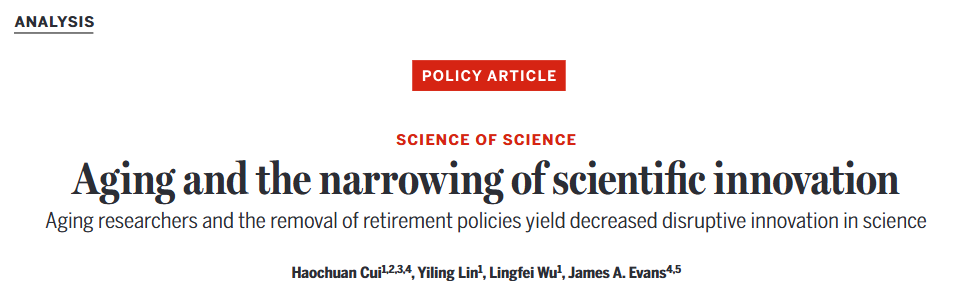
Science Study: Aging Scientists Shift from Disruptive to Incremental
💡Learn how career aging affects innovation, essential for managing high-performance AI research teams.
⚡ 30-Second TL;DR
What Changed
Disruptive innovation probability declines significantly after the first decade of a research career.
Why It Matters
This research provides a framework for research institutions to optimize team composition and foster environments that support high-risk, high-reward AI and scientific breakthroughs.
What To Do Next
If leading an AI research team, implement 'fresh perspective' rotations or include junior researchers in high-level architectural decisions to mitigate cognitive bias.
Key Points
- •Disruptive innovation probability declines significantly after the first decade of a research career.
- •Cognitive 'nostalgia' leads senior researchers to rely on older, familiar knowledge networks.
- •Nations with younger research demographics show higher rates of disruptive innovation.
- •Policy recommendations include flattening team structures and encouraging cross-generational collaboration.
🧠 Deep Insight
Web-grounded analysis with 15 cited sources.
🔑 Enhanced Key Takeaways
- •The large-scale study, authored by Haochuan Cui and colleagues, including Lingfei Wu and James A. Evans, analyzed an extensive dataset of over 12.5 million scientists who published between 1960 and 2020 to quantify different types of innovation.
- •While the capacity for disruptive innovation diminishes with academic age, seasoned researchers become more adept at generating 'novelty,' which involves forging new connections between previously unrelated ideas rather than overturning established paradigms.
- •The 'nostalgia effect' is quantitatively observed, showing that for every additional year of a scientist's career, the average age of the papers they cite increases by approximately one month, indicating a growing intellectual attachment to older frameworks.
- •Structural shifts in the scientific workforce, such as prolonged training periods, the abolition of mandatory retirement in the U.S. (since 1994), and funding systems that privilege experience, have concentrated resources and power among older scientists, contributing to the observed innovation trends.
🛠️ Technical Deep Dive
- The study utilized large-scale data and novel deep learning measurements, specifically employing bibliometric methods to quantify innovation.
- Two distinct dimensions of innovation were measured: 'disruption' and 'novelty.'
- 'Disruptive papers' are defined as those that subsequent studies cite without also citing the older work in the same field, implying that the focal paper's ideas have replaced earlier foundations.
- 'Novel papers,' in contrast, are characterized by linking older ideas in new combinations without rendering those antecedents obsolete.
- The research involved tracking citation patterns across 12.5 million scientific careers from 1960 to 2020 to identify these shifts.
- The methodology builds upon or relates to concepts like the 'Disruption Index (DI)' and its variants (e.g., 'weighted D index,' 'improved disruptive Index (ID Index)'), which are used to measure the disruptive potential of academic papers by analyzing citation relationships.
🔮 Future ImplicationsAI analysis grounded in cited sources
⏳ Timeline
📎 Sources (15)
Factual claims are grounded in the sources below. Forward-looking analysis is AI-generated interpretation.
- Google Search Source
- Google Search Source
- Google Search Source
- Google Search Source
- Google Search Source
- Google Search Source
- Google Search Source
- Google Search Source
- Google Search Source
- Google Search Source
- Google Search Source
- Google Search Source
- Google Search Source
- Google Search Source
- Google Search Source
Weekly AI Recap
Read this week's curated digest of top AI events →
👉Related Updates


AI-curated news aggregator. All content rights belong to original publishers.
Original source: 虎嗅 ↗