Science is aging: Innovation narrowing in academia
💡Learn how academic 'gatekeeping' and aging research systems impact the speed of scientific breakthroughs.
⚡ 30-Second TL;DR
What Changed
Scientists cite older literature as their academic age increases, showing a 'nostalgia effect'.
Why It Matters
The current academic reward and review system may be structurally biased against radical innovation, necessitating a rethink of how we evaluate and fund breakthrough research.
What To Do Next
If you are building an AI-driven research tool, incorporate features that help users discover cross-disciplinary and non-traditional literature to break the 'citation echo chamber'.
Key Points
- •Scientists cite older literature as their academic age increases, showing a 'nostalgia effect'.
- •Senior researchers act as gatekeepers, often favoring established knowledge over disruptive ideas.
- •Collaboration with senior PIs tends to pull research focus toward older, classic references.
- •The removal of mandatory retirement policies in the US has correlated with a rise in citation age.
🧠 Deep Insight
Web-grounded analysis with 10 cited sources.
🔑 Enhanced Key Takeaways
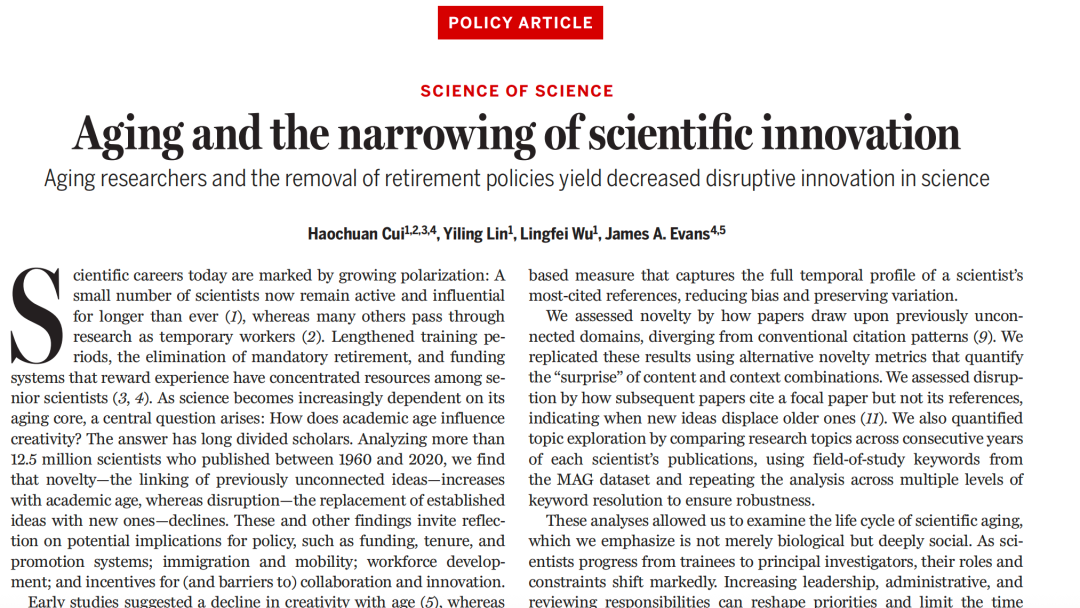
- •The study, which analyzed 12.5 million scientists from 1960 to 2020, distinguishes between 'disruptive' papers that displace older foundations and 'novel' papers that create new links between existing ideas, finding that older scientists tend towards novelty while younger scientists are more inclined towards disruptive breakthroughs.
- •The 'nostalgia effect' is further characterized by scientists' most cited paper often being published around the time they began their own career, approximately two years before their own first publication, which significantly shapes their subsequent intellectual trajectory.
- •The influence of older researchers, acting as gatekeepers, extends through their leadership of labs and their roles as peer reviewers, potentially transmitting the 'nostalgia effect' by encouraging younger colleagues to cite older research and favoring established paradigms.
- •International comparisons reveal that countries with younger scientific communities, such as China and India, tend to produce more disruptive research, contrasting with older workforces in nations like the U.S. and Japan, which excel at integrating and extending existing knowledge.
- •The increase in the average age of the scientific workforce is partly attributed to broader demographic shifts, including reduced fertility rates and increased life expectancy, alongside the elimination of mandatory retirement policies.
🛠️ Technical Deep Dive
- The study evaluated an extensive dataset of over 12.5 million scientists who published between 1960 and 2020.
- It utilized large-scale data and novel deep learning measurements to quantify the impact of scientific aging.
- 'Disruptive' papers were defined as those where subsequent studies cite the focal paper without also citing its references, indicating that the focal paper's ideas displaced earlier foundations.
- 'Novel' papers were defined as those that draw on older research in new combinations without rendering those antecedents obsolete.
- 'Academic age' was measured as the number of years since a scientist's first publication.
- The research also examined patterns within research groups and compared citations in preprints with those in final published papers to understand how the 'nostalgia effect' is transmitted through academic hierarchies and the scientific review process.
🔮 Future ImplicationsAI analysis grounded in cited sources
⏳ Timeline
📎 Sources (10)
Factual claims are grounded in the sources below. Forward-looking analysis is AI-generated interpretation.
Weekly AI Recap
Read this week's curated digest of top AI events →
👉Related Updates


AI-curated news aggregator. All content rights belong to original publishers.
Original source: 虎嗅 ↗