Scaling agentic workflows with native case management
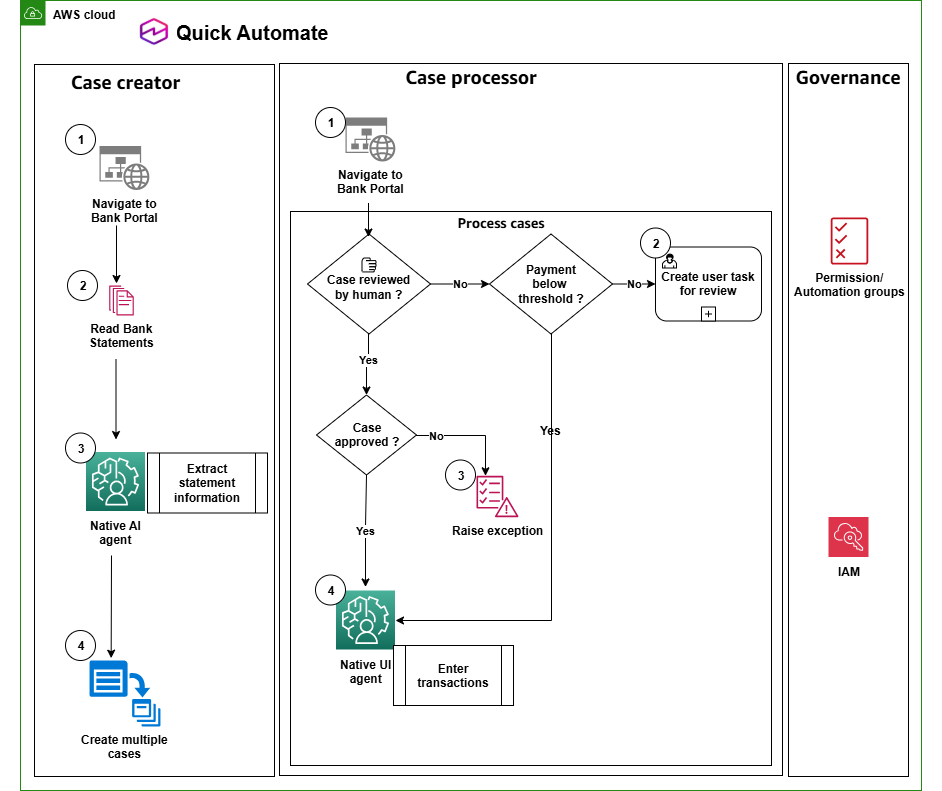
💡Learn how to add enterprise-grade reliability and human oversight to your agentic AI workflows.
⚡ 30-Second TL;DR
What Changed
Native case management for tracking agentic workflow lifecycles
Why It Matters
Enables enterprises to deploy more reliable agentic systems by providing structured oversight and exception handling for long-running tasks.
What To Do Next
Review your current agentic workflows and identify where HITL steps can be integrated using the new case management features.
Key Points
- •Native case management for tracking agentic workflow lifecycles
- •Integration of Human-in-the-loop (HITL) steps for complex resolution
- •Case creator-processor pattern for dynamic enterprise scaling
🧠 Deep Insight
AI-generated analysis for this event — not the original article.
🔑 Enhanced Key Takeaways
- •Amazon Quick Automate leverages Amazon Bedrock's orchestration layer to maintain state persistence across multi-turn agentic interactions.
- •The system utilizes a serverless event-driven architecture, allowing case states to trigger downstream AWS Lambda functions or Step Functions workflows automatically.
- •Native integration with Amazon Q Business allows for automated knowledge retrieval and context injection during the case resolution process.
- •The platform includes built-in observability dashboards that track 'Agentic Latency' and 'Human Intervention Rate' as key performance indicators for enterprise workflows.
- •Security and compliance are managed through AWS IAM and AWS CloudTrail, ensuring all agentic actions and human overrides are logged for auditability.
📊 Competitor Analysis▸ Show
| Feature | Amazon Quick Automate | Microsoft Copilot Studio | Salesforce Agentforce |
|---|---|---|---|
| Case Management | Native/Integrated | Via Dynamics 365 | Native (Data Cloud) |
| HITL Integration | High (Seamless) | Moderate | High |
| Pricing Model | Consumption-based | Per User/Capacity | Per Agent/Usage |
| Benchmarks | Optimized for AWS | Optimized for M365 | Optimized for CRM |
🛠️ Technical Deep Dive
- Architecture: Utilizes a state-machine pattern where each case is represented as a JSON-based state object stored in Amazon DynamoDB.
- HITL Mechanism: Implements a 'Pause-and-Resume' pattern where agent execution is suspended until a callback token is received from the human reviewer.
- Scaling: Employs dynamic concurrency limits based on the complexity score of the agentic task, preventing resource exhaustion.
- Data Handling: Supports RAG (Retrieval-Augmented Generation) pipelines that dynamically update case context as new documents are ingested.
🔮 Future ImplicationsAI analysis grounded in cited sources
⏳ Timeline
Weekly AI Recap
Read this week's curated digest of top AI events →
👉Related Updates
AI-curated news aggregator. All content rights belong to original publishers.
Original source: AWS Machine Learning Blog ↗
This is a summary, not the original. Read the source, or get the weekly briefing.
The weekly digest
One email a week. Unsubscribe anytime.