Beyond Prompting: The Rise of Loop Engineering
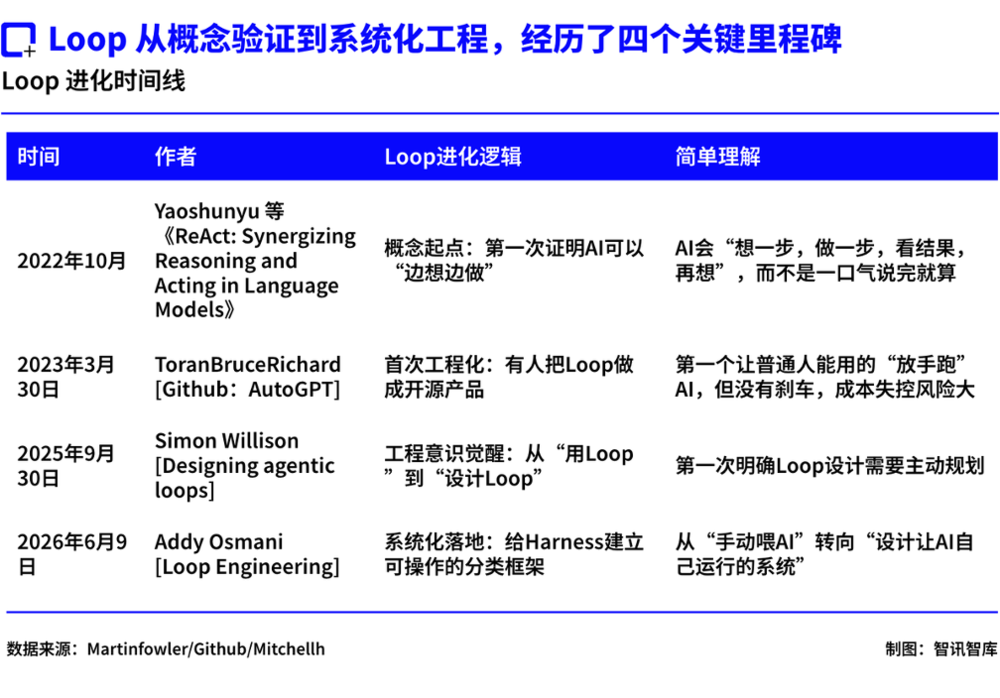
💡Learn how to move beyond simple prompting to building autonomous, self-correcting AI agent systems.
⚡ 30-Second TL;DR
What Changed
Loop defines a closed-loop cycle: trigger, work, evaluate, and retry/finish.
Why It Matters
This paradigm shift allows for autonomous agent teams, but requires developers to build robust guardrails and cost-monitoring systems to prevent financial and operational disasters.
What To Do Next
Implement a strict cost-cap and human-in-the-loop validation step before deploying any autonomous agent loop to production.
Key Points
- •Loop defines a closed-loop cycle: trigger, work, evaluate, and retry/finish.
- •Key components include Worktree for sandboxing, Connectors for integration, and Sub-agents for specialized tasks.
- •High risk of 'Goal Drift' and runaway costs if monitoring and validation are not strictly implemented.
- •Shifts AI from passive Q&A to autonomous, 24/7 service agents.
🧠 Deep Insight
AI-generated analysis for this event — not the original article.
🔑 Enhanced Key Takeaways
- •Loop Engineering frameworks increasingly utilize 'State-Space Memory' architectures to maintain context across long-running autonomous cycles, preventing the degradation common in standard context windows.
- •Industry adoption of Loop Engineering is driving a shift toward 'Deterministic Guardrails,' where symbolic logic is layered over probabilistic LLM outputs to ensure compliance in enterprise environments.
- •The emergence of 'Human-in-the-loop (HITL) checkpoints' is becoming a standard design pattern to mitigate the 'Goal Drift' risk, requiring manual authorization for high-stakes sub-agent transitions.
- •Loop Engineering is fundamentally changing cloud infrastructure requirements, moving from stateless serverless functions to stateful, persistent containerized environments that support long-lived agent sessions.
- •Recent benchmarks indicate that Loop-based systems demonstrate a 40-60% improvement in complex multi-step reasoning tasks compared to traditional Chain-of-Thought (CoT) prompting methods.
📊 Competitor Analysis▸ Show
| Feature | Loop Engineering (General) | LangGraph (LangChain) | AutoGen (Microsoft) |
|---|---|---|---|
| Architecture | Closed-loop cycle | Graph-based state machine | Multi-agent conversation |
| Pricing | Open Source / Variable | Open Source | Open Source |
| Primary Strength | Task isolation/Sandboxing | Complex workflow control | Multi-agent collaboration |
🛠️ Technical Deep Dive
- Implementation typically relies on a Directed Acyclic Graph (DAG) or cyclic graph structure to manage agent state transitions.
- Worktree sandboxing is often achieved through ephemeral Docker containers or WebAssembly (Wasm) runtimes to isolate execution environments.
- Connectors utilize standardized Tool Use protocols (e.g., MCP - Model Context Protocol) to interface with external APIs and databases.
- Sub-agent coordination is managed via a 'Controller' or 'Orchestrator' node that handles message passing and task delegation based on predefined schemas.
🔮 Future ImplicationsAI analysis grounded in cited sources
⏳ Timeline
Weekly AI Recap
Read this week's curated digest of top AI events →
👉Related Updates



AI-curated news aggregator. All content rights belong to original publishers.
Original source: 虎嗅 ↗
This is a summary, not the original. Read the source, or get the weekly briefing.
The weekly digest
One email a week. Unsubscribe anytime.