☁️AWS Machine Learning Blog•Stalecollected in 29m
Scale Agent Memory with Namespace Patterns
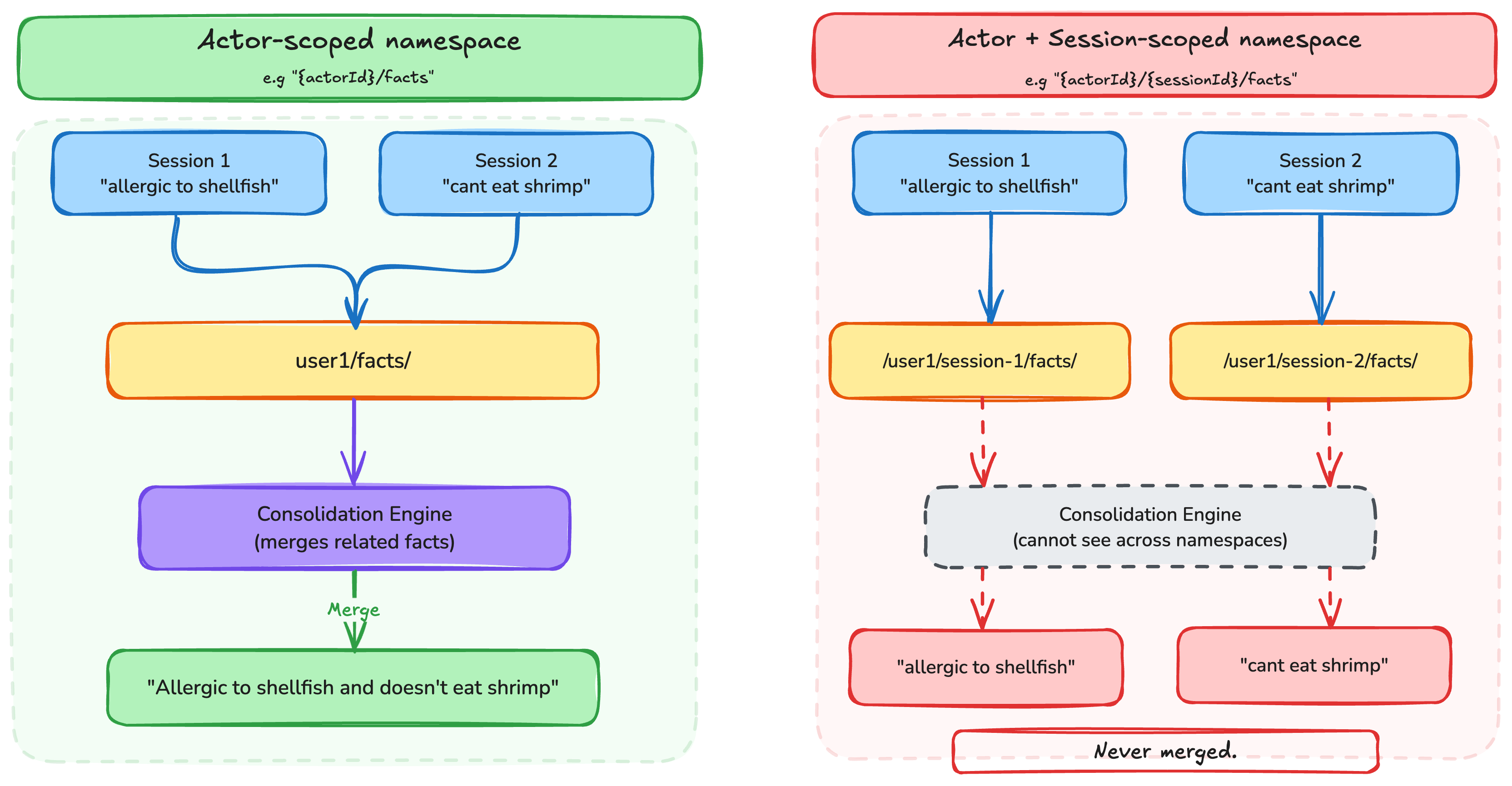
💡Scale AI agents' memory with AWS namespace patterns & IAM controls—essential for production fleets.
⚡ 30-Second TL;DR
What Changed
Design hierarchical namespaces for structured agent memory organization.
Why It Matters
Helps AI builders scale multi-agent systems with efficient memory management, reducing latency and enhancing security. Enables production-ready agent deployments on AWS infrastructure.
What To Do Next
Follow the AWS ML Blog guide to design namespace hierarchies in AgentCore Memory for your agent fleet.
Who should care:Developers & AI Engineers
Key Points
- •Design hierarchical namespaces for structured agent memory organization.
- •Choose retrieval patterns suited for large-scale agent operations.
- •Implement IAM policies for fine-grained access control in AgentCore Memory.
🧠 Deep Insight
AI-generated analysis for this event.
🔑 Enhanced Key Takeaways
- •AgentCore Memory utilizes a multi-tenant isolation architecture that leverages AWS Resource Access Manager (RAM) to share namespace-scoped memory across distinct agent accounts without duplicating underlying data stores.
- •The retrieval optimization strategy employs a hybrid approach, combining semantic vector search with deterministic metadata filtering to reduce latency in high-cardinality namespace environments.
- •IAM-based access control is integrated with AWS Lake Formation, allowing administrators to define fine-grained policies at the namespace level, effectively enforcing data residency and compliance requirements for multi-agent systems.
📊 Competitor Analysis▸ Show
| Feature | AgentCore Memory | LangGraph Memory | Pinecone Serverless |
|---|---|---|---|
| Namespace Isolation | Native IAM/RAM integration | Application-level logic | Namespace-based filtering |
| Access Control | AWS IAM / Lake Formation | Custom/External | API Key / RBAC |
| Scalability | Managed/Serverless | User-managed | Managed/Serverless |
| Pricing Model | Pay-per-request/GB | N/A (Library) | Pay-per-read/write/GB |
🛠️ Technical Deep Dive
- Architecture: Utilizes a hierarchical key-value store optimized for low-latency retrieval of agent state, integrated with Amazon OpenSearch Serverless for vector embeddings.
- Namespace Structure: Implements a dot-notation hierarchy (e.g., 'org.dept.agent_id') that maps directly to IAM policy resource ARNs.
- Retrieval Mechanism: Supports 'Scoped Retrieval' which restricts vector search context windows to specific namespace branches, preventing cross-agent data leakage.
- Consistency Model: Provides eventual consistency for cross-region replication, with strong consistency options available for single-region namespace operations.
🔮 Future ImplicationsAI analysis grounded in cited sources
AgentCore Memory will become the default standard for enterprise-grade multi-agent orchestration on AWS.
The integration of native IAM and RAM controls significantly lowers the barrier for regulated industries to adopt autonomous agent architectures.
Namespace-based memory will lead to the commoditization of agent-specific memory storage.
Standardizing memory organization patterns reduces the need for custom-built memory management layers in agent development frameworks.
⏳ Timeline
2025-03
AWS announces the preview of AgentCore, a managed framework for agentic workflows.
2025-11
General availability of AgentCore with initial support for basic state persistence.
2026-02
Introduction of Namespace-based memory partitioning to support multi-tenant agent deployments.
📰
Weekly AI Recap
Read this week's curated digest of top AI events →
👉Related Updates
AI-curated news aggregator. All content rights belong to original publishers.
Original source: AWS Machine Learning Blog ↗