Sapiom Raises $35M to Cut AI Agent Costs
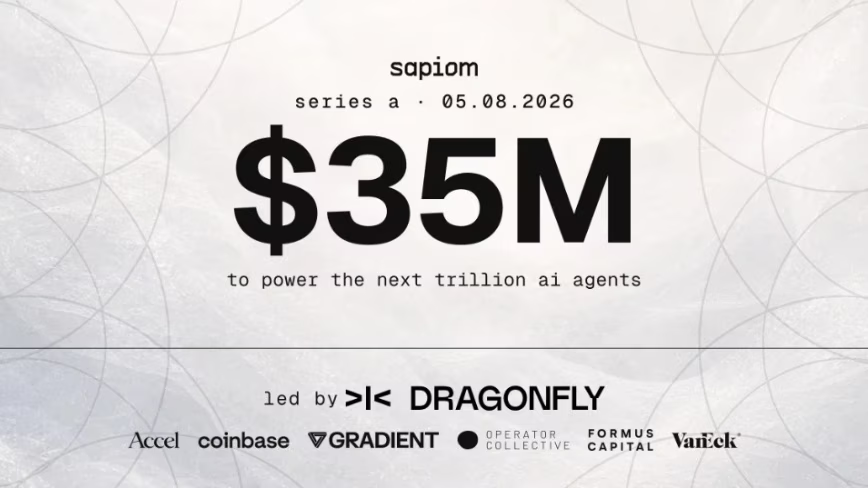
A $35M bet on the infrastructure layer trying to make AI agents cheaper to run
30-Second TL;DR
What Changed
Sapiom raised a $35 million Series A led by Dragonfly.
Why It Matters
The funding signals strong investor interest in infrastructure that can make agentic AI more economical to operate. Anthropic's backing may also increase Sapiom's credibility among teams building model-intensive agent workflows.
What To Do Next
Evaluate Sapiom's platform and integration documentation when available, comparing its per-agent costs against your current direct model calls.
Key Points
- •Sapiom raised a $35 million Series A led by Dragonfly.
- •The company launched 11 months ago and raised a $15 million seed round six months ago.
- •Anthropic is among Sapiom's backers, while total funding now reaches $50 million.
- •Sapiom aims to reduce costs for AI agents by operating between agents and their underlying models.
Deep Insight
AI-generated analysis for this event — not the original article.
Enhanced Key Takeaways
- •Sapiom utilizes a proprietary 'Model-Agnostic Routing Layer' (MARL) that dynamically switches between LLMs based on task complexity to minimize token expenditure.
- •The startup's platform integrates directly with major agent frameworks like LangChain and AutoGPT to provide real-time cost-optimization middleware.
- •Sapiom's architecture includes a caching mechanism that stores semantic embeddings of previous agent interactions to prevent redundant API calls to expensive models.
- •The company plans to use the Series A funding to expand its engineering team and develop a 'Cost-Aware Orchestration' dashboard for enterprise clients.
- •Early beta testing of Sapiom's middleware reportedly demonstrated a 40-60% reduction in operational costs for high-volume AI agent deployments.
Competitor Analysis
- Sapiom
- Dynamic Model Routing
- Helicone
- Observability & Caching
- Portkey
- LLM Gateway & Management
- Sapiom
- Automated Routing
- Helicone
- Caching-based
- Portkey
- Rule-based Routing
- Sapiom
- Yes
- Helicone
- Yes
- Portkey
- Yes
| Feature | Sapiom | Helicone | Portkey |
|---|---|---|---|
| Primary Focus | Dynamic Model Routing | Observability & Caching | LLM Gateway & Management |
| Cost Optimization | Automated Routing | Caching-based | Rule-based Routing |
| Model Agnostic | Yes | Yes | Yes |
Technical Deep Dive
- Implements a dynamic routing engine that evaluates prompt complexity against a cost-performance matrix before dispatching to models like Claude 3.5 or GPT-4o.
- Utilizes a vector-based semantic cache to intercept and serve responses for recurring agent queries without re-invoking the LLM.
- Provides an asynchronous API wrapper that handles request queuing and load balancing across multiple model providers.
- Features automated fallback protocols that trigger cheaper, smaller models if latency thresholds are exceeded or primary model endpoints fail.
Future ImplicationsAI analysis grounded in cited sources
Timeline
- 2025-09Sapiom officially launches operations in San Francisco.
- 2026-02Company secures $15 million in seed funding.
- 2026-08Sapiom closes $35 million Series A led by Dragonfly.
Weekly AI Recap
Read this week's curated digest of top AI events →
Related Updates



AI-curated news aggregator. All content rights belong to original publishers.
Original source: The Next Web (TNW) ↗
This is a summary, not the original. Read the source, or get the weekly briefing.
The weekly digest
One email a week. Unsubscribe anytime.