Sail Raises $80M to Reduce AI Agent Costs
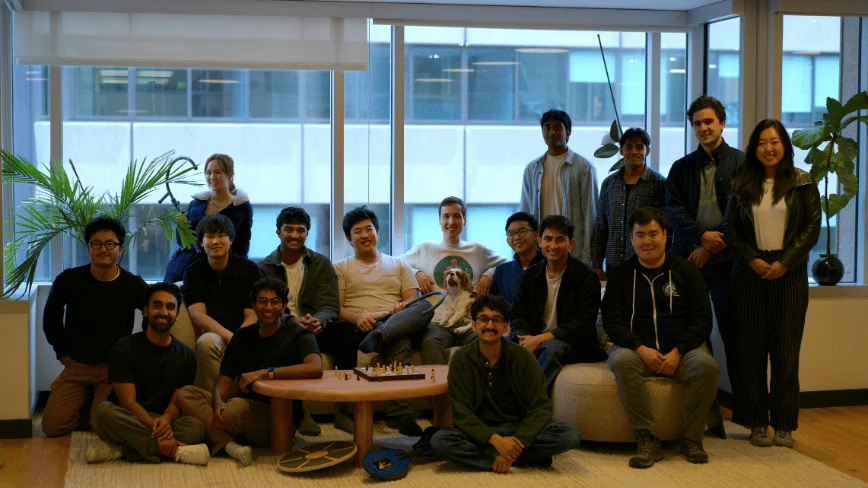
A 10x reduction in token costs for AI agents could be the breakthrough needed for scalable agentic workflows.
30-Second TL;DR
What Changed
Raised $80 million in funding.
Why It Matters
High operational costs are a major barrier to agentic AI adoption; a 10x reduction could significantly accelerate enterprise deployment.
What To Do Next
Keep an eye on Sail's upcoming developer tools to see if their cost-reduction methods can be integrated into your agent workflows.
Key Points
- •Raised $80 million in funding.
- •Focuses on reducing the high cost of running AI agents.
- •Claims to reduce token consumption costs by up to 10x.
Deep Insight
AI-generated analysis for this event — not the original article.
Enhanced Key Takeaways
- •The Series B funding round was led by Andreessen Horowitz (a16z), signaling strong venture capital confidence in the infrastructure layer of agentic AI.
- •Sail Research utilizes a proprietary 'Context Compression' engine that dynamically prunes redundant tokens from LLM prompts without degrading reasoning performance.
- •The platform integrates directly with existing agent frameworks like LangChain and AutoGPT, allowing developers to implement cost-saving measures without refactoring core agent logic.
- •The company plans to allocate a significant portion of the $80 million toward expanding its engineering team to develop specialized hardware-aware optimization kernels.
- •Sail Research's technology is specifically optimized for long-running autonomous agents that typically suffer from 'context bloat' during multi-step reasoning tasks.
Competitor Analysis
- Sail Research
- Token/Context Optimization
- Unify
- Model Routing/Cost
- LangSmith (LangChain)
- Observability/Tracing
- Sail Research
- Up to 10x (Compression)
- Unify
- Dynamic Model Switching
- LangSmith (LangChain)
- Monitoring/Debugging
- Sail Research
- Middleware/Proxy
- Unify
- API Gateway
- LangSmith (LangChain)
- SDK/Platform
| Feature | Sail Research | Unify | LangSmith (LangChain) |
|---|---|---|---|
| Primary Focus | Token/Context Optimization | Model Routing/Cost | Observability/Tracing |
| Cost Reduction | Up to 10x (Compression) | Dynamic Model Switching | Monitoring/Debugging |
| Integration | Middleware/Proxy | API Gateway | SDK/Platform |
Technical Deep Dive
- Context Compression Engine: Employs a selective attention mechanism that identifies and removes low-entropy tokens from the KV cache during inference.
- Latency Impact: The optimization layer adds less than 5ms of overhead per request, maintaining real-time performance for interactive agents.
- Model Agnostic: The architecture supports major foundation models including GPT-4o, Claude 3.5 Sonnet, and Llama 3, acting as a transparent proxy layer.
- KV Cache Management: Implements advanced cache eviction policies that prioritize stateful information necessary for agentic memory over transient prompt data.
Future ImplicationsAI analysis grounded in cited sources
Timeline
- 2025-03Sail Research founded by former AI infrastructure engineers from Meta and OpenAI.
- 2025-09Company secures $12 million in Seed funding to develop initial context compression prototype.
- 2026-02Beta launch of the Sail optimization proxy for enterprise customers.
- 2026-06Sail Research closes $80 million Series B funding round.
Weekly AI Recap
Read this week's curated digest of top AI events →
Related Updates


AI-curated news aggregator. All content rights belong to original publishers.
Original source: The Next Web (TNW) ↗
This is a summary, not the original. Read the source, or get the weekly briefing.
The weekly digest
One email a week. Unsubscribe anytime.